


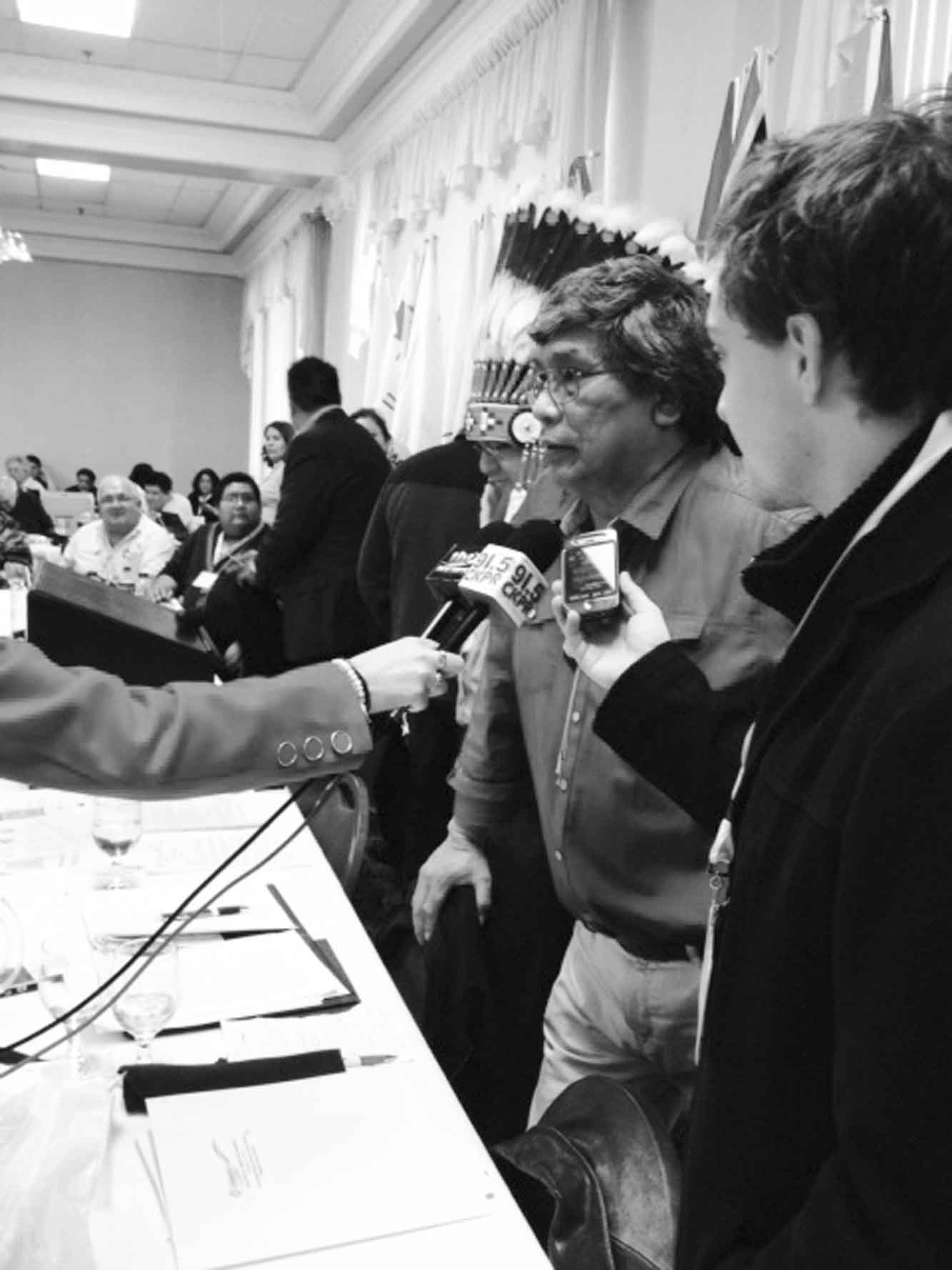
Nishnawbe Aski Nation is standing up for First Nations’ inherent and treaty rights to control education in the wake of the federal government’s Proposal for a Bill on First Nations Education.
“Today we stand in unity to declare that the future of education in NAN will not be based on federal legislation but on our inherent right to self-government, including education jurisdiction,” said Grand Chief Harvey Yesno. “The government of Canada has failed to meet its obligation to deliver education to First Nation students on par with the rest of Canada.
No longer will we allow our children to be denied their inherent right to education.”
Yesno, Deputy Grand Chief Goyce Kakegamic and a group of chiefs, councillors, First Nation educators, Elders and youth announced the NAN Declaration on Our Inherent and Treaty Right to Education on the final day of the Nov. 5-7 Chiefs Summit on Education. More than 200 delegates attended the summit at the Prince Arthur Hotel in Thunder Bay.
“We have a plan, we have a vision to go for our (education) jurisdiction,” Kakegamic said.
“We have been in the table for over 10 years in good faith as government to government (over framework agreements for governance and education jurisdiction with the government of Canada and) we want to finish it.”
NAN signed framework agreements for governance and education jurisdiction with the government of Canada in October 1999; draft agreements-in-principle for governance and education jurisdiction were tabled in June 2007 and final agreements-in-principle for the governance sector and the education jurisdiction were initialled in July 2009.
The NAN Declaration on Our Inherent and Treaty Right to Education calls for the federal government to acknowledge and respect NAN’s inherent right to education; respect the educational obligations made by the Crown to the people of NAN through Treaty No. 9 and Treaty No. 5; recognize NAN’s rejection of the imposition of the First Nations Education Act and support NAN First Nations by recognizing their right to self-govern their education systems.
“This is a historic day as NAN leadership stands together to assert our inherent right to lay the path forward for education for the sake of our children and our children’s children,” Kakegamic said. “We have a sacred trust to our children and future generations to provide a quality education that respects our culture, values, and traditions while enabling them to live safe, healthy and productive lives, and today we are taking action to make that a reality.”
Kakegamic said the “jurisdiction route” is key in providing a successful education for community members.
“The reality that we have lived for the past hundred years-plus makes it clear that no one else can or should take responsibility for our future in education,” Kakegamic said. “It is up to us and it is our hope, our dreams, our reality and for that we will have to accept that it is also our responsibility.”
Recent high school data, from 2004-2009, indicates First Nation students have a graduation rate of about 36 per cent compared to the Canadian graduation rate of 72 per cent, according to an Assembly of First Nations document from the October 2012 Chiefs Assembly on Education.
Kakegamic said many municipal leaders from across northern Ontario support NAN’s objectives in education jurisdiction.
“That was a big start yesterday when two municipality organizations stood with us stating publicly their support that both governance and education jurisdiction should go through (to) the final agreement,” Kakegamic said. “We’re so close — give us the opportunity to finish this (education) jurisdiction.”
Chapleau Cree Chief Keith Corston said the Proposal for a Bill on First Nations Education would have major impacts on First Nation communities.
“It’s going to impact every community; it’s going to impact the seven generations,” Corston said. “It’s a direct attack against the children, it’s a form of assimilation and we have to fight this new legislation.”
Corston said there was not any “real consultation” with First Nations about the Proposal for a Bill on First Nations Education.
“We haven’t been duly consulted for our consent to have this done,” Corston said. “They’re taking a word-of-the-street approach to this and we are fed up with this approach and we will be attacking this with vigor.”
The federal government announced the Proposal for a Bill on First Nations Education on Oct. 22.
“Our government firmly believes that all First Nation students across Canada deserve access to a school system that meets provincial and territorial standards, while respecting First Nation culture, language, rights and treaties,” said Bernard Valcourt, minister of Aboriginal Affairs and Northern Development. “The draft legislative proposal for First Nation education would put in place a system that is accountable to students, and ensures that First Nation students have access, like all Canadians, to a good education.”
The Working Together for First Nation Students: A Proposal for a Bill on First Nations Education includes a number of options, such as First Nations working together to form First Nations education authorities to provide a broader range of services to students and schools.
The proposal also indicates First Nations would be able to enter into agreements with provincial school boards to have First Nation students attend school off-reserve or to manage an on-reserve school and to negotiate self-government arrangements over education, at which point the proposed act would no longer apply to them.
The federal government said it consulted the 600-plus First Nations across the country and other stakeholders through eight face-to-face regional consultation sessions, more than 54 technical briefings and information sessions via video or teleconference sessions and an online survey that received 631 responses.
MP Carolyn Bennett, the Liberal Party of Canada critic for Aboriginal Affairs, said the proposed bill has received a failing grade from coast-to-coast during an Oct. 24 House of Commons session.
“First Nations are rightfully frustrated,” Bennet said during the session. “The proposal ignores the fundamental problem of equitable funding. Instead, it imposes new requirements on them with no new resources. Why does the minister still refuse to deal with the outright discrimination that exists when funding First Nations students?”
Bennett said that more bureaucracy, more paperwork and more power to the minister is not the answer for the two-thirds of First Nation students not completing high school.
“The Conservatives should push pause on this flawed, top-down strategy, sit down with First Nations communities and build a workable, fully funded plan that respects, supports and empowers First Nations to control their own education systems.”


Forest fires have always been a deep worry for those of us who live in the far north of Ontario. We are surrounded by endless forests and we know full well...
First Nation youth representatives are letting the world know that Indigenous people are ready to stand up and protect the land. Keira Spence, Kohen...