


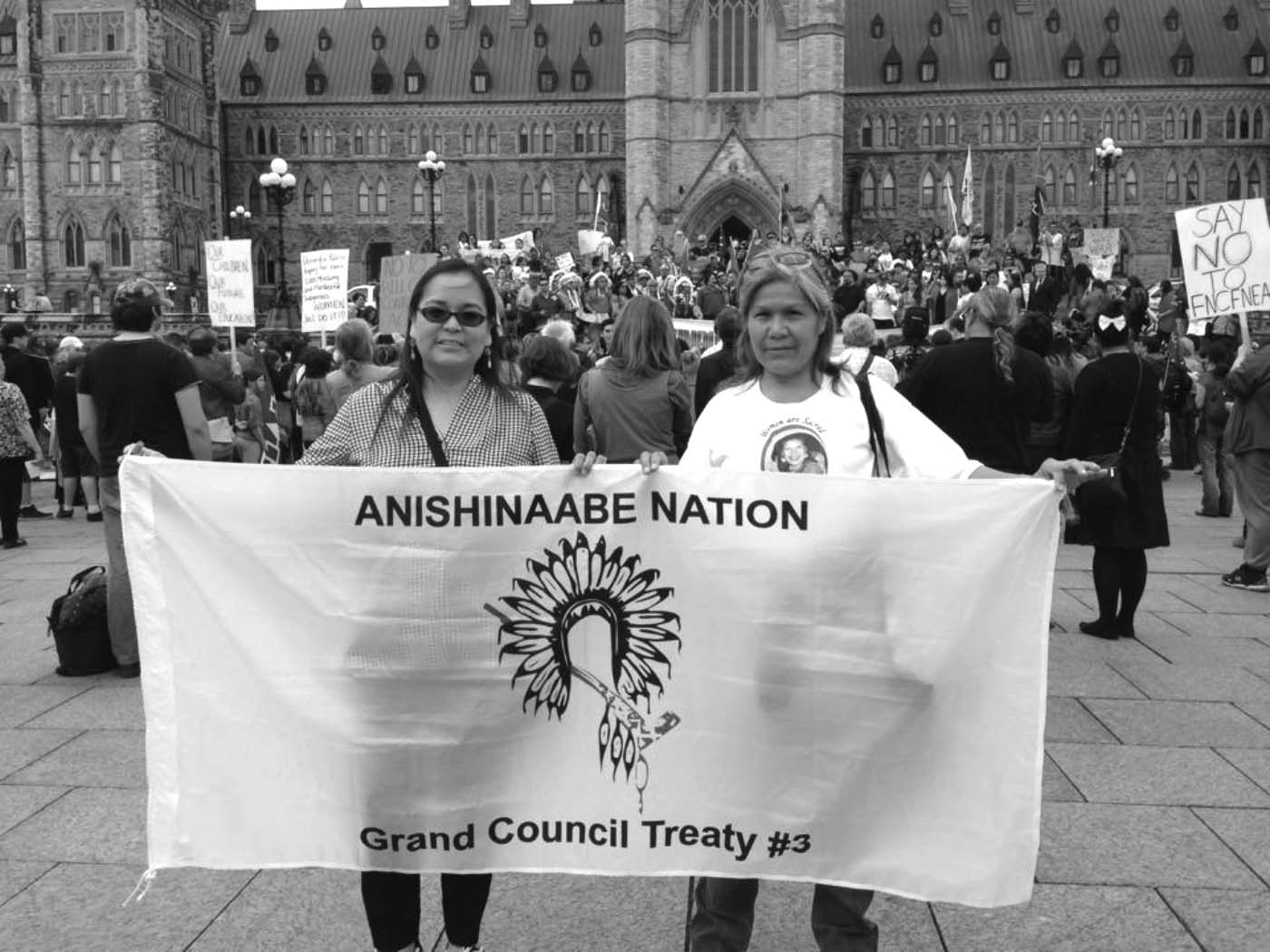
More than 1,000 people gathered on Parliament Hill for a protest on May 14 for the National Day of Resistance, with protests also being held in several cities and towns nation-wide.
Grand Council Treaty #3 member Tania Cameron was at the protest with Wabauskang First Nation Chief Leslie Cameron and Treaty 3 member Jo-Anne Petiquan-Moore.
Tania Cameron said they were in Ottawa for the Keewatin appeal with Grassy Narrows First Nation at the Supreme Court, and had learned prior to heading to Ottawa that there would be a protest at Parliament Hill.
“We heard about it (the protest) at the Chiefs of Ontario Education summit the week before, so we made plans to be at the rally,” Cameron said.
Cameron said that there are a number of reasons why they wanted to be at the protest.
“There are a number of issues for Wabauskang to be there, we’re quite concerned about the First Nations Education Act, Bill C-33,” Cameron said. “Another big thing would be the national inquiry about missing and murdered Aboriginal women.”
Cameron said at first glance she thought there were around 500 people present, but then realized there were over a thousand. Cameron said that as the group marched through downtown Ottawa, more people kept joining.
“It was huge,” she said. “We got excited. Jo-Anne was able to bring a flag from Treaty 3. We showed up and held it up.”
Cameron said that they took part in the march through downtown Ottawa, and that it was a great feeling of solidarity.
“My chief was when we were done the march that he was so glad we came. He isn’t a city person, but he was okay with marching through downtown Ottawa,” Cameron said. “It felt very proud.
There was a sense of family, and the solidarity was so strong.”
Cameron said she is hopeful that the Conservative Government will hear the message the protestors wanted to send on issues like Bill C-33 and missing and murdered Aboriginal women “and not continue to ignore us and railroad us on a number of legislation.”
Cameron said that the only way to overcome the Conservative Government is to vote them out in 2015.
“The only way to get an impact is to vote them out,” Cameron said. “Aboriginal people are underrepresented on both federal and provincial levels. We need to encourage our people to get out and vote.”
Cameron explained that she was looking at information on the Aboriginal voter turn-out from the Kenora NDP Riding Association and realized how much power the Aboriginal vote can have.
“The Kenora riding was one of 10 ridings across Canada where the Aboriginal vote can actually have sway on who gets elected or not,” Cameron said. “Unfortunately voter turn-out is low, maybe 25 to 30 per cent. It varies in our communities.”
Cameron explained that increasing Aboriginal voter turn-out would require a number of things in order to happen.
“Things like voter ID, we have to work on that,” she said. “And just explaining why it is important to vote. I heard some people say ‘it’s not my government,’ Well you know what, this government is changing laws on us and we have to tell them enough is enough. We have to utilize our votes.”


This past month, I was happy to attend two Pow Wows I hadn't been to in years. I attended the Mattagami First Nation Pow Wow and the Matachewan First Nation...
I was happy to see my home community of Attawapiskat on the James Bay coast announce the opening of the new St Francis Xavier Parish Church on August 25....