


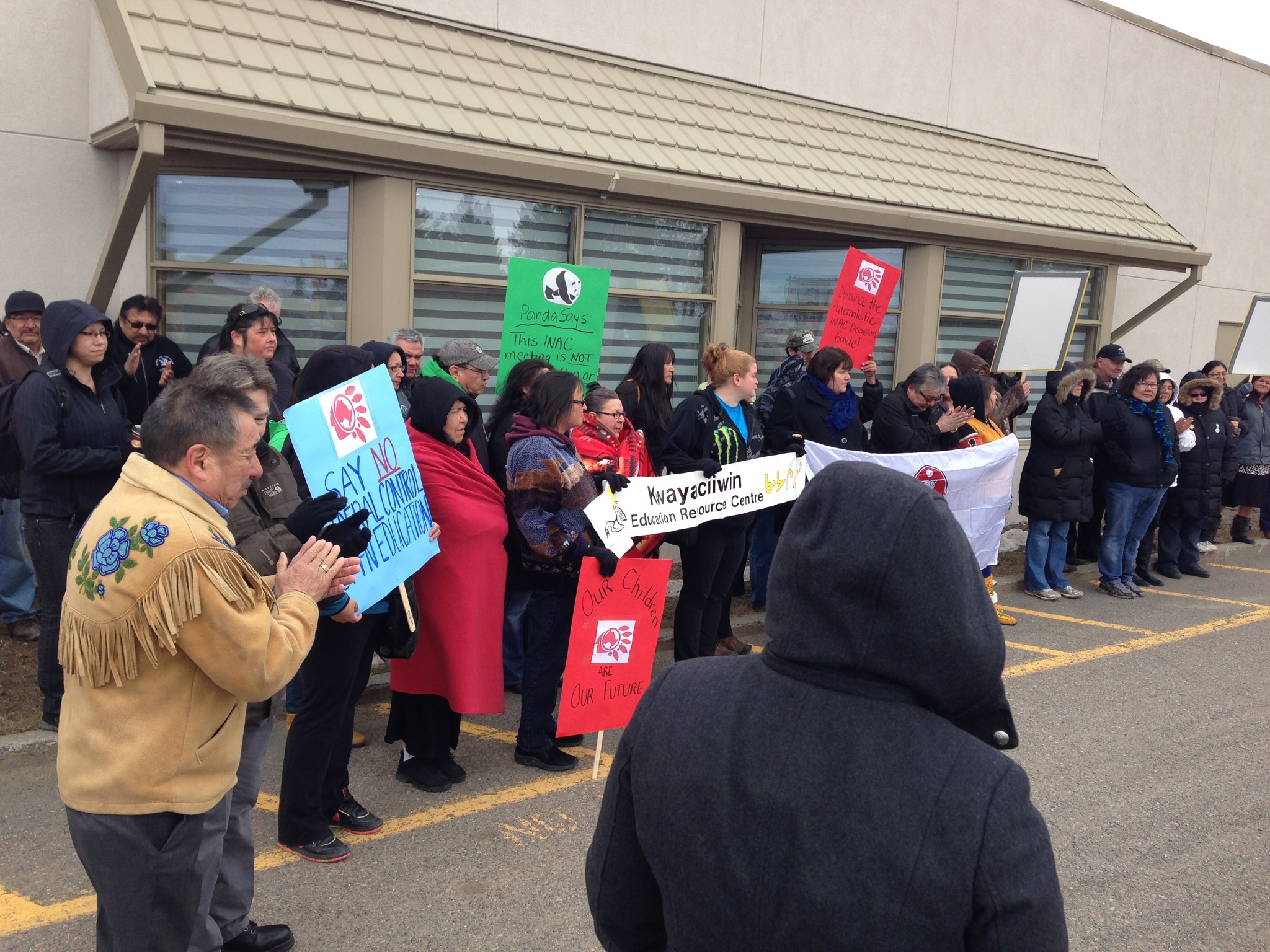
As federal government officials met with what Ontario Regional Chief Stan Beardy called “a small number of chiefs” about the First Nations Education Act in Thunder Bay, dozens of people protested outside the consultation meeting.
The Chiefs of Ontario organized the April 11 protest, in order to show opposition to the proposed federal education act on which Aboriginal Affairs and Northern Development of Canada (AANDC) officials were conducting consultations.
Last December, the Ontario chiefs passed a resolution rejecting AANDC’s consultation process for the First Nations Education Act on the grounds that it was not based on a true partnership with First Nations.
“It’s pre-selected who can make a presentation and they’re inviting a small number of chiefs just so they can say they did their consultation,” Beardy said following the rally. “If it was to be done properly, it’s the right-holders who need to be part of this process, but I’m not sure our membership has been invited to speak to this panel about this process.”
The federal government is expecting to pass the First Nations Education Act in September 2014. The bill, which is based on the results of a joint task force co-sponsored by AANDC and the Assembly of First Nations, is expected to promote the creation of regional native school boards. Individual band schools would be gathered into the boards, which would look after staffing, capital budgets and developing a Native-centred curriculum.
AFN initially supported the bill until the framework for the consultation process was revealed last December.
According to the AFN, data shows the First Nations high school graduation rate is 36 per cent, compared to 72 per cent in Canada overall. A First Nations youth is more likely to end up in jail than graduate high school.
Beardy said there are many inequalities facing First Nations people, but as opportunities are arising – particularly in mining – many are unable to take advantage due to the inadequacies in education in First Nations communities.
“We need qualified educators, we need proper facilities, and we need support mechanisms for our students to make sure they have their chance of succeeding at the post-secondary level,” Beardy said.
But he said that is not happening, and the lack of proper consultation in this process will hurt future generations.
Looking at the average Canadian or Ontarian, First Nations receive far less per student in the area of education.
“If we’re forced to accept any less, it’s a crime,” Beardy said. “We’re talking about basic universal rights. It’s the right for the children, especially for one of the richest countries, and there is no reason why our children (don’t) have the same opportunity as the average Canadian.”
“We’re talking about discrimination here.”
The rally began with speeches by Beardy, Anishinabek Grand Chief Patrick Madahbee, Association of Iroquois and Allied Indians Grand Chief Gord Peters, and others.
The protesters then marched to the windows outside the conference room where the consultations were taking place, where they made more speeches and performed a round dance.
The rally proceeded into the conference room where Beardy and Peters made short speeches on the need for a nation-to-nation dialogue and for the federal government to honour the treaties. It ended peacefully with a drum prayer song.
Beardy said this is only the beginning. He said the Idle No More grassroots movement seems to have faded after Theresa Spence’s hunger strike and the series of rallies that took place last winter.
“It’s very obvious now that we’re not being listened to,” Beardy said. “And I think we need to go back to the mobilization of our rights-holders to be on the ground to put pressure and advocate for fundamental changes to ensure we have a quality of life for our children.”


Forest fires have always been a deep worry for those of us who live in the far north of Ontario. We are surrounded by endless forests and we know full well...
First Nation youth representatives are letting the world know that Indigenous people are ready to stand up and protect the land. Keira Spence, Kohen...