


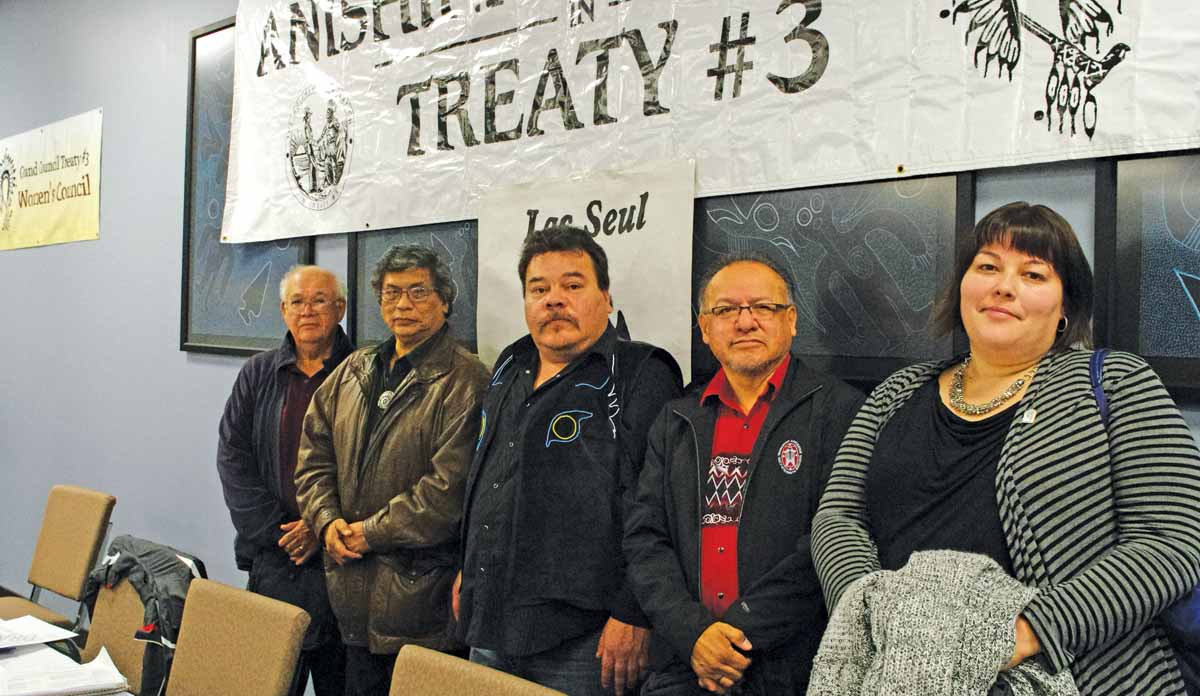
Nishnawbe Aski Nation recently met with Grand Council Treaty #3 about the federal government’s Proposal for a Bill on First Nations Education.
“There is a major change on the horizon that will affect us all as First Nations and also our education organizations — the status quo will not be an option,” said Deputy Grand Chief Goyce Kakegamic on the second day of Treaty #3’s fall assembly, held Oct. 22-24 in Lac Seul.
“Today, as your neighbours from Nishnawbe Aski Nation, we see that we have a very important decision to make. We basically have two options from our perspective: that the changes will be made by us or change will be made for us.”
Kakegamic said many of NAN’s smaller schools will not be able to meet the requirements specified in the federal proposal, which was released on Oct. 22.
“We believe as Nishnawbe Aski Nation that we have an inherent right to educate our children given by the Creator,” Kakegamic said. “And we must never ever forget that, that we have that right as a nation. Any government that signs a treaty, it has to be a nation to a nation, government to government, so we had our governance and education system in place before the invasion.”
Kakegamic said the proposal would eliminate a number of current education programs, such as the First Nation Student Success Program that helps First Nation educators improve school results; the Education Partnerships Program that promotes collaboration between First Nations, provinces, Aboriginal Affairs and Northern Development Canada and other stakeholders to improve the success of First Nation elementary and secondary students in First Nation and provincial schools; and the New Paths for Education Program that funds projects and activities to improve the quality of education in First Nation schools.
“We believe that we are going to have to aggregate, we’re going to have to change how we do business in our schools,” Kakegamic said.
AANDC Minister Bernard Valcourt said the proposal would put in place a system that is accountable to students, and ensures that First Nation students have access, like all Canadians, to a good education.
“Our government firmly believes that all First Nation students across Canada deserve access to a school system that meets provincial and territorial standards, while respecting First Nation culture, language, rights and treaties,” Valcourt said. “First Nation youth represent the fastest growing segment of the population in Canada yet they have one of the lowest graduation rates. This draft legislative proposal is a significant step forward, in the spirit of reconciliation, in pursing our shared goal with First Nations of closing the gaps between First Nations and all Canadians.”
MP Carolyn Bennett, the Liberal Party of Canada critic for Aboriginal Affairs, asked Valcourt why Aboriginal students receive substantially less funding than non-Aboriginal students in the proposal, during an Oct. 24 House of Commons session.
“Mr. Speaker, the government’s First Nations education proposal has received a failing grade from coast to coast to coast,” Bennett said during the session. “First Nations are rightfully frustrated. The proposal ignores the fundamental problem of equitable funding. Instead, it imposes new requirements on them with no new resources. Why does the minister still refuse to deal with the outright discrimination that exists when funding First Nations students?”
Bennett said that more bureaucracy, more paperwork and more power to the minister is not the answer for the two-thirds of First Nation students not completing high school.
“The Conservatives should push pause on this flawed, top-down strategy, sit down with First Nations communities and build a workable, fully funded plan that respects, supports and empowers First Nations to control their own education systems,” Bennet said.
The Working Together for First Nation Students: A Proposal for a Bill on First Nations Education includes a number of options, such as First Nations working together to form First Nations education authorities to provide a broader range of services to students and schools.
The proposal also indicates First Nations would be able to enter into agreements with provincial school boards to have First Nation students attend school off-reserve or to manage an on-reserve school and to negotiate self-government arrangements over education, at which point the proposed act would no longer apply to them.
The federal government said it consulted the 600-plus First Nations across the country and other stakeholders through eight face-to-face regional consultation sessions, more than 54 technical briefings and information sessions via video or teleconference sessions and an online survey that received 631 responses.
Regional Chief Stan Beardy and Association of Iroquois and Allied Indians Grand Chief Gord Peters, COO’s education portfolio holder and member of the Assembly of First Nations’s Chiefs Committee on Education, called the proposed education bill a step backward that sets a path for a collision course with First Nations.
“We have offered recommendations on how the consultation process could have been more meaningful for First Nations and on how we can be accommodated by coming to a common understanding of funding inequities prior to a proposal for a bill, and it has completely fell on deaf and unwilling ears,” Beardy said. “While extremely disappointed by the release of the proposal, First Nations in Ontario are stronger in their resolve to implement a campaign to ensure the process does not go past January 2014 in part by enlisting the support of Canadians who understand that the era of colonialism and termination in this country must end.”
The federal government plans to receive feedback on the proposal up to early January 2014.
“First Nations have been clear about serious concerns with both the federal process to date as well as what is required to support First Nation student success,” said National Chief Shawn A-in-chut Atleo. “We have been very vocal in what we are seeking: an approach that respects our rights and enables First Nations control of First Nations education. Our children and students deserve safe and good schools and supporting their success with fair and stable funding that will address the gaps while supported by strong First Nations systems and delivering a curriculum that respects our rights and our languages. This work is tremendously important to First Nations and is a top priority. The federal government must meaningfully and immediately engage with First Nations. We must get this right, right now.”


Forest fires have always been a deep worry for those of us who live in the far north of Ontario. We are surrounded by endless forests and we know full well...
First Nation youth representatives are letting the world know that Indigenous people are ready to stand up and protect the land. Keira Spence, Kohen...