


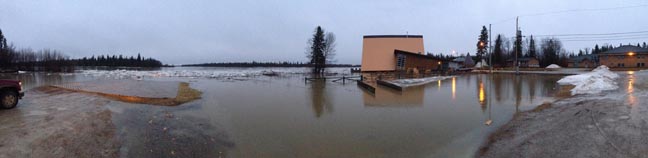
Communities along the James Bay coast and northeastern Ontario have been impacted by spring flooding, with states of emergency declared for four First Nations and a James Bay municipality and evacuations ongoing.
Sewage plant failures and basement and bathroom flooding in Kashechewan and Attawapiskat resulted in those communities being partially evacuated. A water treatment plant breakdown in Fort Albany has left residents without access to clean water, and forced some evacuations.
And high water levels on the Moose River due to break up has resulted in preparations for the evacuation of vulnerable residents from Moose Factory and Moosonee.
Both Attawapiskat and Kashechewan First Nations declared state of emergencies on April 30 after sewer backups flooded basements in those communities.
Kashechewan Chief Derek Stephen said that at least 44 homes had been flooded, including four teacher residences, leaving 200 people without shelter. As of May 3, about 240 Kashechewan residents were evacuated to Kapuskasing.
As the breakup of the Albany River and the threat of flood approached, Kashechewan evoked a stage one evacuation of its community members on May 4, which Stephen called a “precaution.” Two days later, about 350 residents had been evacuated to Cornwall and about 150 were flown to Thunder Bay.
On May 6, Stephen said more residents would be evacuated to Greenstone, bringing the total number of residents evacuated to about 1,000 of its 1,700 members.
Stephen said once most of the ice has flowed out to James Bay, the threat of flooding would be gone and residents could return.
However, it could take longer for the 200 residents impacted by the sewage backups.
“We are looking for pumps, and they’re not easily as accessible as we thought because to order a brand new one it’s 6-10 weeks. And to repair one it’s about two weeks,” Stephen said.
In Attawapiskat, the hospital and school have been closed due to the sewage backup. Andrew Morrison, spokesperson with Ontario’s department of Justice and Community Safety, said about 140 people have had their homes contaminated, and although no large scale evacuation is planned “it could still happen.”
In Fort Albany, an equipment failure in the community’s water treatment plant has left many residents without drinking water. Morrison said alternative services are being put in place.
The community has declared an emergency as a result of the drinking water shortage.
Morrison said no evacuations are expected in Fort Albany as repairs should be completed shortly.
Meanwhile, flood coordinators in Moose Factory and Moosonee continue to monitor the water levels in the Moose River system.
On May 2, the water had reached critical levels, with water beginning to flood isolated low lying portions of Moose Factory Island, including areas near the Weeneebayko General Hospital and the Cree Village Ecolodge.
As water levels continued to rise on May 3, the Town of Moosonee declared a precautionary state of emergency and airlifted about 100 vulnerable residents to Sudbury that night followed by another 100 to Timiskaming the following day.
The town also restricted access to the bridge leading to its airport as the water levels rose dangerously high along the creek.
On May 4, the Weeneebayko General Hospital in Moose Factory transferred some of its patients to southern facilities as a precaution.
On May 6, Moose Factory Fire Chief Chris Alisappi said there is no state of emergency and no one has been evacuated.
He said there has been a decrease in water levels due to some channels that have opened up on the Moose River, allowing the water and some of the ice to flow out to the bay.
“Right now, I don’t see any possible threat,” Alisappi said. “The best scenario is that the warm weather will help the ice to melt and hopefully move along and help the water move out to the bay, which is what we want to see.”
South of James Bay, Mattagami First Nation has also declared a state of emergency as flood waters eroded the only road into the community.
On May 1, 67 residents of Mattagami were evacuated to Timmins. According to a community member, no wash out has yet to occur as of May 6.
Morrison said the flooding events are being caused by snow pack run-off combined with the first impacts of spring thaw of the rivers and lakes.
“Our thoughts are with the residents of the communities that have been impacted by flooding events,” Morrison said. “Our number one priority is to ensure everyone’s safety. Emergency Management Ontario (EMO) remains in contact with community leadership in affected areas as well as the federal government to coordinate support and resources.”
Morrison said emergency declarations are also in effect further south, including in the Town of Bancroft, City of Kawartha Lakes, Minden Hills and Sagamok First Nation as a result of flooding.





First Nation youth representatives are letting the world know that Indigenous people are ready to stand up and protect the land. Keira Spence, Kohen...
My home community of Attawapiskat First Nation is celebrating the annual graduations of students from Kattawapiskak Elementary School and Vezina Secondary...