


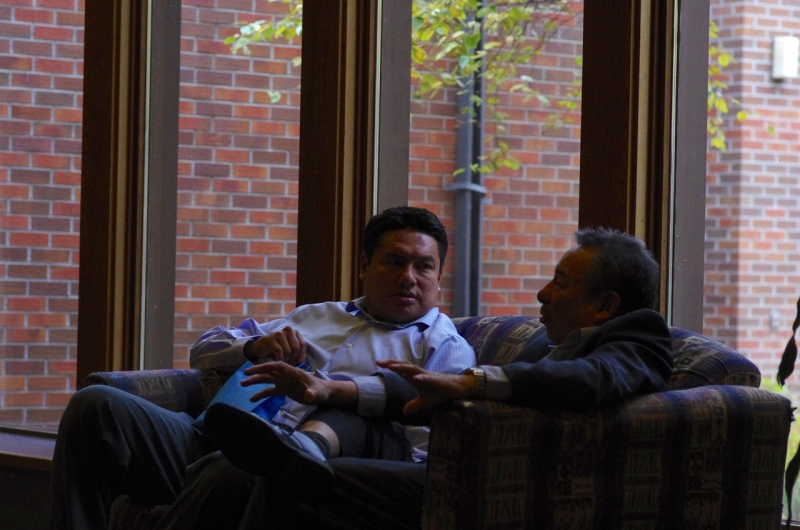
Deputy Grand Chief Derek Fox described how he enjoyed suing people on behalf of his clients during Nishnawbe Aski Development Fund’s 5th Annual Mining Summit. “I liked sending them letters saying you are being sued,” Fox says. “I just enjoy advocating for people. And there came a point in time where I decided I needed to advocate for my people, First Nations people.” Fox says First Nations youth need help to keep their language skills, noting their fluency levels are dropping. “One day the language will just be gone — we will wake up tomorrow and the language will be gone if we don’t do something about it,” Fox says, quoting Wab Kinew. “The reason I talk about this is it all comes down to resources and development. That is how First Nations are going to establish themselves and provide for themselves: revenue sharing, mining.” Fox says the traditional land north of Kitchenuhmayooosib Inninuwug is “the most beautiful territory you will ever see.” “It’s a never ending maze of snake-shaped rivers, moose, caribou in abundance, sturgeon, walleye,” Fox says. “That’s where my grandparents grew up; that’s where my parents grew up.” Fox says many First Nation leaders from the area still talk about their trap lines and how sacred their lands are. “So that is why mining at first scared me,” Fox says. “The thought of oil spills or accidents contaminating the north kind of scared me. So that is why it is important to build relationships.” Fox says it is important to acknowledge the law regarding free, prior and informed consent and the duty to consult and accommodate. “It is important to reach out to the First Nations and the leadership, not just the leadership but the trappers and the holders of those lands,” Fox says. “I am a big believer in resource development, but not at the expense of our lands.” Fox says NAN’s role is to advocate on behalf of the NAN communities. “There is a lot of potential to build relationships,” Fox says. “We have a ton of resources, so we need to do so carefully. We need to ensure that our children have someplace to grow.” Fox says his children and grandchildren need to have the same connection he had with the land. “So I need to ensure those lands are still there, that they have the right to hunt, fish and trap and be (on the land for) spiritual development,” Fox says. “For leadership, it comes down to ensuring that our future leadership can speak their language.” Fox says all people, not just First Nations, need to start asking themselves what they are leaving for future generations. Held Oct. 27-28 in Thunder Bay, the 5th Annual Mining Summit also featured a presentation by Mark Podlasly, from Nlaka'pamux First Nation in B.C., on Starting Up IBA Discussions with Major Mining Companies. “We host an existing mine in our territory, Canada’s largest open pit copper mine which has been operating for about 40 years,” Podlasly says. “At its peak it was pulling out over a billion dollars a year in revenue.” When an extension of the mining agreement with the crown came up for negotiation, Podlasly says his community looked at 150 IBAs around the world. He says all the cards were stacked in favour of the companies from 50 to 100 years ago, but over the past 40 years the situation has started to balance out between companies and First Nations. “But the number one thing in the past 10 years that has changed negotiations is the Internet,” Podlasly says. “Once you have these (cellphones), you can talk to other Indigenous people around the world.” Podlasly says First Nations people can now see the agreements between mining companies and other Indigenous communities around the world within minutes. “And even better, if a company operating in South America is being a complete jackass, we will know about it,” Podlasly says. “In the late 1990s and early 2000s, we began to see revenue sharing deals begin to appear. About 10 years after that, we started to see equity deals.” Podlasly says the equity deals started out as one to five per cent of shares but is now ramping up with Indigenous communities buying larger shares. “There is starting to be a trend of First Nations increasing from minority positions in a company to majority operating decisions in mines,” Podlasly says. “There aren’t many of them, but it’s starting to happen.”




My home community of Attawapiskat First Nation is celebrating the annual graduations of students from Kattawapiskak Elementary School and Vezina Secondary...
I was happy to see my nieces and nephews in Attawapiskat taking the opportunity to learn about the traditional practice of making Nah-mesh-tek, the Cree...