


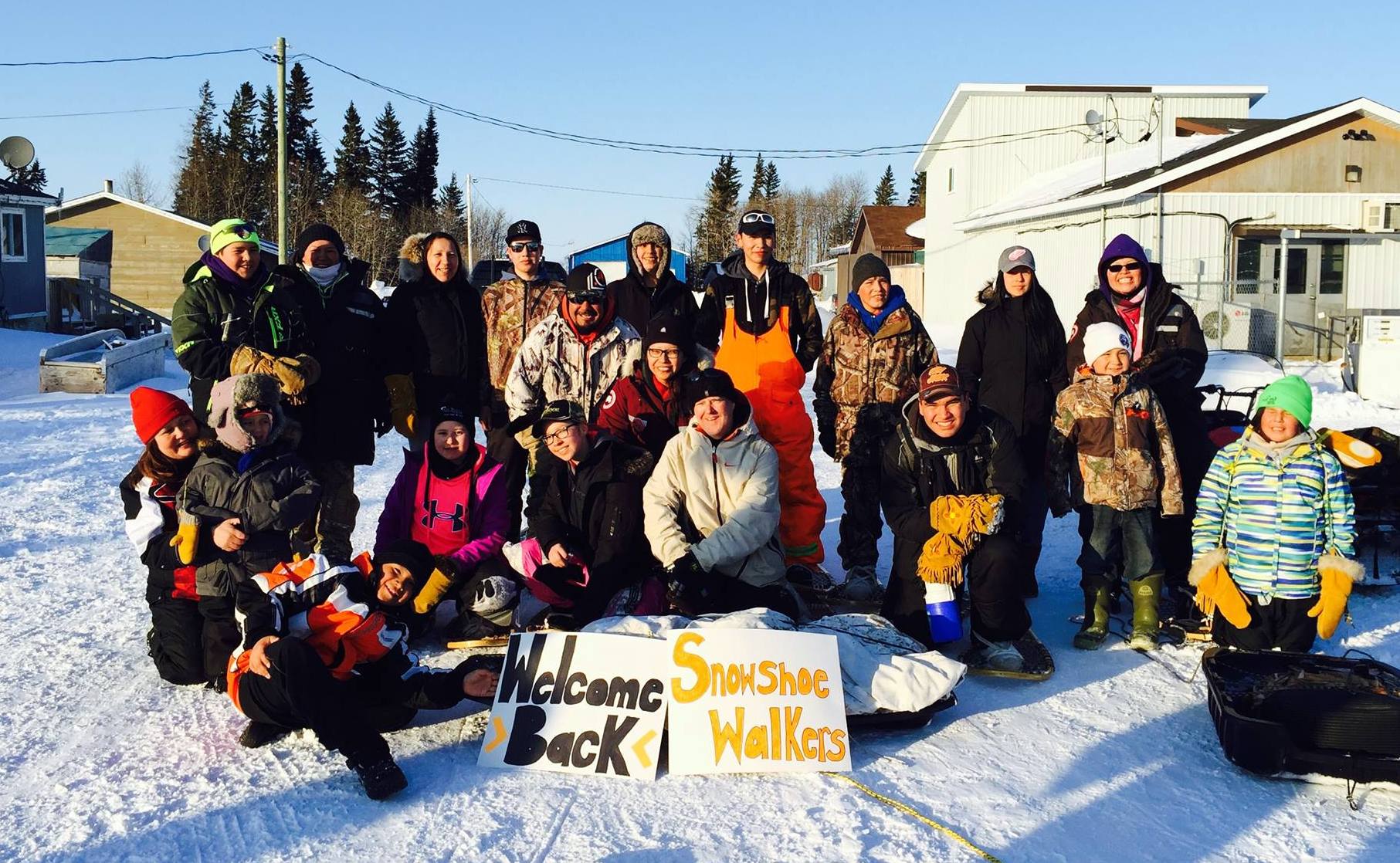
“How far did you walk?” asked the Elder.
“We walked 12 kilometers today, coming home,” replied the Snow Walker.
“Kah…‘neeshaw ay-skwaw-ping’ – ‘twice as far as the eye can see.’ That’s how far you walked today.”
“Kah, cool!”
This was overheard as the twilight shadows lengthened and the Snow Walkers arrived home to waiting families. Four days away at Kwe-ta-po-ha-kun Youth Camp. A dozen walkers, between 9 and 49 years of age. A good taste of life on the land, taw-pway. That was at the end of March, the end of last winter. And now we await more snow and begin talk of our 2016 trip.
“Helen’s frybread tasted so good. one young Snow Walker remembered. One of the many experiences the Snow Walkers and their guides shared. Sharing: a Grandfather Teaching. That’s what made the journey most remarkable, according to participants:
“Everyone getting along, sharing stories around the fire and laughing.”
“I liked when the kids gathered in one place.”
“Laughter and kindness. People helping each other, like when someone fell, or tying on snowshoes.”
“How the youth wanted to share stories, and the communication amongst them.”
No electronic devices were allowed on this trip; people just shared each other’s company. Days 1 and 4 involved snowshoeing to and from camp, walking on rivers, lakes and through the bush. The middle days were spent around the campsite, or on trips to the muskeg.
The youth participated in many activities and teachings, some planned, others spontaneous: splitting wood, rabbit snaring and partridge hunting, making snow water, gathering boughs for seating, preparing a goose blind, repairing skidoos, fire starting, marten trapping, prepping wild food… and of course, lots of eating of delicious food cooked by the women and their young helpers.
“I will remember the different kinds of survival skills we learned, like going trapping.”
“I liked the small workshop type of teachings on fire making.”
“I enjoyed those ‘teachable moments,’ without schedules.”
“Watching students being experientially involved and them asking questions.”
“I remember going to the muskeg when it was cloudy with wet snow falling.”
One Snow Walker was Jeremiah, a high school student from Fort Albany. He spoke on Wawatay Radio soon after the trip. Here’s some of what he said:
“The experience was good, because I got to communicate with people I never had a chance to before. There are so many things to be learned. We have to get back on the land, like we used to. We’re so caught up with technology. A trip like this gives us a chance to realize that there’s something out there for us. We can go out on the land and be connected, it clears our minds fully and we realize more things about ourselves. We learned different things out there: how to trap marten, and other teachings. The calmness though, that’s what I enjoyed the most.
The walking itself, it is physical, mental, and spiritual. Physical, because it’s a challenge. Coming home we walked 12 kilometers, so you gotta’ push yourself. Mental, because you have to encourage yourself to keep going. And spiritual… when you’re out there, you’re connecting with your roots, and that’s important.”
There was also the emotional part, when everyone stood in a circle the final morning to share and pray for a safe journey home. Something was felt in that circle, like someone was standing with us in Spirit, happy to see the youth taking part in something meaningful. The sun shone down and the conditions were perfect for snowshoeing.
We need to continue these Snow Walks each year. It’s an ongoing tool that our ancestors used in order to get their strength—in all 4 aspects of life. We must continue to use what our ancestors did, to survive in the bush. Encouraging our youth like this will make them want to do the good things connected to our past. Our ancestors provided for their families, and we can follow their path and reclaim our roots. This will help young people keep away from drugs/alcohol and other negative situations. It was impressive and inspiring to see the teenagers, how fast and long they could walk, which is what they need: positive ways to test and discover their strength. We say the children are our future, so we should prepare them with a positive foundation so that they will know where to direct themselves when the time comes for each individual or family.
We wish to thank all the volunteers who made Fort Albany’s 2015 Snow Walkers trip a reality, as we now look forward to fresh snow, and more walking together. The final words belong to the young people:
“I liked walking with the bigger kids.”
“I liked the walk home and the conversations while walking.”
“I liked the fresh air, and walking with the others. The walking was good.”



This past month, I was happy to attend two Pow Wows I hadn't been to in years. I attended the Mattagami First Nation Pow Wow and the Matachewan First Nation...
I was happy to see my home community of Attawapiskat on the James Bay coast announce the opening of the new St Francis Xavier Parish Church on August 25....