


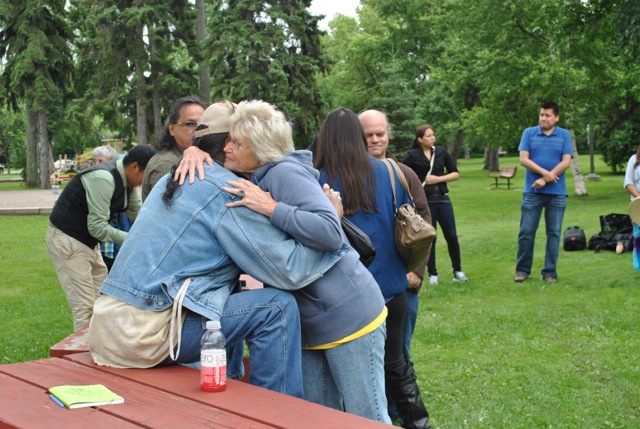
More than 30 people gathered together on July 25 at Vickers Park in Thunder Bay to call on the federal government to “Honour the Apology” that Prime Minister Stephen Harper gave to residential school survivors on July 11, 2008.
The event was planned in response to newly published research by Ian Mosby, a food historian at the University of Guelph, which shone light on the thousands of children who were unknowing subjects of nutritional experiments between 1942 and 1952. The experiments, conducted by federal government officials, resulted in children being malnourished and hungry.
Attendees of the event were invited to share their stories and thoughts during an emotional time of reflection.
Clyde Moonias of Neskantaga First Nation organized the event alongside Andrea Landry of Pays Plat First Nation. Moonias, or Ka-pe-ta-ya-way-we-tung which means The One Coming with a Voice, planned the event to help others heal.
“The reason I did this was for healing,” Moonias said. “I’d like to show that no matter who we are, we all have a voice.”
Moonias expressed a great sense of hope for Nishnawbe people healing from the residential school system and its effects.
“We, as Nishnawbe people, once dominated the land,” said Moonias. “We roamed and hunted. We lived the good life. Since the residential schools, our children have been traumatized. An apology cannot take back years of pain or suffering. In time, we will live the good life. We will thrust in our ways.”
Jim Chicago, a residential school survivor and attendee of the event, agreed that it was helpful in healing.
“Sometimes,” Chicago said, “you think you’re healed. But you’re not. What brought this back were the medical experiments. We went through that at St. Joe’s and at St. Mary’s.”
Chicago, who attended St. Joseph’s residential school in Thunder Bay and St. Mary’s residential school in Kenora, explained that as a child he would search for and steal food because he was not properly nourished.
“The food was bad. So bad that we would steal food and rummage through the kitchens to get scraps,” Chicago said. “I would run away and bring food from the gardens to kids who were too afraid. We never had fresh vegetables.”
Chicago would like to draw attention to false information, which he says the church and the government had provided.
“I just want people to know that what the government and churches said they gave us was totally false,” shared Chicago. “What they fed us was very bad and very little.”
After leaving residential school in 1964, Chicago spent time struggling as “a street person.” Since 1971, Chicago has been clean. He now receives support from his wife, his son, elders in Treaty 3 and his connection to his culture. Chicago says that learning to laugh helped him to heal.
“I go to my Elders in Treaty 3 when I need guidance,” Chicago shared. “That’s one of the things they’ve always told me. You can’t heal without crying. Once you start looking at things differently, you’ll be able to laugh. The tears from your eyes wash away the hurt, and then you find laughter.”
Honour the Apology events were held in Winnipeg, Vancouver, Ottawa, Saskatoon, Edmonton, Sudbury and Thunder Bay on July 25th at noon.


This past month, I was happy to attend two Pow Wows I hadn't been to in years. I attended the Mattagami First Nation Pow Wow and the Matachewan First Nation...
I was happy to see my home community of Attawapiskat on the James Bay coast announce the opening of the new St Francis Xavier Parish Church on August 25....