


A minor hockey program is flourishing in Lac Seul First Nation’s new arena.
After the arena’s NHL-size artificial ice surface became ready for play in April 2013, local parents began talking about creating an organized hockey program for their kids.
Up until then, less than 20 youth from Lac Seul’s on-reserve population of 840 would typically play for teams in the Sioux Lookout Minor Hockey Association each hockey season.
For players living in the Frenchman’s Head part of Lac Seul, participation required an 80-kilometre round trip for practices and games, three times a week. Players living in the Lac Seul communities of Kejick Bay and Whitefish Bay would have to travel even farther to get to the arena in Sioux Lookout – an extra 20-30 kilometres each way.
So, when a the Lac Seul Minor Hockey Association formed in September to offer hockey opportunities closer to home, the level of participation boomed. A total of 96 boys and girls registered in the full range of minor hockey divisions at $400 per player, from novice (starting at age seven) to midget (up to age 17), “which far exceeded our expectations,” says Sam Manitowabi, the association’s president. “It was a great surprise.”
Manitowabi confirms that accessibility has been key to the surge in minor hockey interest.
“Not a lot of parents are able to drive their kids into Sioux Lookout every other day for minor hockey,” he says.
Manitowabi’s daughter, Jenelle, was one of the youth who cut the ribbon for the August grand opening of the Lac Seul Events Centre (which includes the arena), when a minor hockey organizing meeting was also announced.
“I was pretty happy (with the news) because I’m the first girl goalie in from Lac Seul and I want other girls to start playing too,” Jenelle said at the time.
“Like her,” the bantam goaltender continued, looking beside her at friend Natasha Lawson.
“She played before (but stopped) because didn’t like driving into town. So, she’s starting again.”
Added Lawson, who missed the previous three hockey seasons: “Some of the reserve kids can finally get the chance to skate.”
With that benefit in mind, a group of parents had invited representatives of Hockey Northwestern Ontario (HNO), a branch of Hockey Canada, to make a presentation in Lac Seul about the startup of a minor hockey association under HNO. About 40 people, representing 20 Lac Seul families, listened to the presentation. They decided to pursue the formal hockey program for their kids, rather than simply bringing them to the arena for unorganized play.
“It was really important for the community that our teams be able to travel to other minor hockey tournaments,” which is possible for associations and teams affiliated with HNO and Hockey Canada, explains Manitowabi. “And then being able to have exhibition games against other associations on top of that.”
Relying on a template from HNO, a Lac Seul Minor Hockey Association constitution was developed and a volunteer executive chosen, preparing the way for the flood of player registrations.
“Any time you’re part of a larger organized group that has set guidelines, policies and programs, I think it’s easier to build capacity within the community,” Manitowabi says of HNO’s support for the startup.
HNO offered three days of training, beginning with a Speak Out course required for volunteers who serve as team officials. The four-hour course helps coaches identify and deal with abuse, neglect, harassment, and bullying. Twenty-five people from Lac Seul took the course.
Ten of them also received the training necessary to become certified coaches, and seven more became certified trainers.
With six minor hockey teams in Lac Seul – two in peewee and one in each of the other divisions – a lot of adult volunteers have been needed. Coaches, who can plan practices using Hockey Canada coaching manuals, instruct their teams during four to six hours of ice time a week.
More training for team officials, plus training for local referees, may be provided by the end of this hockey season, Manitowabi notes. So far, Lac Seul has relied on referees from Sioux Lookout.
Equipped for Fun
Meanwhile, Lac Seul players have benefitted from HNO’s connection with a minor hockey association in Ottawa.
“They sent up a large quantity of quality hockey equipment to outfit the kids that didn’t have any,” Manitowabi says.
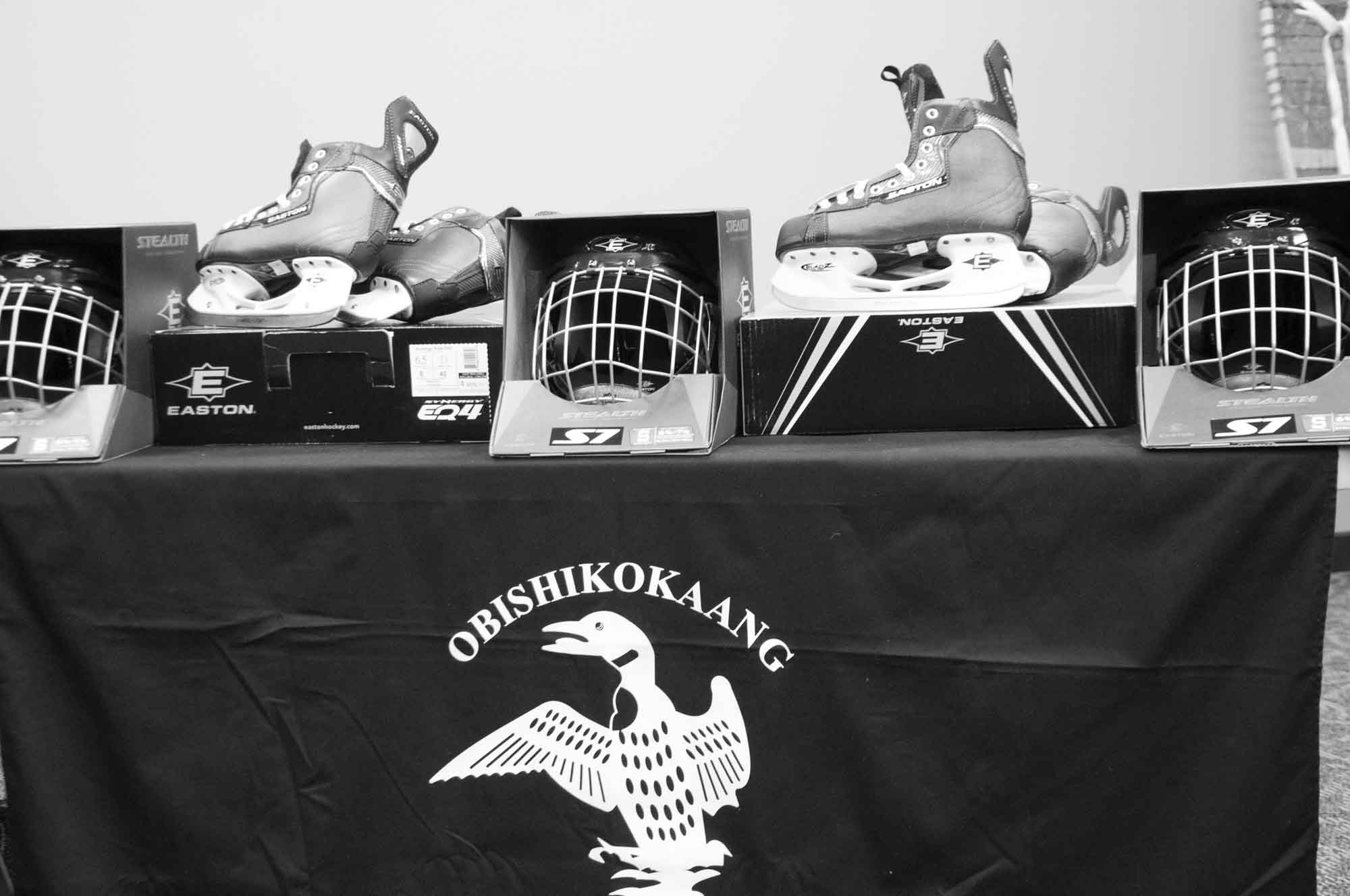
In addition to that contribution was a donation of 20 new helmets and 20 new pairs of skates from GCK Consulting of Thunder Bay and a financial donation from the Domtar pulp and paper company for program expenses, including equipment.
Lac Seul’s chief and council have also contributed financially to the minor hockey program.
On the ice, players sport the nickname Junior Eagles on jerseys in the double-blue shades of the Winnipeg Jets, which are also the colours of the First Nation’s logo. They’re playing in tournaments throughout the region, and in exhibition games against teams from Sioux Lookout.
There are plans for the Sioux Lookout and Lac Seul minor hockey associations to form a working group to discuss “how we can work together, how we can support each other’s programs,” adds Manitowabi, who envisions the two communities co-operating for other sport programs as well, such as soccer and baseball.
This month the focus has been on hockey, with the Lac Seul and Sioux Lookout arenas co-hosting 45 teams playing in the annual Little Bands Native Youth Hockey Tournament.
Manitowabi serves as an assistant coach for the midget Jr. Eagles. His son, Samuel, shares bantam goalie duties with Jenelle, and two foster daughters play in younger divisions.
Prior to the start of the Little Bands, Manitowabi shared his expectations for all Lac Seul teams: “I just expect them to have fun – that’s the thing that we’re promoting first and foremost. We get together and we have fun. We try our hardest.”
Speak Out
For the future of Lac Seul Minor Hockey, Manitowabi talks of expanding the reach of the Speak Out program to “anybody who will be stepping into the rink,” including players.
“It doesn’t matter what sport or age you’re working with, you are going to encounter issues with bullying and that kind of behaviour, so maybe if we educate them at the forefront about … how it’s not acceptable, any of that kind of education will help the community be healthier.”
Lac Seul players, coaches and parents are already required to sign their agreement with the hockey association’s conduct policies.
The group continues to look for more volunteers to help improve its hockey program, Manitowabi says.
With Lac Seul’s arena located in Frenchman’s Head, accessibility remains a challenge for players in the First Nation’s other two communities, he says, although car-pooling has become more common for rides to the rink.
Manitowabi confidently predicts one improvement for next year: more players.
“I think there will be more kids registering and I think (minor hockey) will be more accessible in terms of costs and registration fees.”


This past month, I was happy to attend two Pow Wows I hadn't been to in years. I attended the Mattagami First Nation Pow Wow and the Matachewan First Nation...
I was happy to see my home community of Attawapiskat on the James Bay coast announce the opening of the new St Francis Xavier Parish Church on August 25....