


I did not know what to expect when I first approached the gates to Victoria Island on Dec. 20.
Attawapiskat Chief Theresa Spence was on her 10th day of fasting in a teepee and I was there primarily to report on it and the upcoming Idle No More rally.
But within me, I wanted to show my support for her. I’ve known her since I was a child when she and her family lived in Moosonee.
And since I am a member of Attawapiskat, she is my chief.
I heard drums as I walked up to the gates. I entered and a helper welcomed me and asked me to sign a guest book.
And I saw the famous teepee where Theresa was conducting her fast. A helper stood watch. I recognized him.
It was Pat Etherington Jr., who I had went to school with in Moosonee. I ran into him last year at a Truth and Reconciliation Commission event in Halifax. He had been one of Theresa’s helpers since Dec. 15.
“I’m running into you all over the place,” he joked.
I would see many people I knew or who knew my parents during my time on the island.
From the start, there was a lot of positivity and love in the camp.
That day, many visitors came from all over to take part in the upcoming rally.
A young woman said she left Saskatoon days earlier with $1.25 in her pocket and paintings she planned to sell.
She was denied access to the teepee because Theresa was resting, but she happened to meet her when Theresa stepped out.
“I never thought I would make it here,” she said, and began to cry. “And now she just accepted my paintings.”
Theresa was surprised to see me as I stepped in for my visit, recognizing me.
She was tired but she was doing well.
When I was a kid, my cousin and I were climbing a tree and jumping into the snow. My hood got caught and I was just hanging there, almost choking. My cousin ran to Theresa’s, the nearest house, and her partner at the time came and got me down.
After talking with Theresa at Victoria Island, I was about to leave when she said, “don’t go hanging on trees now” and we laughed. It was a memory I had almost forgotten.
Despite her suffering, Theresa was in high spirits. Her laughter was contagious and could be heard frequently from outside the teepee.
Days after the rally, I gave serious consideration to staying in Ottawa over the holidays, to stay on the island with Theresa and the other helpers. But I had family up north expecting me.
When I returned to Ottawa on Jan. 3, I was welcomed like a family member.
My plan at the time was to stay a few nights at a hostel before going back to Thunder Bay.
I told this to Edmond, one of the helpers.
“Theresa wouldn’t want you to stay in a hostel,” he said. “Stay in a tent over there. We’ll set up a bed for you.”
And that is how I became a helper. Each morning I’d wake up, have a smoke and coffee, sit by the sacred fire, and then help out anyway I could.
I helped with tending the fires, supporting the ceremonies, welcoming visitors, and watching over the door to the teepee.
It was almost pointless to askwhat the plan for the day was. Events unfolded naturally.
Being on Victoria Island was an experience of spirituality and love.
Ceremonies of various kinds occurred each day. One of the duties as a helper was to offer visitors a smudge and tobacco as an offering to the fire.
And all kinds of visitors came by, from different parts of Canada, from different races, creeds and religions.
One day a group of Crees from Treaty 6 in Alberta showed up to conduct a ceremony for Theresa. They brought along a sacred bundle and pipe that was used at the signing of the treaty and was passed down over five generations.
A group of Muslims came by one Sunday. They offered a gift for Theresa and when I offered a smudge, they gratefully accepted.
One of them explained to his son what to do.
“It’s cleansing,” he told him.
Nearly everyday I was asked by a visitor if there was anything they could do to help. I always said I don’t know, because we received food and money donations everyday.
About a week after I became a helper, Pat presented me with a strip of red fabric. Most helpers wore one as an arm band, signifying their role. I gave him a tobacco offering and proudly wore it from that day.
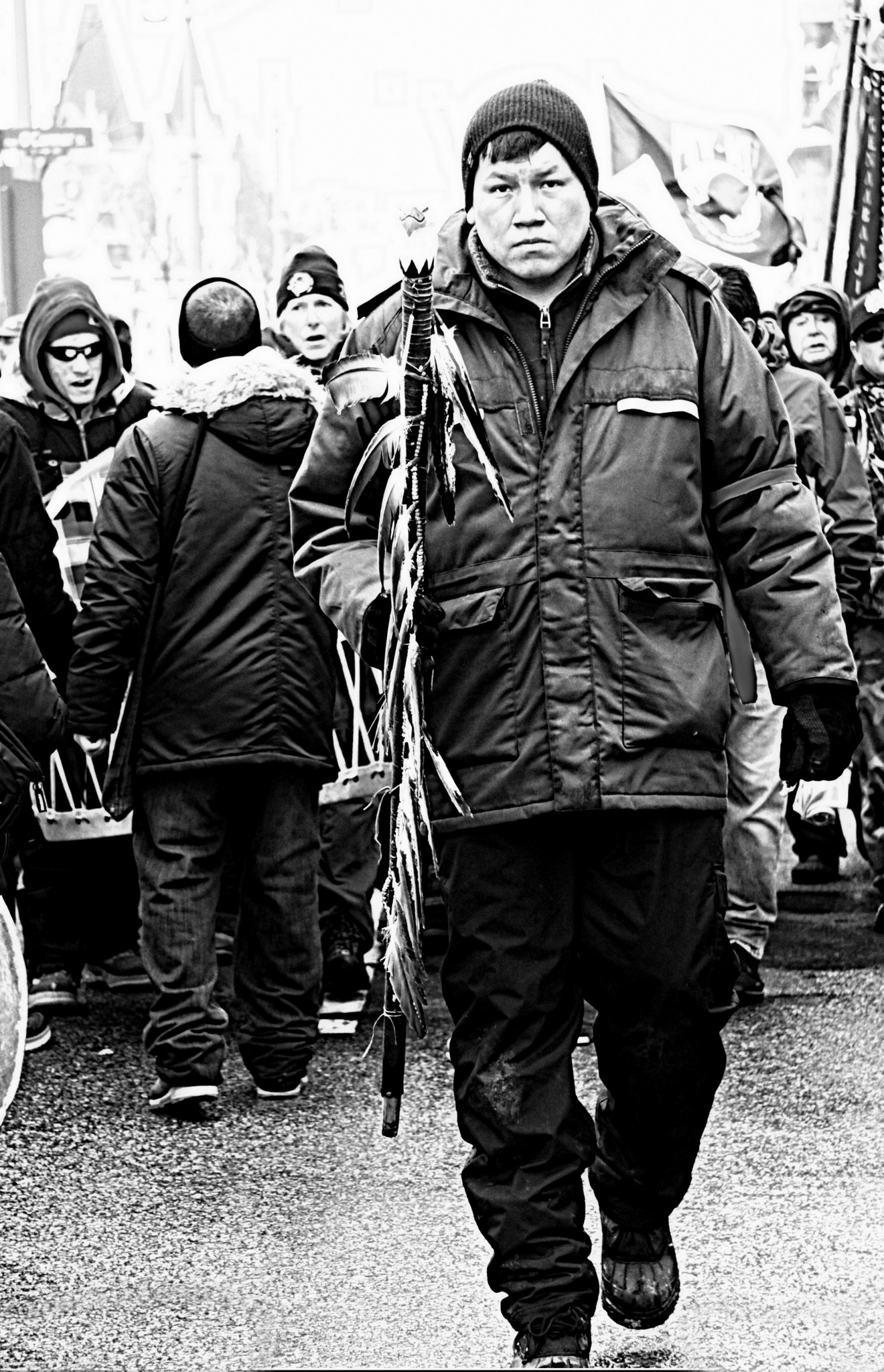
Carrying the staff
I woke up on the morning of Jan. 11 expecting to go into reporter mode for the day’s Idle No More rally. Like at the Dec. 21 rally, I planned to be on sidelines taking photos and conducting interviews.
But as we prepared for Theresa to hold a press conference, someone asked her who should carry her eagle staff since her spokesman was attending meetings.
“She said Lenny should carry it,” came the reply, and I was stunned.
We did the press conference and Theresa addressed the crowd gathered on the island who were taking part in the rally. She said she was proud of them for standing up for First Nations rights, and added a wish.
“When you do this rally,” she said, “do it with peace and love.”
People cheered as she went back into her teepee, then the rally began.
“Lead the way, Lenny,” a helper told me, and I was the first one out through the camp gates.
So there I was. Instead of watching from a distance, I was leading hundreds, if not thousands, of people from Victoria Island to begin the march to Parliament Hill.
Once we got on the road, which police had blocked off for us, we allowed the marchers to assemble and we lined up, staff and flag carriers at the front.
And we marched.
Since I was carrying Theresa’s staff, I made sure to walk alongside Cross Lake Elder Raymond Robinson and Mi’kmaq sundance warrior Joseph Jean Sock. They were fasting on Victoria Island in solidarity with Theresa. That’s who she would be marching with, I thought.
‘We won’t leave a warrior behind’
During a stop to allow those behind to catch up, Raymond crouched. Wincing, he said he wasn’t feeling well. He got up and walked when the rally proceeded, but stopped again. He said he was light-headed and had a pain in his abdomen. Police asked if he wanted a ride back to camp but he said no. He recovered a bit and marched on.
A block later, he stopped again, this time on his own. I thought for sure he wouldn’t be able to go any further. The whole rally stopped, the organizer saying: “We won’t leave a warrior behind.”
Then the organizer called for women drummers to come up. Within a minute we were encircled by these women, singing for Raymond. I stood behind him and a woman asked me to move. She had her hand extended toward him. I’m praying for him, she said. Another woman smudged him with sage.
The song stopped. Raymond got up for a second but bent back down. It wasn’t looking good. Then he stood up again. He looked behind and put his arm in the air, acknowledging the crowd, telling them he was OK.
He never showed weakness again during the march and proceeded with the rally with more energy than I had seen him, shouting “You can’t stop me, Harper.”
At the PM’s doors
As we reached the gates to Parliament Hill, someone informed the crowd that Prime Minister Stephen Harper was meeting with chiefs in the Langevin Block, the official home of the prime minister’s office and right across from Parliament Hill.
The crowd converged around the building.
I was into it at first. Let’s show Harper we’re here, I thought. Songs and chants were punctuated with the pounding of the drums.
But things began to grow intense. Anger appeared.
They began to knock at the door of the building, calling for Harper to come out. Women called for non-violence.
I was right on the doorsteps, holding the staff, watching everything unfold and feeling the anger, the negative energy. All Idle No More protests were peaceful. This was getting ugly.
Then a chief in a headdress turned to me, knowing I was carrying Theresa’s eagle staff.
“Are we doing the right thing right now?” he asked. “Should we be doing this?”
I remembered Theresa’s words that morning, to rally with peace and love.
“No,” I told him. “I don’t like this. Theresa wouldn’t want this. I think we should go to Parliament Hill.”
He reflected for a moment.
“OK, lead the way and we’ll follow,” he said.
So I asked for people to move, telling them I was going to Parliament Hill. I was joined by some of the helpers and Theresa’s daughters, and they followed me as I went up to the steps of the Hill.
Soon, the crowd filled the grounds, including the chief who had asked me what to do.
The rally proceeded peacefully and the speeches began.
As some talked, I thought I should say something, to reiterate Theresa’s message on Victoria Island.
I was given the microphone and I told the 4,000 people assembled the story of being at Harper’s doors and what the chief asked me, and remembering Theresa’s words.
“I’m feeling the love right now,” I said, and some cheered. “Are you feeling the love?”
Hearing the cheers from the crowd was incredible as I asked if they loved the land, the water, and each other.
Following the speeches, there was a round dance and then someone offered the idea of marching back to the island.
I led the way alongside Theresa’s daughters, everyone following my pace, respecting the staff.
Leaving the island
Two days later, I left the island to fly back to Thunder Bay.
As I went back to my apartment and my daily routine, I felt a great sense of disconnect, a void within myself.
I was not a spiritual person in my day-to-day life, but after being around it so much on a daily basis on the island, I missed it. I felt incomplete without it. The daily smudging, the tobacco offerings, the drums, the cedar.
And I missed the people, the daily visitors, the helpers who dedicated themselves to the cause and to Theresa.
When I returned to the island on Jan. 23, I was greeted with many hugs and handshakes.
“Welcome home,” one Elder said to me. And it felt that way.
I was glad to be on the island again, even if just for another night.
The next day, a ceremony was held for Theresa to honour her fast.
I was glad to be there for that, to be there for the end. The next day, the camp was disassembled. The teepee and tents were taken down.The sacred fire was ashes.
I paid a visit to the site before I caught my flight back to Thunder Bay. I recalled all the visitors that walked through the gates, the ceremonies conducted by the fire, and the drum songs and prayers that continue to resonate within those wooden gates.
My experience there opened my eyes to the strength of our people, the power of our spiritual ways. It changed me for the better. I learned so much about our traditions and spirituality.
And I made a new family. We, the helpers and close supporters, became a tight-knit group.
On the last morning, we gathered in the teepee and shared our experiences. We had laughed together, undergone challenges together. We put any differences we might have had aside and worked together for Theresa. Tears were shed.
We’re still in touch, most of us, and promised to reunite at the island at some point.
Being on Victoria Island was the experience of a lifetime. It was a life-changing event and I’ll never forget it. I feel so honoured and grateful to have been a part of it.
It was a special place and time for our people, even if most were not there.



This past month, I was happy to attend two Pow Wows I hadn't been to in years. I attended the Mattagami First Nation Pow Wow and the Matachewan First Nation...
I was happy to see my home community of Attawapiskat on the James Bay coast announce the opening of the new St Francis Xavier Parish Church on August 25....