


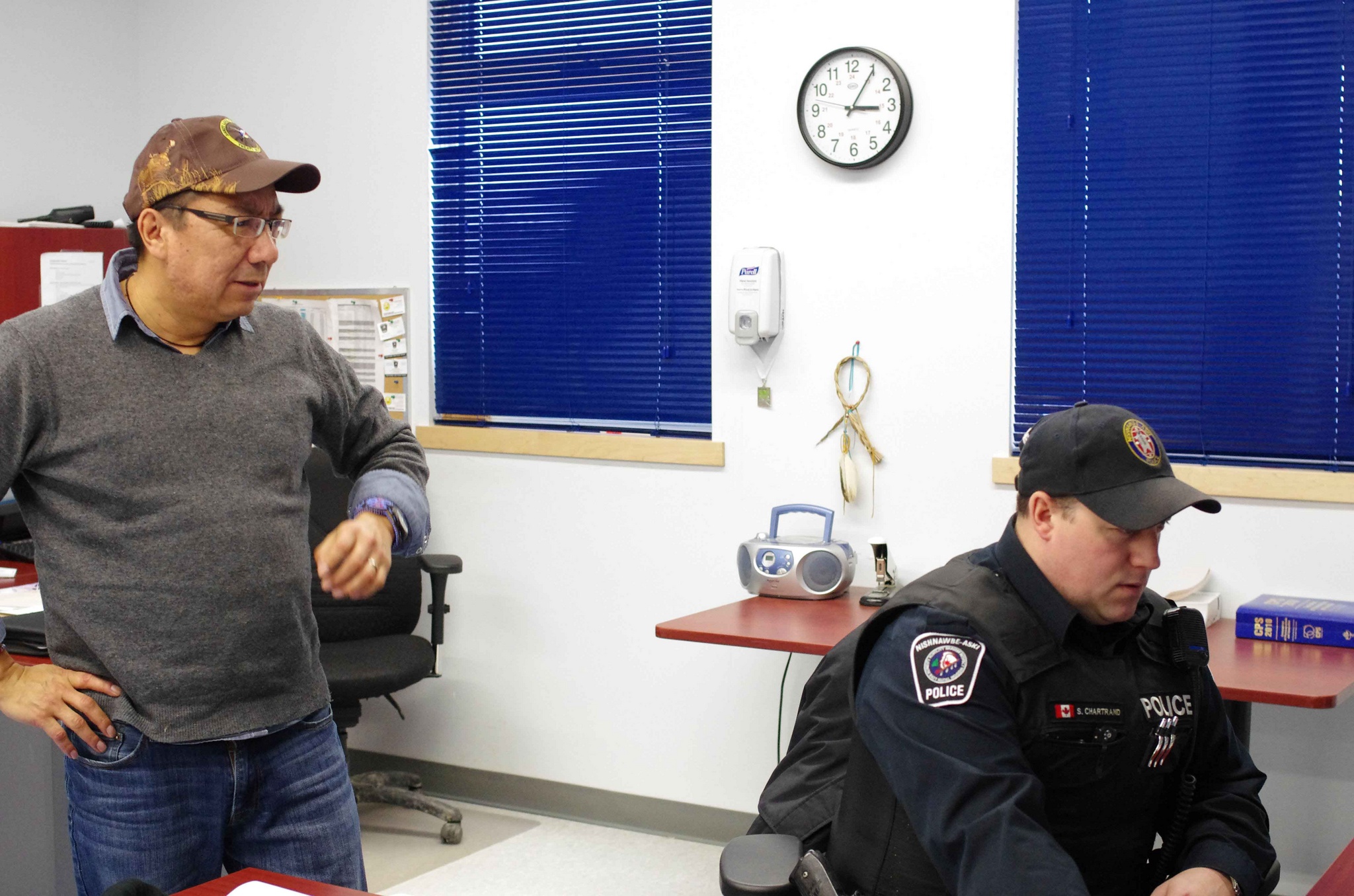
In light of the death of a Kasabonika woman that is once again raising issues with policing in First Nations communities, a Nishnawbe Aski Nation deputy grand chief says NAN still lags behind the rest of the country when it comes to policing services.
Alvin Fiddler said equivalent policing standards and services are still not being provided seven years after two men died in the Kashechewan police jail fire and almost four years after the Coroner’s Inquest called for adequacy of policing resources in NAN communities.
“One of the recommendations that came out of the Kashechewan Inquest was that Nishnawbe-Aski Police Service be considered a mandated service,” said Fiddler.
“As such, it would be legislated and there would be standards for NAPS to follow. But the way it is now, it is not considered a mandated service; it’s considered a program by both levels of government and because it is a program, we are not obligated nor are we funded to meet those (equivalent policing) standards.”
The inquest into the deaths of Ricardo Wesley and Jamie Goodwin of Kashechewan, released on May 21, 2009, called for Canada and Ontario to develop a method for establishing equivalence in policing standards and services between First Nations and non-First Nations communities.
The verdict also said Canada and Ontario should provide NAPS with the funding required to ensure that the communities it serves receive the same level and quality of policing services and infrastructure that non-First Nations communities receive, noting that funding levels should be sufficient to allow NAPS to comply with adequacy standards set out in the Ontario Police Services Act and the Policing Standards Manual of the Ministry of Community Safety and Correctional Services and Royal Canadian Mounted Police guidelines.
“Dating back to the Kashechewan Inquest ... and the Ipperwash Inquiry, there have been repeated recommendations that First Nations policing be the subject of a regulatory framework, in other words, be governed by standards and laws like other forms of policing in this country,” said Julian Falconer, legal counsel for NAN. “That just hasn’t happened, and certainly, NAN advocated strongly for those recommendations in Kashechewan and supported them.”
Falconer noted that since NAPS is considered a program, it does not fall under laws, standards and criteria set up to protect the public that apply to other police forces such as the Ontario Provincial Police.
An example is the Feb. 1 death of a 23-year-old woman in Kasabonika, which occurred while the woman was in police custody. If the death had occurred while she was in OPP custody, the independent Special Investigation Unit (SIU) would have completed an investigation.
But since the community is served by NAPS, an SIU investigation was not required and the OPP instead took on the investigation.
Fiddler said NAN is looking for NAPS to be operated as a legislated police service instead of a program, as it has been for the past 18 years since being founded.
“Our communities deserve a police force that has (equivalent policing) standards and is funded to meet those standards,” Fiddler said.
“In a normal police service, if they receive a call, they need to have two officers to respond to that call. But in our reality, with NAPS and the communities that it polices, when there is a call usually it is just the one officer responding to our call. And that is not the police service that our communities deserve.”
The Kashechewan inquest also called for the standard for NAPS detachments to be brick and mortar buildings, noting that permanent purpose-built detachments speak to equality of service, pride of policing and professionalism.
The verdict noted that as many as 19 of the NAPS detachments did not meet the National Building Code standards and did not have sprinkler systems installed.



This past month, I was happy to attend two Pow Wows I hadn't been to in years. I attended the Mattagami First Nation Pow Wow and the Matachewan First Nation...
I was happy to see my home community of Attawapiskat on the James Bay coast announce the opening of the new St Francis Xavier Parish Church on August 25....