


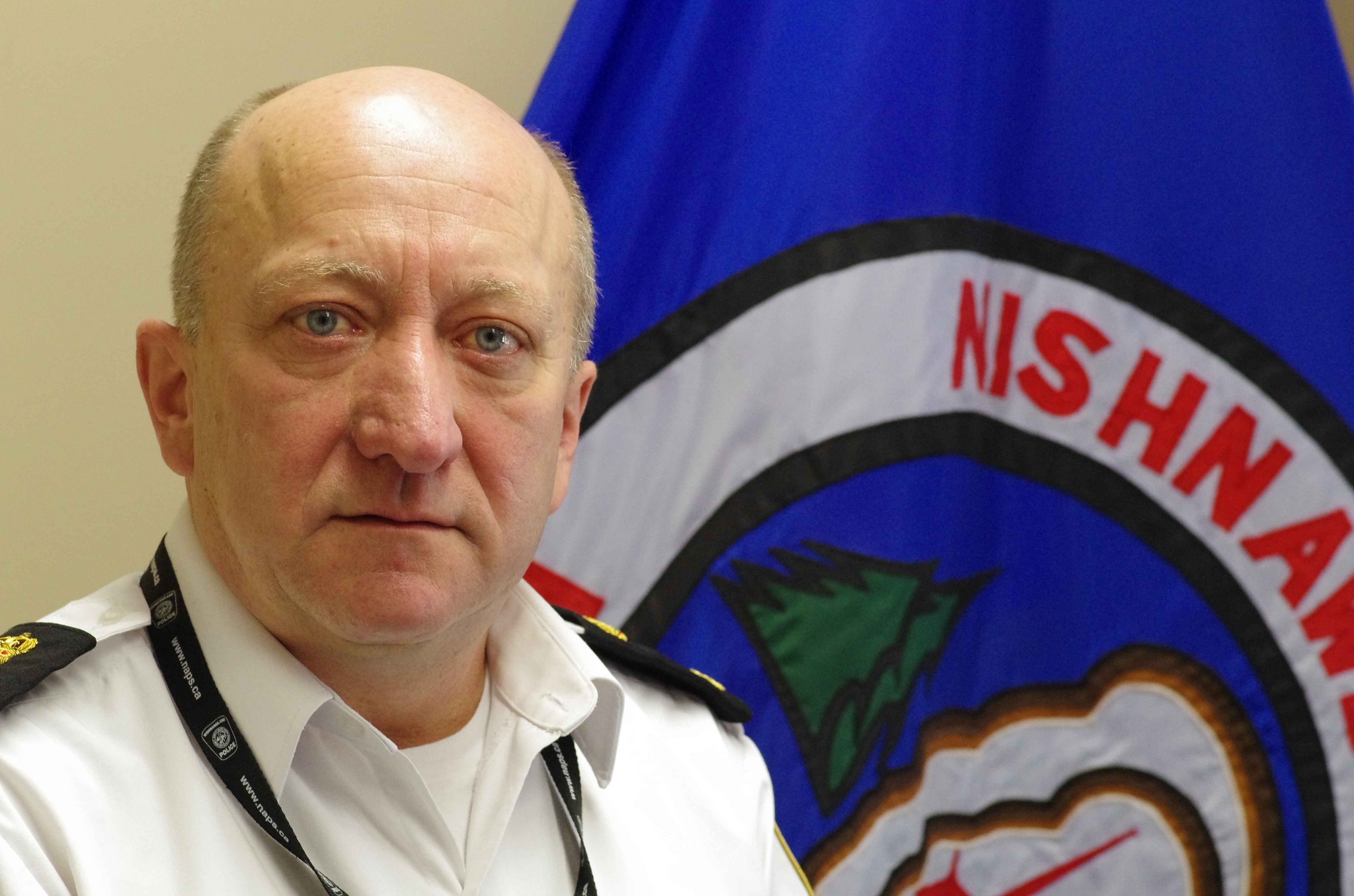
Nishnawbe-Aski Police Service Acting Chief of Police Robert Herman is calling for the same policing standards as other police forces.
“We’re still a program, and that is one of the problems — we shouldn’t be a program,” Herman said. “We should be legislated, we should be afforded the same opportunities as the national police force, the provincial police force and the municipal police forces.
“If government is serious about having First Nations policing First Nations communities, then they need to take the positive step such as a legislative framework that treats us the same as any other police service in Canada,” Herman added. “Right now, that is not the case.”
Herman, a former chief of police with the Thunder Bay Police Service, was surprised with the situation when he began serving with NAPS about 11 months ago.
“When I came to NAPS, it was kind of an eye opener because there is no legislation or framework that actually governs how we police,” Herman said. “I can tell you that if this was a municipal police force, a lot of the infrastructure and things like radio communications would not meet provincial standards.
Herman’s comments echo those made by Ontario’s Chief Coroner David Eden during the inquest into the deaths of two Kashechewan men during a fire in the community’s jail.
“Because it is a funding program without a legislative mandate, it can be discontinued at any time, which negatively affects both staff retention and long-term contracts such as rental agreements,” Eden wrote in the inquest.
Herman said the funding shortfalls limit the force’s ability to staff police in communities, and puts additional challenges on officers working for NAPS.
“It’s really inequitable, when you look at it,” he said. “We’re not afforded the same opportunities as a police service to have the proper infrastructure, to have proper housing for officers, to have the ability to staff the communities on a basis where we can provide good police service. Quite frankly, it’s totally unacceptable.”
Herman said some of the NAPS communities currently have good police facilities while others do not.
“Often time, officers are working alone — they have no backup,” Herman said. “Sometimes the backup has to come out of the community. So it does have a really hard effect on the officers from a moral standpoint and a retention standpoint. A lot of the officers have to pay for their own flights into the communities to do their shift schedule, which is unacceptable when you look at the provincial police.”
Timmins-James Bay MP Charlie Angus recently raised concerns about “third world policing conditions” faced by northern First Nations after a young woman died in NAPS custody in the back seat of a police car in Kasabonika.
“We have police officers working with no back-up and sleeping in places where you wouldn’t let a dog sleep,” Angus said in a Feb. 20 statement. “We have prisoners being held in the back seats of cars or in makeshift jails where they face risk of either fire or freezing. The NAPS officers are being forced to work in conditions that no other police unit in Canada would accept. Why the double standard?”
Angus wrote to Justice Minister Vic Toews in October 2012 asking for a plan to address the chronic under-funding, but he said Toews had not yet answered.
“The Conservatives talk loudly about being tough on crime and providing safe communities,” Angus said. “Yet they are leaving northern citizens and First Nation police to put up with third world conditions. This situation is unacceptable.”
Meanwhile, NAPS has restructured to improve service to the communities by creating three regions instead of two, increasing the number of supervisors and adding an additional regional commander.
“We want our regional commanders, who are inspectors, to actually go out in the field and meet with chief and council,” Herman said.
“We also want our supervisors to have more presence in the communities so that we can focus on community problems and community policing. It is a new way of doing business. It’s going to take a few months to roll it out but at the end of the day, we expect our service to be a lot better than it is right now.”
Herman said NAPS has been adopting the standards of other police services as best as possible even though it is not legislated to do so.
“I think we have come a long way but there is certainly a lot of room for improvement,” Herman said.
“We are at a juncture where the government has to get serious about whether they want First Nations policing to grow and actually be the model for First Nations communities. We can’t be a program any longer; we need to be legislated and we need to be treated the same.”
The federal government currently provides 52 per cent of the funding for NAPS while the provincial government provides 48 per cent.


This past month, I was happy to attend two Pow Wows I hadn't been to in years. I attended the Mattagami First Nation Pow Wow and the Matachewan First Nation...
I was happy to see my home community of Attawapiskat on the James Bay coast announce the opening of the new St Francis Xavier Parish Church on August 25....