


Rick Garrick
Wawatay News
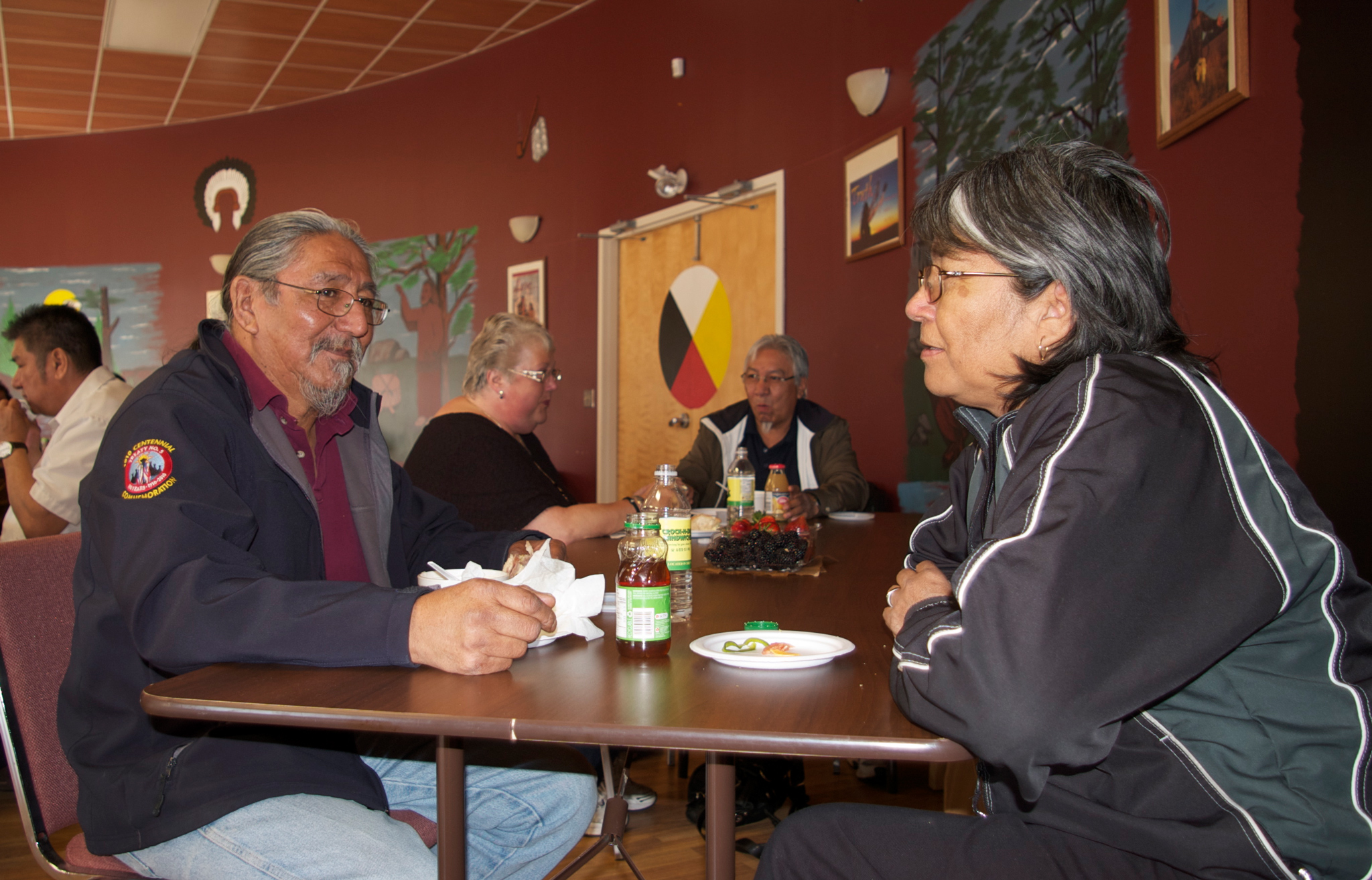
Nishnawbe-Aski Legal Services Corporation recently honoured its Talking Together program Elders for the help they provide during child welfare dispute resolution circles.
“They are the important and essential part of the circle – they are there to guide us and help us and we appreciate their teachings within the circle,” said Talking Together program manager Arlene Dodge during the April 7 gathering at the Fort William First Nation Community Centre.
“We have our facilitators who lead the circle and our Elders are there to guide and to help the families.”
The Talking Together Program currently has facilitators in Pikangikum, Sioux Lookout, Thunder Bay and Timmins and another will soon be hired for the James Bay coast.
“Anybody can access the program,” Dodge said. “If the child is in care in any one of the agencies within NAN territory, we can become involved.”
The Talking Together Program was implemented in 2002 to provide a dispute resolution method based on traditional circles and used since time immemorial to restore harmony between family members.
“We’ve had this Talking Together process since 2002 and we are ready, willing and able to take any referrals we can get,” said Celina Reitberger, NAN Legal’s acting executive director.
While some families have taken advantage of the Talking Together program, NAN Legal is encouraging more families to consider the dispute resolution process when dealing with child welfare agencies.
“We need to get the word out there that we exist and that every family has the right to ask for an alternative dispute resolution,” Reitberger said. “Treatment councils need to know about this possibility because children are being lost at an alarming rate.”
Reitberger said the Child and Family Services Act states that child welfare agencies have to consider alternative dispute resolution processes. She estimated there are about 550 children in care in Thunder Bay, with about 40 per cent of those in care being from Nishnawbe Aski Nation territory.
Reitberger said the strength of the Talking Together program is it brings all the stakeholders in the child welfare process together in one room.
“For the first time ever the child welfare people are hearing how the families feel,” Reitberger said. “The families are hearing about the real concerns of the child welfare agencies but all the other stakeholders are there as well.”
The Talking Together process begins with a referral from the family, the child welfare agency, or the court.
“Then the (Talking Together) worker will contact all the parties who should be in that circle and an Elder – we always use an Elder to convene the circle,” Reitberger said. “Hopefully some kind of a resolution will come. It’s not always about sending the children right home, but we’re also looking at extended family.”
The Talking Together process frequently involves more than one circle, each of which can last from two to three hours.
“It can be a lengthy process, but if it’s successful it really works well,” Reitberger said. “Everybody in the circle is on the same level and it is probably the first time they (the family) have had the chance to say what they really feel.”
While some people may express anger at the child welfare agency, Reitberger said the Talking Together facilitator does not allow that to derail the process.
“It’s not about personal feelings; it’s about what is best for this child,” Reitberger said. “It’s very powerful.”


This past month, I was happy to attend two Pow Wows I hadn't been to in years. I attended the Mattagami First Nation Pow Wow and the Matachewan First Nation...
I was happy to see my home community of Attawapiskat on the James Bay coast announce the opening of the new St Francis Xavier Parish Church on August 25....