


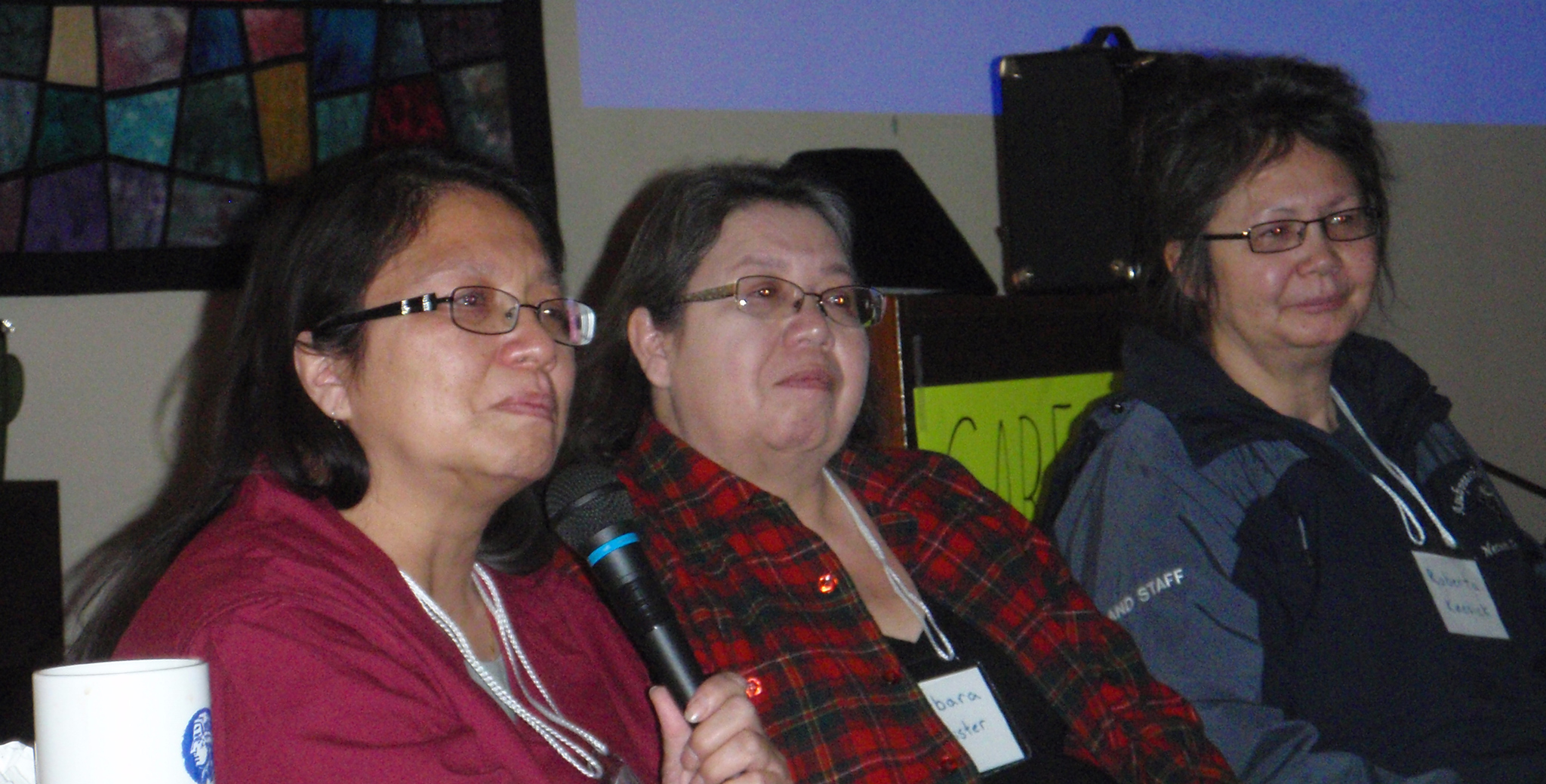
Three Grassy Narrows women took their battle against destruction of their traditional lands to southern Ontario.
“We continue to try and protect the land and our way of life,” said Judy da Silva, who participated in the March 21-26 Voices from Grassy Narrows Indigenous Rights and Our Common Future speaking tour.
Her sisters Roberta Keesick and Barbara Fobister also participated.
“We just follow our instincts in our hearts that says we need to protect the water, the air, the land and our people’s way of life,” da Silva said.
The women spoke to about 500 people in a number of southern Ontario communities including Toronto, Hamilton and Mississauga, about the impacts of forest harvesting and mercury poisoning over the years in their community as well as Weyerhaeuser’s continued logging practices on lands surrounding Grassy Narrows’ traditional territory.
The community set up their blockade in 2002, the longest running blockade in Canada, on a logging road about five kilometres from Grassy Narrows to protest against clear-cutting practices that community members felt were interfering with traditional, constitutionally-protected activities such as hunting and trapping.
The community’s commercial fishing operations were also closed down 43 years ago due to the discovery of mercury contamination in the English River system.
While fishing had been a critical source of both jobs and food for the community at the time, Amnesty International said in an April 2010 press release the people of Grassy Narrows now face pervasive unemployment, widespread and severe health problems, and lingering concerns about the impact of mercury poisoning on this and future generations.
The three sisters also told people on their speaking tour that everyone has a responsibility to the land and how they consume and use products from the earth.
“It is not just our future,” da Silva said. “It is also their future, for their children that they need to make responsible decisions about how they use things from the earth.”
Da Silva was pleased with the response she and her sisters received during the speaking tour.
“The highlight of our trip was the two Grade 6 classes,” da Silva said, describing a school visit in Mississauga. “They had so many questions. When we finished our time with them they still had their hands up. That was good to see at the Grade 6 level, how enthusiastic and motivated they were.”
Da Silva emphasized a question one student asked about what they could do.
“The only thing I could tell them is to think of how you use paper in your classroom,” da Silva said. “Think about how you use things at home.”
While the groups of people attending the speaking tour were different in each location, da Silva described the sessions as “very personal” and “very down-to-earth.”
“We would sit in circles and we’d have a question and answer period,” da Silva said. “It was really a one-on-one kind of dynamics.”
The women also sang songs using their traditional hand drums.
“For the Grade 6 children, it was really fun for them when we sang,” da Silva said. “When we went to each territory, we sang a song for the original peoples of those lands to honour them.”
Gail Lorimer, co-chairwoman of Hamilton/Burlington Kairos, was impressed with the respect people had for the women and their community’s continuing blockade.
“What they are trying to do is a wonderful thing for all of us,” Lorimer said. “We are just in awe of them.”
She said the speaking tour was a good learning experience for those involved.
“We all have to learn to use less products, less paper, less wood, less water,” Lorimer said.


This past month, I was happy to attend two Pow Wows I hadn't been to in years. I attended the Mattagami First Nation Pow Wow and the Matachewan First Nation...
I was happy to see my home community of Attawapiskat on the James Bay coast announce the opening of the new St Francis Xavier Parish Church on August 25....