


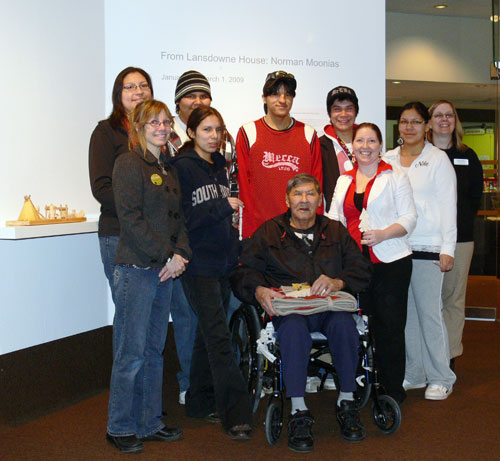
Neskantaga’s Norman Moonias is remembered for his woodcarvings of everyday life in the north.
“He was a great artist,” said his son William Moonias. “Whatever the type of carvings he did was always the way he lived.”
Although Moonias didn’t see much of his father while he was in residential school, he still respected the way he did things.
“He loved the north,” Moonias said. “It was sad to see him come to the city. I know how he missed his way of life.”
Norman Moonias, 89, passed away May 23 from kidney failure at Dawson Court in Thunder Bay with his family at his side. He had been a resident at Dawson Court for about five years after moving to Thunder Bay for health reasons.
Funeral services were held May 26 in Thunder Bay, with burial and internment May 27 in Neskantaga.
Moonias began woodcarving as a hobby in the early 1970s and was introduced to the idea of wood sculpture in 1978 by a visitor to the community.
When he retired from work in 1985, he took up woodcarving full time.
He used cedar for the main part of the carving, poplar for small miniature parts and black spruce for the base. His work involved two major types of sculptures: singular form pieces of birds, fish, beavers and other animals and complex genre sculptures depicting the elements of everyday life, such as utensils, tools, canoes and other campsite objects.
One of his sculptures depicted a beaver family near a fallen tree with the mother beaver teaching her kittens the art of felling trees.
“Every carving had a meaning to it,” said Roy Moonias, former Neskantaga chief and another son of Norman’s. “He used to tell me each carving was a legend of how he survived hunting, trapping and fishing. He loved his traditional land.”
He said his father used to haul freight by canoe to Lake Nipigon and Thunder Bay.
“He used to tell me stories about hauling freight,” Roy Moonias said. “He told me about Gitche Gumee (Lake Superior).”
Norman Moonias explained his sculpture work as capturing the look of an activity almost photographically so it will tell a story about the Anishinabe and their way of life.
“Everything he did was from so-called everyday life,” said Sharon Godwin, director of the Thunder Bay Art Gallery. “You see the sleds and the animals and the birds. They are all from things around him.”
Moonias’ work was first exhibited in the Thunder Bay Art Gallery as part of the February-April 1999 exhibition of The Art of Norman Moonias and Patricia Angeconeb. Those pieces of his work are now included in the Thunder Bay Art Gallery’s permanent collection.
His work was also exhibited in the Thunder Bay Art Gallery from January to March 2009.
His work is also held in private collections.
Moonias was born and raised in Neskantaga and the community’s traditional area, where he lived as a traditional hunter and trapper.
He maintained his traditional way of life using natural medicines and cultural teachings even though he was a devout Roman Catholic. His traditional harvesting area was the Ekwan River, which is now part of the Ring of Fire mineral exploration area.


This past month, I was happy to attend two Pow Wows I hadn't been to in years. I attended the Mattagami First Nation Pow Wow and the Matachewan First Nation...
I was happy to see my home community of Attawapiskat on the James Bay coast announce the opening of the new St Francis Xavier Parish Church on August 25....