


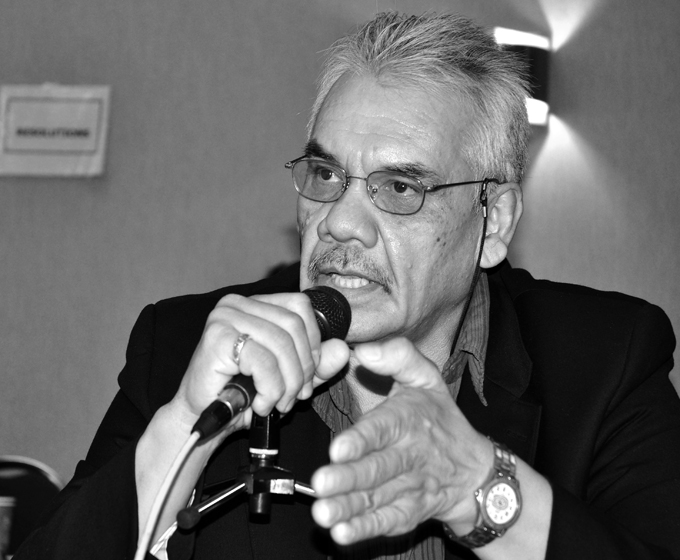
Mushkegowuk Grand Chief Stan Louttit discussed some interesting facts about the James Bay Treaty - Treaty No. 9 during the Nov. 22-24 Nishnawbe Aski Nation Special Chiefs Assembly.
Louttit said policy workers for both Ontario and Canada spent about six to eight months negotiating the Treaty 9 document before it was presented to First Nations people in 1905.
“And they were told by their superiors to take this thing, do not change it despite what the Indians put forward, do not change any part of it and come back with that X,” Louttit said.
The treaty document also includes a taking up clause, he said, which the First Nation leaders at the time were not allowed to see until much later.
According to Louttit, the clause said Aboriginal people can use the land as they have always done, to fish, hunt and trap, but the government of the day has the authority to claim the land at any time for resource development and other uses.
While the clause was written into the treaty, Louttit said it wasn’t translated into the Native language of the leaders signing it.
The latest information was obtained from the diaries of the treaty commissioners, two from Canada and one from Ontario.
“We’re finding the treaty commissioners … said many, many things to our forefathers in regards to the treaty for the purpose of getting that X,” Louttit said. “We know for a fact that the commissioners did not tell our forefathers what it says exactly in the treaty about the taking up clause, about you (First Nations people) can use it but if we (government) want to use it we can take it.”
Louttit said the diaries confirm what the Elders have been saying about the treaty all along, that the treaties are about a spirit of understanding, sharing and collaboration.
“That is very powerful evidence that we are finding and seeing as it relates to the treaty,” Louttit said.
He said the treaty commissioners did not say anything about the taking up clause in their discussions with the First Nations people as the commissioners travelled throughout northern Ontario in 1905 and 1906.
“The diaries confirm all of that,” Louttit said. “That is why we are very excited and we are moving forward strongly in a united way in terms of our understanding about the treaty and what it means now, because it confirms what our Elders have said all along.”
Because the documents shown to Louttit’s grandfather and other chiefs at the time were not what they understood the treaty to be, he said First Nations people need to inform the federal and provincial governments, non-governmental organizations, private organizations and the Canadian public about the treaty so it’s better understood.
“He understood the words that came out of the treaty commissioners,” Louttit said of his grandfather. “And those words are ‘you can always use your land.’”
Louttit said he and a number of Mushkegowuk chiefs recently met with senior Ontario government officials in Toronto to discuss this new treaty information.
“We told this story here, the real agreement as orally agreed to, and they were quite interested because they didn’t really know about this,” Louttit said. “So what comes out of that, what do we do? One of the things we said is we need to continue that dialogue, we need to continue that conversation in regard to the treaty.”
Louttit said the Ontario government officials have agreed in principle to keeping the conversation going.
After meeting with Ontario, Louttit also approached the federal government and agreed to meet with them in Ottawa.
Louttit said the Mushkegowuk legal team has also prepared a statement of claim to take Ontario and Canada to court because the treaty was not properly presented to the chiefs.
“So we’re developing a legal claim, we are reviewing it, we’re thinking about it, our communities are doing their own analysis of it,” Louttit said. “At the end of the day we may be in a position hopefully that we may have a united approach and move forward.”
Louttit said the claim involves a test case with one individual, whose historic territory handed down to him from his parents currently has a number of claims and activities taking place on it.
“We feel that particular case is a good one, it’s a strong one,” Louttit said. “The reason we feel that way is because if we look at the real agreement that we orally agreed to, if those things are going on in that particular area, the person who is named in the test case cannot hunt, cannot fish, cannot trap as in the days of yore.”


This past month, I was happy to attend two Pow Wows I hadn't been to in years. I attended the Mattagami First Nation Pow Wow and the Matachewan First Nation...
I was happy to see my home community of Attawapiskat on the James Bay coast announce the opening of the new St Francis Xavier Parish Church on August 25....