


First Nations downriver from four proposed Northland Power Inc.-Constance Lake hydro projects on a tributary of the Albany River are raising concerns about potential impacts on water quantity and fish and wildlife.
Chiefs from Fort Albany and Kashechewan say their communities have not been consulted or involved in the ongoing plans to build new dams on their river system, despite the effects they will eventually see downstream.
“They have to involve us,” said Kashechewan Chief Jonathan Solomon. “We’re downstream here — we’re already feeling the consequences of past projects that have happened in our tributaries. No matter how small those rivers may be, that water goes towards the Albany River.”
Solomon said past projects on tributaries of the Albany River have impacted the river and his community, noting water has been diverted from the Albany River system to power hydro-electric generating stations on Lac Seul and upstream and downstream of Lake Nipigon.
“What kind of impacts does it have on the fish and the wildlife?” Solomon said. “The sad part is that we have no say and are not involved. We have been negatively impacted. Why is there mercury in the fish; why are the sturgeon in a state of disappearing?”
Solomon also stressed the low water levels on the Albany River over the last three summers.
“Sometimes people walk across the Albany,” Solomon said. “The river may be up to their knees — that’s about it in some areas.”
From page 1
Solomon said a well-used shortcut to nearby Fort Albany is no longer passable during the summer.
“I remember cruising in that shortcut with no problems,” Solomon said. “In the summer, all you see is gravel and rocks on that channel now. There’s no water.”
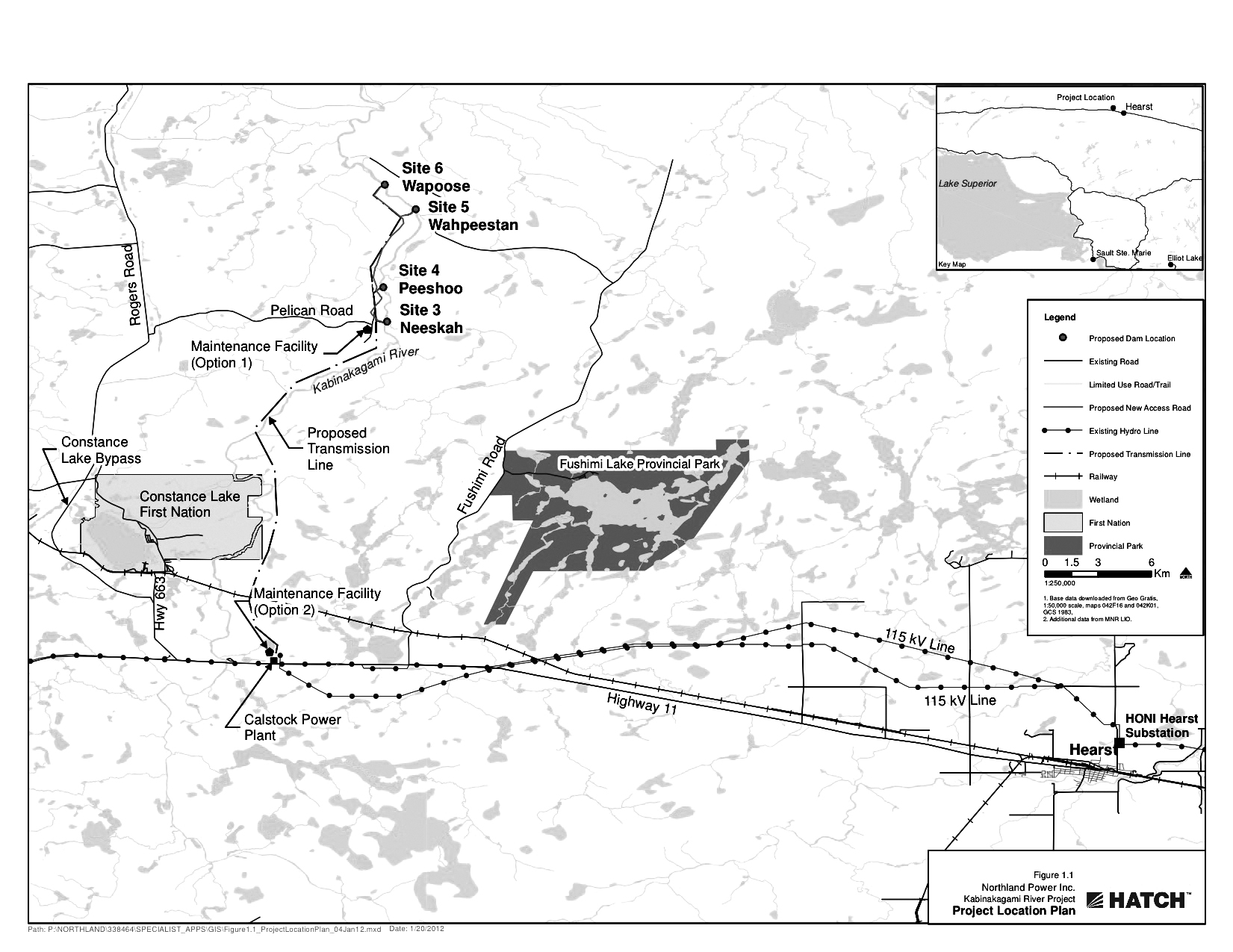
Northland Power and Constance Lake are proposing to build and operate four 6.5 MW run-of-river hydro-electric generating stations, through a 50-50 partnership, along the Kabinakagami River about 30 kilometres west of Hearst.
Notice of the start of an environmental assessment was filed Dec. 14, 2011 by the Canadian Environmental Assessment Agency.
Each generating station will consist of an earth-fill dam with head ponds ranging from 6 to 43 hectares, a 50 or 70 metre concrete overflow spillway, a powerhouse and intake and tailrace channels. Each powerhouse will contain two pit-type turbine 3.25 MW generating units.
“These projects represent responsible use of our natural resources and will be an important source of income for Constance Lake through their long-term ownership interest,” said Northland Power CEO John Brace in an April 2010 news release.
The proposed hydro project was among the contracts awarded to Northland Power by the Ontario Power Authority under the Ontario government’s Clean Energy Act’s Feed-in-Tariff program to build 216 MW of renewable green energy projects.
Members of the Paquataskamik Project in Fort Albany also raised concerns about how the proposed hydro project would impede their community’s culture project, which has been conducting cultural and educational activities on the watershed for more than four years.
“The water level has dropped for at least the past 15 years now,” said Meshan Sutherland, Paquataskamik Project coordinator. “Another dam on the tributaries of the main river will obviously affect us in terms of our summer travels and we’re not sure what contaminants or pollutants will flow down in our area.”
Sutherland said plans under the Paquataskamik Project to educate the youth about the land and its importance were affected by the low water levels this past summer.
“We couldn’t pull it off so we just hung around the nearby community,” Sutherland said.
The low water levels are also affecting the way of life for community members in Kashechewan.
“Going up the river is challenging because of the rapids,” Solomon said. “The fishing is impacted because people don’t have access to their fishing site anymore because the water is just too fast and too powerful because of the rapids.”
Solomon said the low water levels have also caused problems with the gathering and transportation of dry firewood from further up the Albany River for use during winter.
“We can’t even do that anymore,” Solomon said. “A lot of people just cut green wood during the wintertime and dry them up during the summertime.”


This past month, I was happy to attend two Pow Wows I hadn't been to in years. I attended the Mattagami First Nation Pow Wow and the Matachewan First Nation...
I was happy to see my home community of Attawapiskat on the James Bay coast announce the opening of the new St Francis Xavier Parish Church on August 25....