


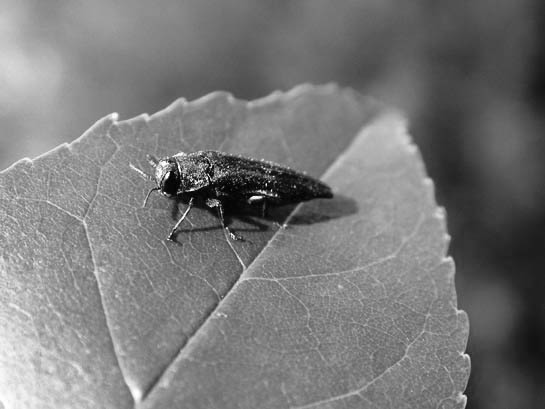
Do not move firewood into or out of your area.
That is the main recommendation to stop the introduction of the invasive Emerald Ash Borer, which has destroyed more than 20 million ash trees in southern Ontario since 2002.
“Emerald Ash Borer is an invasive beetle that attacks and kills healthy ash trees,” said Brad Wesley, forestry information officer with Grand Council Treaty #3. “Although it has not been detected in northwestern Ontario, the Emerald Ash Borer is as close as Sault Ste. Marie and St. Paul, Minnesota, and spreading.”
Wesley organized a May 17 Emerald Ash Borer branch sampling training session in Kenora, with support from the Ministry of Natural Resources and the Emerald Ash Borer Task Force – Northwest Region.
“They have attempted to battle it in southern Ontario unsuccessfully and it is spreading,” Wesley said. “It’s being spread by people moving firewood.”
Wesley said the Emerald Ash Borer lays its eggs on ash trees, which then hatch into a larval stage that feeds on the ash tree’s inner bark, eventually killing the tree by cutting off nutrients.
“In Treaty #3 we have an old stand of ash trees that go from Fort Frances all the way to the Aulneau Peninsula, just south of Kenora,” Wesley said. “There are a lot of reserves that are going to be impacted, if and when that beetle makes its way through this area.”
Wesley said an infestation would definitely have an impact on traditional forest users.
“They will probably have to destroy the (infested) tree, cut it down and burn it,” Wesley said.
Traditional uses for black ash trees include snowshoe construction, canoe building and other traditional crafts and tools.
Black ash stands are also valued for the medicinal plant species they support.
Wesley said a serum has been developed to save ash trees from infestation, but it is expensive.
“It will cost $200 a tree, so that is not really feasible,” Wesley said. “They are testing the serum in southern Ontario and it does work, but it is just not financially viable.”
About 16 people attended the training session, which included an overview of the Emerald Ash Borer life cycle, its current situation in Ontario and a demonstration of branch sampling techniques used in the field for early detection.
Thunder Bay Mayor Keith Hobbs proclaimed the second Saturday of May as Emerald Ash Borer Awareness Day, noting the insect is most often spread when firewood is moved from an infested area to a non-infested area.
People are encouraged to stop moving firewood, to use local firewood and to burn it on site.
Thunder Bay could lose up to 25 per cent of its street trees as well as an unknown number of park trees and privately owned trees, if the beetles make it to the city.
Initially discovered in Detroit, Michigan in 2002, the Emerald Ash Borer is an introduced pest from Asia that attacks all species of ash (Fraxinus) trees. Mountain ash is not a true ash species, so it is safe from the infestation.


This past month, I was happy to attend two Pow Wows I hadn't been to in years. I attended the Mattagami First Nation Pow Wow and the Matachewan First Nation...
I was happy to see my home community of Attawapiskat on the James Bay coast announce the opening of the new St Francis Xavier Parish Church on August 25....