


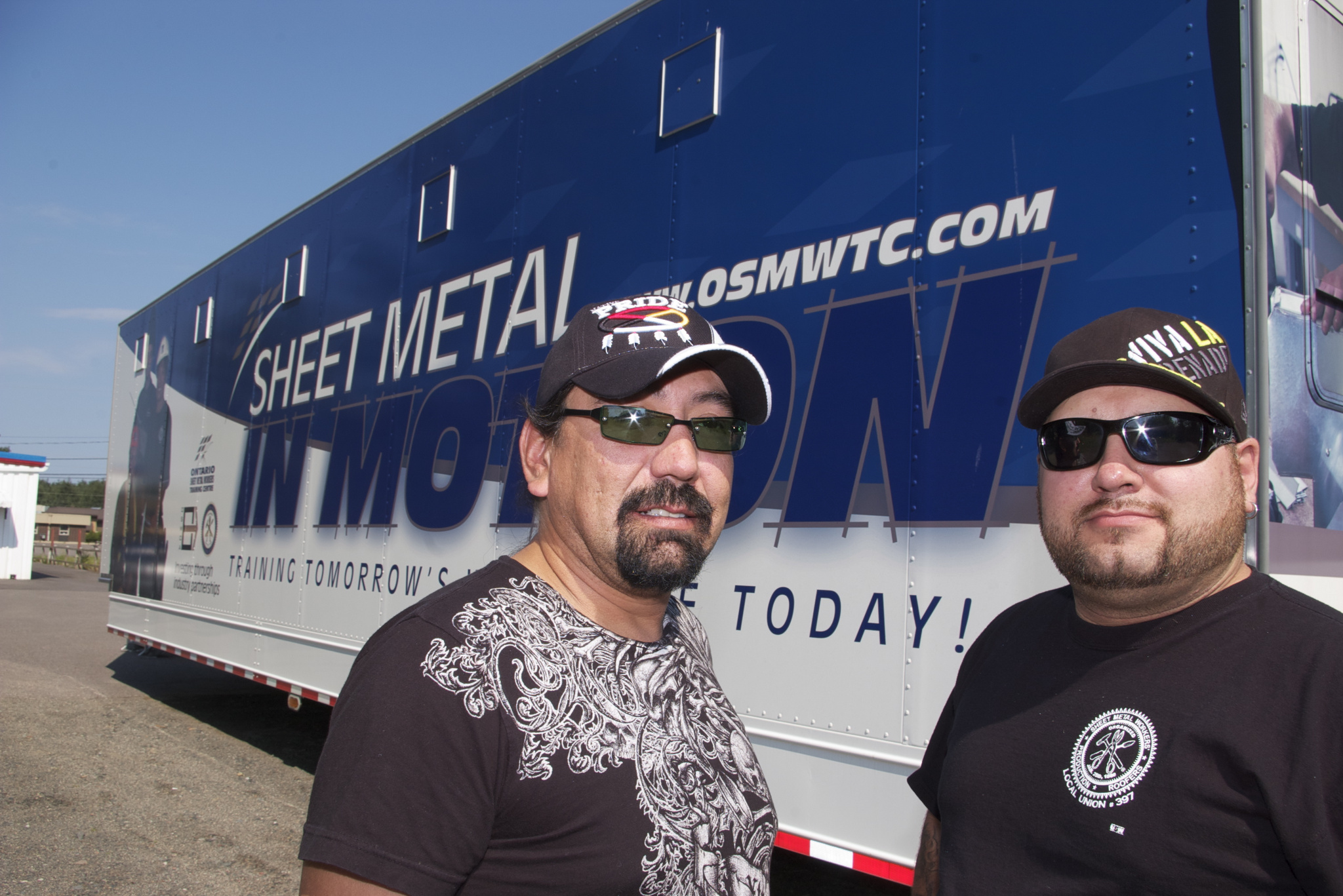
Sheet Metal Workers Local 397 has been busy over the past year signing up First Nation workers for high-paying union jobs across the north.
“I did an eight-month term in Detour Lake and I’m back there again with a different company,” said Jeordi Pierre, a Fort William band member who signed on with the union about a year ago.
“I came in green with no prior experience. There were three Aboriginal workers that went up, myself included, and it was a very good experience.”
While the Detour Lake gold mine job was a good experience for Pierre, he did feel some “pain and suffering” while getting used to sheet metal work.
“But after you got into a rhythm, it was all OK,” Pierre said. “It was a little bit physical. You were walking steel sometimes — you’re up at 130 feet up in the air sometimes — so you’ve got safety on the top of your game every day.”
Pierre appreciated the high population of Aboriginal people at the location where he was working.
“It’s kind of comforting when you are with your own people,” Pierre said.
Sheet Metal Workers Local 397 has signed on about 16 Aboriginal union members from a number of communities, including Shoal Lake, Couchiching, Fort William, Lake Helen and Sand Point, since a First Nation liaison was hired about 10 months ago.
“We have five guys currently working on the Detour Lake gold project,” said Dennis Renaud, the union’s First Nation liaison.
Renaud said First Nation union members have an opportunity to work anywhere in North America once they are a certified sheet metal worker.
“It’s a transferable skill set that you gain with our union,” Renaud said. “Our union hall is 100 per cent name hire, which means that if you work hard, you’re never laid off. The harder you work, the more work you get.”
Renaud encourages First Nation communities to use unionized companies to build their projects so any community members working on the project will have an opportunity to continue working in construction once the project is completed.
“I want to see (Aboriginal) people get long-term employment, get long-term jobs,” Renaud said.
Pierre feels good about the work he has done so far at the Detour Lake mine site, noting he has installed the deck, flooring and cladding in nine buildings.
“It’s big time satisfying,” Pierre said. “You see all the walls that you put up and then when you step inside you see all the decking you put on and there’s concrete on it now.”
During his first job at Detour Lake, Pierre worked for three straight weeks of six 10-hour days with one week off.
His latest job at Detour Lake still has the same three weeks on and one week off schedule, but the weeks are now seven days at 12 hours per day.
“I just got back from 21 days straight,” Pierre said. “We get seven days off and it’s a 12-hour drive for us, so we actually only have five days off.”
Pierre appreciated having a First Nation journeyman teaching him some of the different aspects about sheet metal work.
“There was lots to learn and we’re still learning,” Pierre said. “It’s a good opportunity for our people to get into the trades and the construction business, with all the work going on around northwestern Ontario.”
Pierre had previously worked in cultural-type activities around Thunder Bay before joining Sheet Metal Workers Local 397.
“Those hours weren’t that steady for me, so it’s good to have something more steady,” Pierre said. “The pension for ourselves is pretty good and we’re putting lots of money away for ourselves for the future.”
Pierre is also advancing quickly through the union ranks due to the long hours he has been working.
“We’ve been stepped up to the next stage, which is material handler,” Pierre said. “We’re actually doing the work of the assistant sheeter now.”


This past month, I was happy to attend two Pow Wows I hadn't been to in years. I attended the Mattagami First Nation Pow Wow and the Matachewan First Nation...
I was happy to see my home community of Attawapiskat on the James Bay coast announce the opening of the new St Francis Xavier Parish Church on August 25....