


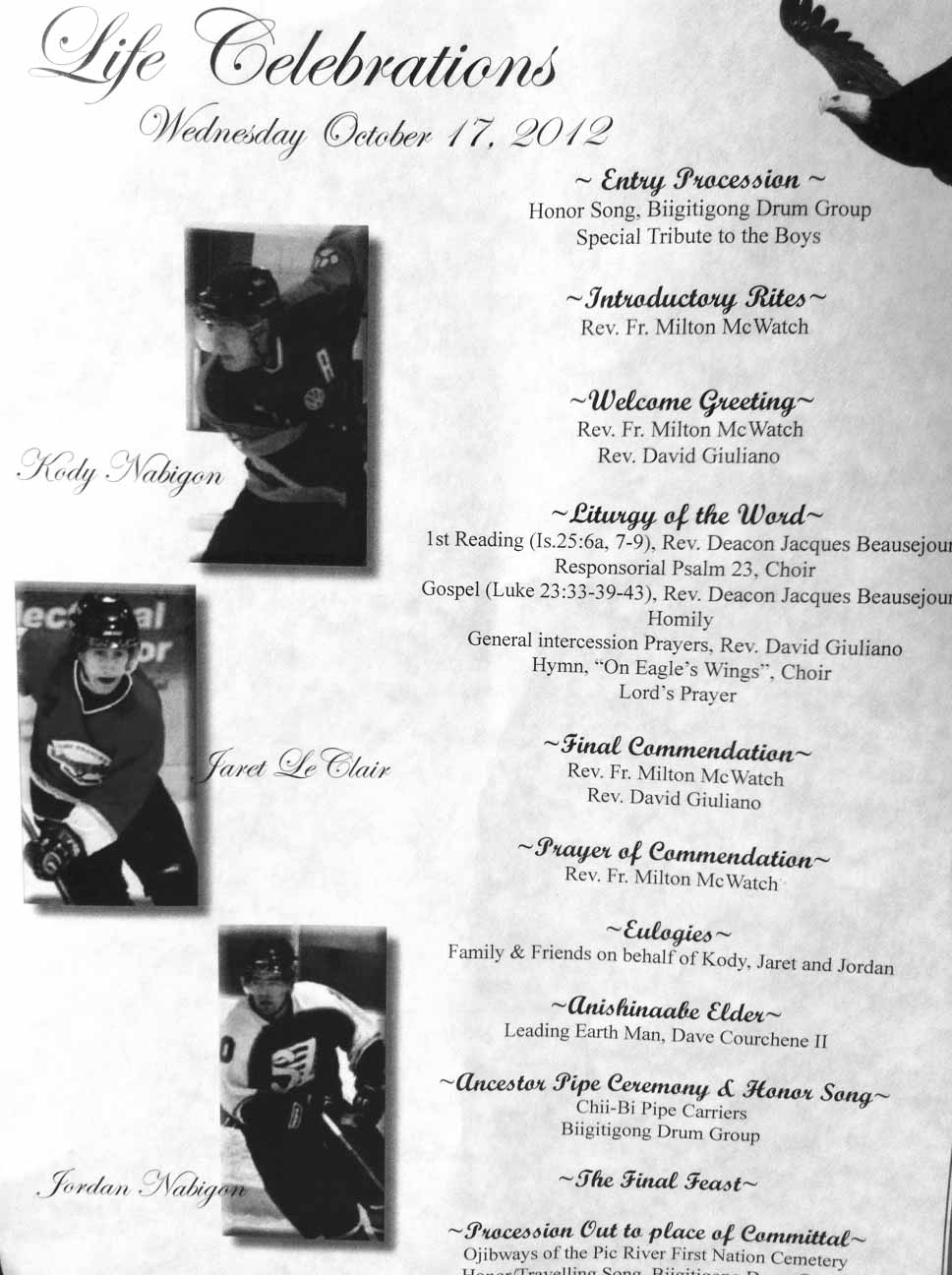
Jaret LeClair’s excitement after setting up the first goal in last year’s SIJHL finals is entrenched in the memory of his coach and general manager.
“It was game one in Wisconsin — obviously they were undefeated at home until that time,” said Wayne Strachan, head coach and general manager with the Fort Frances Lakers. “Jaret’s line had scored the first goal.”
Strachan recalled the incident during the Oct. 17 funeral for LeClair, 20, Jordan Nabigon, 22, and Kody Nabigon, 17, who passed away in an Oct. 7 car accident. The funeral for Greg Nabigon, a 36-year old father of four from Pic River who also passed away in the accident, was held on Oct. 20.
Strachan emphasized the hard work LeClair put into getting the puck out to the front of the net for his teammate to score at 5:35 in the second period.
“And then his excitement and just the expression on his face of how pumped he was for us to get the lead down there and then obviously win the hockey game was something that sticks in my mind,” Strachan said. “Once he put his skates on and stepped on the ice, he did whatever it took to help the team have success.”
Strachan said LeClair was known for standing up for his teammates, but he could also get his team going by scoring a big goal or delivering a big hit.
“He was obviously a very fierce competitor,” Strachan said. “He could shut down an opponents top line; he was definitely one of the best penalty killers in the league.”
Strachan said it was “just awesome” to see the turnout of about 950 people at the funeral at the arena in nearby Marathon for the three youth.
“Obviously, not only Jaret but the other two young men, the Nabigon boys that have passed away, really touched that community in some way and had a lot of friends and family that are going to be missing them,” Strachan said.
The three youth, who all played hockey in a number of communities across northern Ontario, passed away after their car collided with a pickup truck driven by Greg Nabigon, who is well known on the powwow trail, on Hwy 627 near Pic River.
Three Fort Frances Laker staff members and four players paid their last respects along with Strachan at the funeral.
Pic River Chief Roy Michano said the hockey players’ salute with their sticks raised to the sky as the pallbearers carried the three coffins out of the arena was “indescribable.”
“I cannot begin to describe the emotions that took place,” Michano said. “Unreal, beautiful, sad. It is an unreal network of people who connected with us in regards to these beautiful young men.”
Michano said the deaths shook his community, but when he saw all the sacred fires being lit in the community, he knew the spirit was with the community.
“After a whole year-and-a-half of funerals, this one was a shocker because the previous ones were of people dying of natural causes,” Michano said. “But when you get four young men going, it was just unreal.”
Michano said the deaths of the three hockey players hit municipalities throughout the area, not just Pic River’s community of about 800 people.
“It was difficult, but it was very interesting to see the support that occurred both within the church groups and within the traditional areas,” Michano said. “Sacred fires are done here to allow the deceased to make their struggles and journey towards the west for three days. On the third day they return back towards the eastern direction to come home. Then they are ready to be put into the resting place at the cemetery.”
Michano said the community is holding up “very well,” as circles are being held and support is being provided for those who lost loved ones.
“This is so beautiful in the Anishinabe world,” Michano said. “We don’t leave them to grieve alone.”
Michano said the grieving process usually takes about two weeks.


This past month, I was happy to attend two Pow Wows I hadn't been to in years. I attended the Mattagami First Nation Pow Wow and the Matachewan First Nation...
I was happy to see my home community of Attawapiskat on the James Bay coast announce the opening of the new St Francis Xavier Parish Church on August 25....