


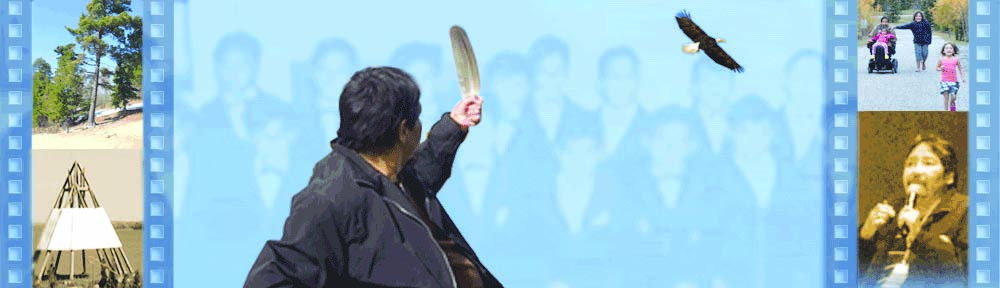
Lac Seul’s Garnet Angeconeb is looking to create more awareness of the residential school issue through the launch of a new website — www.garnetsjourney.com.
“Even though it’s been in the news and an issue that is well known, there is still a lot of work to do to create awareness,” said Angeconeb, an Aboriginal Healing Foundation board member who disclosed in the 1990s the sexual abuse he suffered in residential school. “I bet you that the average Canadian you meet on the street probably doesn’t know anything about the legacy of the Indian residential school system, nor have they ever met a survivor of the system in person.”
Angeconeb is also looking for people to use the website to engage and dialogue about the residential school issue, whether they are lawyers working in the court system, healthcare professionals working with residential school survivors and descendants of survivors or anyone who is affected by the residential school legacy.
“It is also for young people so they understand their history,” Angeconeb said. “I think it’s good for all Canadians so that we know our collective path and so we can better understand one another in terms of our relations in Canada between Aboriginal and non-aboriginal people.”
Through a combination of journalism and oral history, the website provides an opportunity for Canadians to meet a residential school survivor and hear his life story in his own words.
“We engaged Ashley Wright, a journalist, to gather stories or to document my story by me telling my history or my life story in relation to the residential school and how it affected me, my family and my community,” Angeconeb said.
Angeconeb first met Wright in 1989 at CBQ Radio in Thunder Bay. Wright has since covered many First Nations stories and is now a journalism instructor at Algonquin College and Carleton University.
“Many Canadians have never met a person who went to residential school, but after you visit this site, you’ll feel you know Garnet personally,” Wright said.
The website begins with a 21-minute mini-documentary about Angeconeb’s journey from the trap line to residential school to today.
“I know that this is totally impossible, but I would give anything if I could turn the clock back,” Angeconeb said in the mini-documentary. “And continue on from where the residential school system interrupted a way of life. I would give anything to get that back.”
About 150,000 First Nations and Aboriginal children were taken from their families during the 1800s and 1900s by the federal government and sent to residential schools operated across Canada by a number of Christian denominations, including the Catholic, Anglican, United and Presbyterian churches.
“We hear many people say get over it already, get over the residential school, move on,” Angeconeb said. “Well, it’s not that simple. One of the (mini-documentary’s)purposes is to help create that awareness that the legacy of the residential school lives on today with the younger people.”
Angeconeb said the “bug” that destroyed the souls of many of the residential school survivors is still alive in terms of its intergenerational affects in the Aboriginal community.
“We are working at healing, we are working at restoring what we lost in terms of our ways, our values, our thinking,” Angeconeb said. “It’s called healing, and healing leads to reconciliation, so the purpose of the (mini-documentary) is to point those things out.”


This past month, I was happy to attend two Pow Wows I hadn't been to in years. I attended the Mattagami First Nation Pow Wow and the Matachewan First Nation...
I was happy to see my home community of Attawapiskat on the James Bay coast announce the opening of the new St Francis Xavier Parish Church on August 25....