


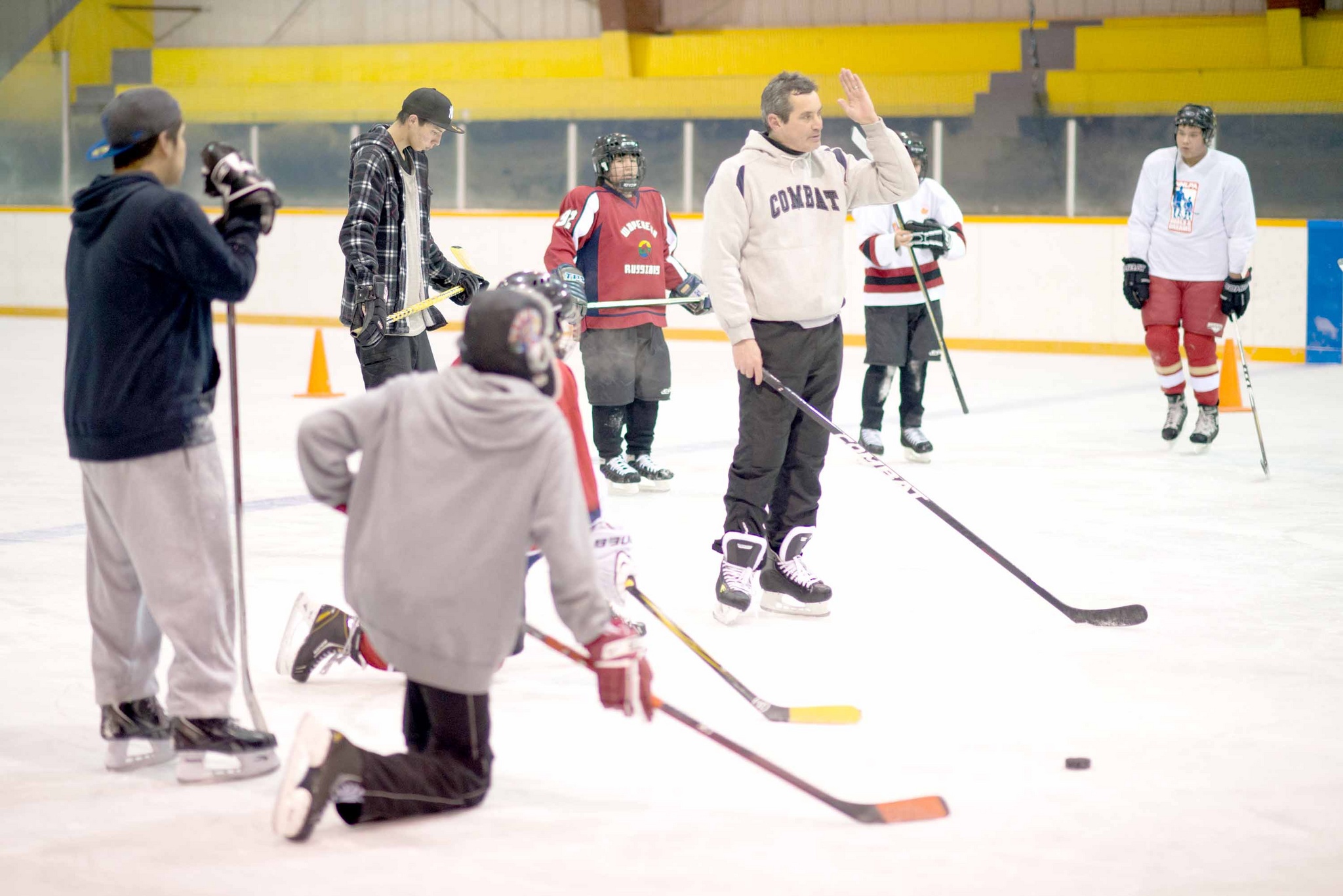
Youth in northern Ontario had the opportunity to enhance their hockey and leadership skills during Right to Play’s hockey camp tour of Attawapiskat, Webequie, Sachigo Lake and Kitchenuhmaykoosib Inninuwug (KI).
Right to Play, an international organization that uses sports to educate and empower youth facing adversity, brought its Hockey for Development program to the northern communities along with a former NHL player and an Olympic gold medalist.
The program made its first stop in Attawapiskat prior to the Christmas holidays, said Lauren Simeson, sport for development manager at Right To Play,
“Attawpaiskat is full of kids,” Simeson said, noting that 150 kids took part in the program. “They all have equipment. Their on-ice skill is amazing. They’re really talented hockey players.”
John Chabot, a former NHL player and member of Kitigan Zibi Anishinabeg First Nation in Quebec, facilitated the camp.
The program then made its way to Webequie, where about 100 youth took part in the camp led by Sami Jo Small, a two-time Olympic gold medalist with the women’s ice hockey team.
In Sachigo Lake, 100 local youth were joined by about 20 from Muskrat Dam.
“We’re bringing communities together and working together and encouraging them to bring their kids together to do more things,” Simeson said.
In early February, the program was in KI, where 70-80 youth took part. They also received 50 sets of equipment thanks to a partnership Right to Play has with NHLPA’s Goals & Dreams Fund. The equipment was theirs to keep following the program.
Simeson said the first day of the program is introductory and opens with a family skate. Then the youth take part in structured practice sessions before a full scrimmage on the last day. And the youth are usually divided up by age group, which ranged from four-years-old to the mid-20’s.
Simeson said the change in the youth’s skill development and mentality throughout the camp is noticeable.
“They enjoyed different drills and stick handling,” she said. “And you see a lot of
leadership where the older youth work with younger kids. And there’s a lot of encouraging remarks, a lot of teamwork.”
The youth also learned some life skills along the way.
“Leadership, cooperation and teamwork: they’re all inherent through sport,” Simeson said.
The program also included off-ice sessions, such as leadership skills, team building, and goal setting activities.
In KI, there were also seven adults that took part in a coaching workshops and who are on their way to be certified coaches with Hockey Canada.
It is the third year the program has been in north. It was previously in Pikangikum, Moose Cree, Wapekeka, Sandy Lake and Marten Falls.
The Hockey Development program is part of a larger program called PLAY (promoting life skills in Aboriginal youth), which is offered in 45 First Nation communities in Ontario.
PLAY employs a community mentor in each community and includes two core programs in youth leadership and after-school programming, the latter often led by youth.


This past month, I was happy to attend two Pow Wows I hadn't been to in years. I attended the Mattagami First Nation Pow Wow and the Matachewan First Nation...
I was happy to see my home community of Attawapiskat on the James Bay coast announce the opening of the new St Francis Xavier Parish Church on August 25....