


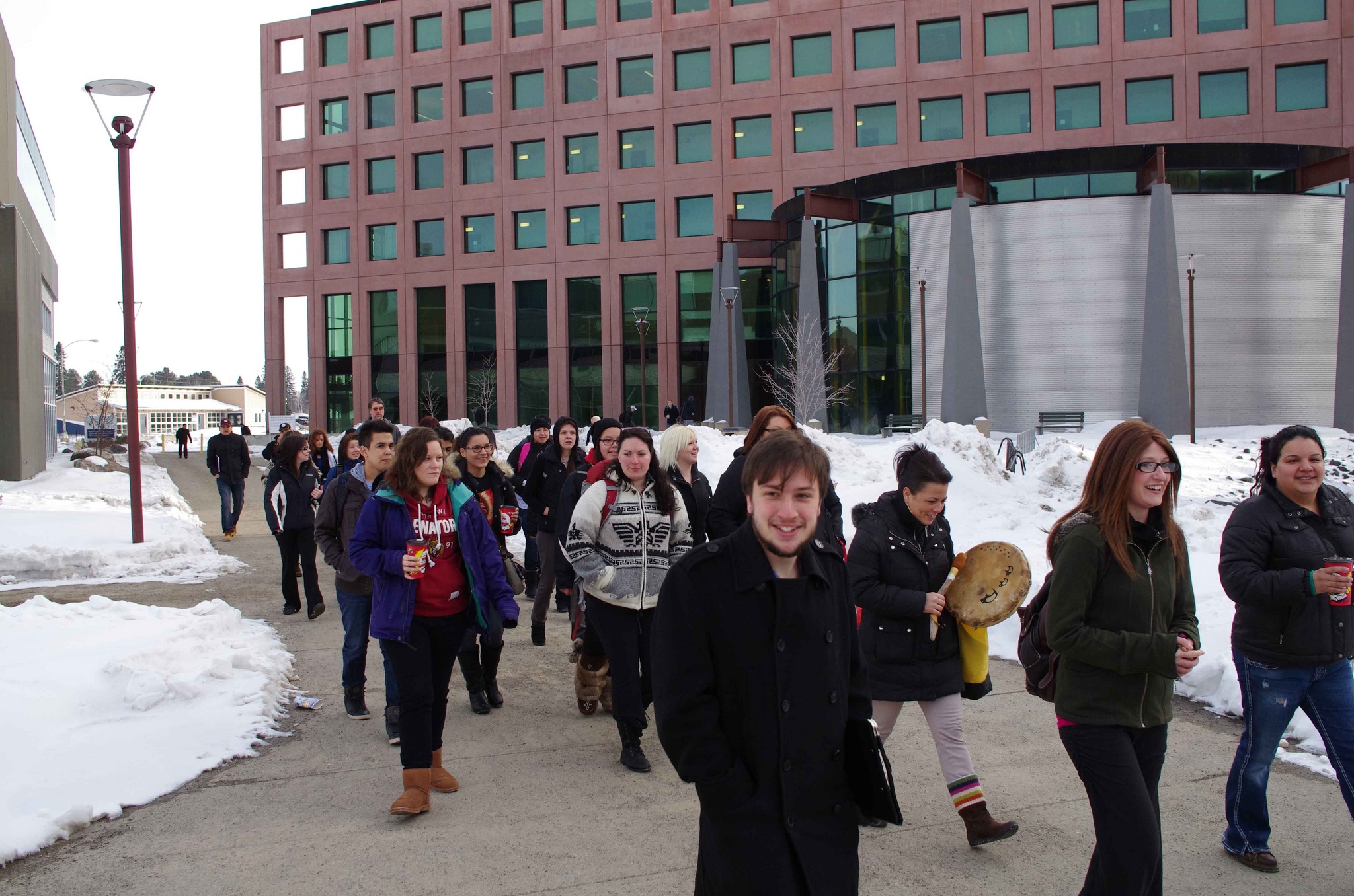
Lakehead University students have raised concerns about changes to the Faculty of Law’s indigenous course, saying the changes will reduce the new program’s focus on indigenous issues.
“The course before this change would have been taught by Indigenous Learning faculty and now it’s taught by law faculty,” said Sebastian Murdoch-Gibson, an Indigenous Learning student.
“Before they made this change, it would have been a full credit — now it’s a half credit. It would have focused on the law and other institutions of western civilization through the perspective of First Nations, whereas now it focuses on First Nations through the perspective of the law, which is a major distinction.”
Murdoch-Gibson said the students are planning to hold a meeting on the morning of Feb. 25 at the University Centre Agora, including a visit to LU President Brian Stevenson’s office.
The dean of the faculty of law, however, argued that the changes would make the course better suited for law students.
“My understanding is that the students, mostly from the Indigenous Learning program, wish to have it as an Indigenous Learning course taught in the law school,” said Lee Stuesser, founding dean of LU’s Faculty of Law. “It’s our view from the Faculty of Law that it’s better to be taught as a law course — that it gives the course a larger measure of credence and it stamps our position that we think this is so important in terms of being in the law program that we want it as a law course.”
Stuesser added that having the course taught by full-time members of the law faculty helps to develop the faculty’s “Aboriginal base.”
The Indigenous Learning course was called Native Canadian World Views while the Faculty of Law course is called Native Canadian World Views and Law.
Stuesser said the Indigenous Learning course is a second-year undergraduate university course while the new course is a law course.
“We’re talking about students that are on average 24 years of age — all have a degree, most have an honours degree, many have masters degrees, so you can see there is a different audience here that we are dealing with,” Stuesser said.
Stuesser said the Faculty of Law is the only law school in Canada that has a standalone, mandatory Aboriginal course in first year.
“Not only that, it has the same standalone mandatory course in second year,” Stuesser said. “And we’re very proud of that. There’s no attempt here at watering down. In fact, it’s the reverse: we want to enhance the presence of Aboriginal law within the program.”
Stuesser said the program was changed to a half credit to accommodate the inclusion of a criminal law component that had not been in the law school’s proposed curriculum that was originally accepted by the Federation of Law Societies of Canada in 2011.
“We had to make some changes and property law was one course that I felt we could cut from six credits to three,” Stuesser said. “And then we took a good look at the Native Canadian World View course and I thought it could run very well as a half course, complementing at the same time, a course called Foundations of Canadian Law, which is the western perspective. We’ll see the Aboriginal perspective in the one and the western perspective in the other.”
Stuesser said the Faculty of Law also integrates Aboriginal issues into all of its courses.
The inaugural class at LU’s law school starts in September 2013. The school is the first new law school in Canada in 42 years.


This past month, I was happy to attend two Pow Wows I hadn't been to in years. I attended the Mattagami First Nation Pow Wow and the Matachewan First Nation...
I was happy to see my home community of Attawapiskat on the James Bay coast announce the opening of the new St Francis Xavier Parish Church on August 25....