


As Aboriginal people continue to represent a disproportionate number of the prison population across Canada, First Nations communities and tribal councils are trying to find ways to bring the numbers down.
One tribal council in northern Quebec has found success by establishing its own justice and corrections department.
It took more than 30 years, but in 2008 the Grand Council of the Crees (Eeyou Istchee) finalized the agreement on its own Department of Justice and Corrections.
The department’s mission statement asserts that its purpose is to “represent the people it serves, help create the conditions for safe communities and harmonious relationships, and ensure that fundamental justice rights and practices are protected.”
The department arose out of the historic James Bay and Northern Quebec Agreement, which was signed in 1975. The agreement called for compensation of the James Bay Cree and Inuit communities in northern Quebec that would be affected by the James Bay Hydroelectric Project.
While the agreement allowed for increased support or establishment of departments in the areas of economic development, education, local government and health and social services, Section 18 – which covers justice – went largely unimplemented until 2007.
“It was supposed to be on building facilities, ensuring people who came into our territory knew the Cree ways to ensure any delivery of justice respected that,” said Donald Nicholls, director of the department and a member of Mistissini Cree Nation who was born in Moose Factory.
It also called for more programs and services for the nine Cree communities along with the establishment of a judicial advisory committee.
In 1998, Nicholls was hired to be the first coordinator of justice but it did not meet the criteria set out in the agreement. In 2002, Nicholls said the council renewed its relationship with the province and the parties reexamined parts of the agreement that was unimplemented, which was mostly in the area of justice.
In May 2007, they signed an agreement with Quebec and established the judicial committee, which is composed of members of the province and the Cree nation, before establishing the department the following year.
One of the key points raised was to build a justice centre in each community, which would employ local members and have its own community justice officer. Originally the centres would only hold criminal courts but it was augmented to have civil trials and arbitrary hearings.
“We’re able to offer what every legal system can offer,” Nicholls said, adding that construction on the last centre will be completed in the summer.
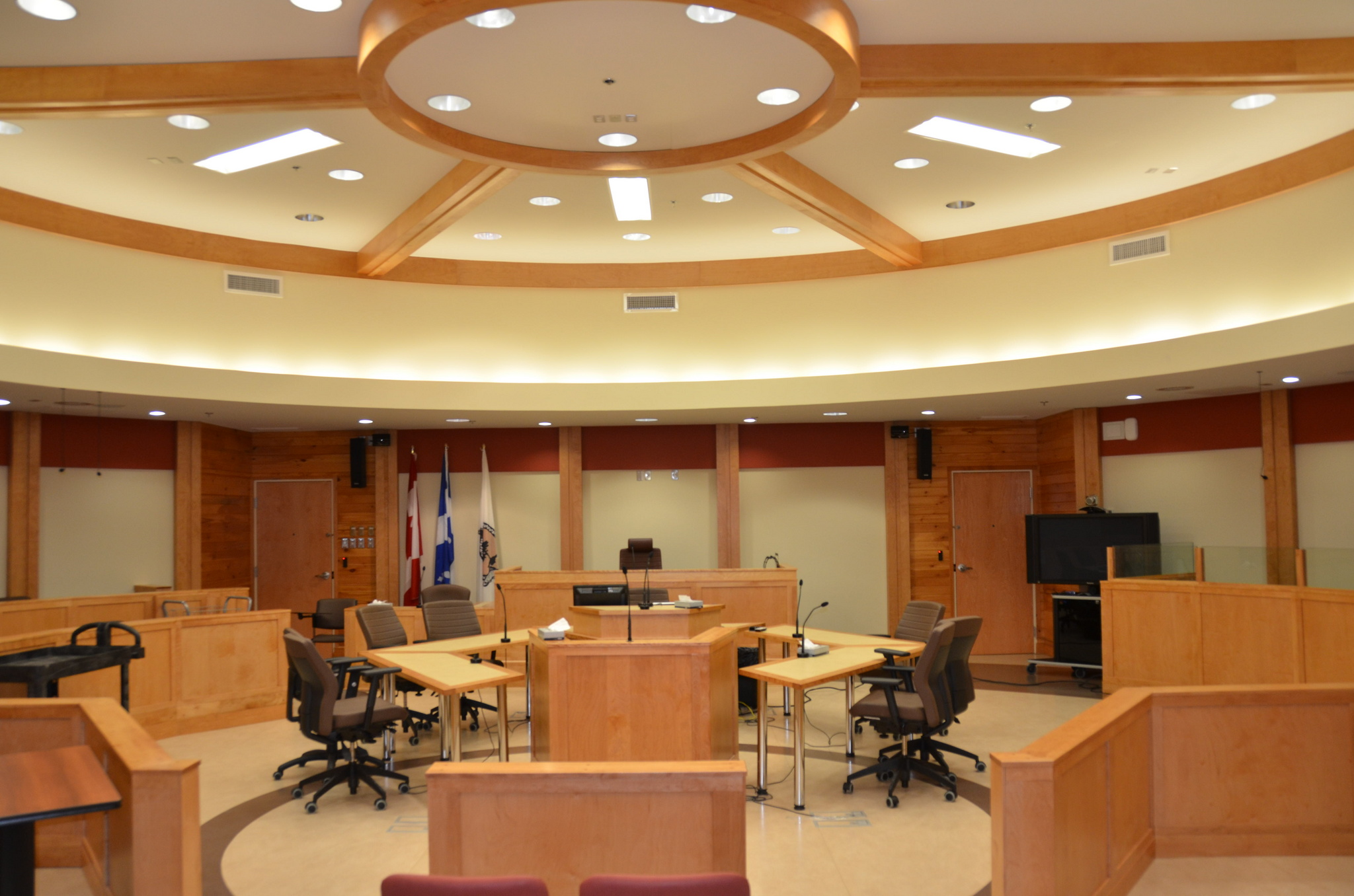
The centres were designed to have elements of Native traditions.
The department invited Quebec’s minister of justice to attend the opening of one centre and the minister was bewildered at the design of the courtroom.
“He said, ‘how do my judges judge in here?’ And I said, ‘what do you mean? We hold court in here all the time,’” Nicholls recalled. “He said, ‘Yes, but I’ve never been in a round courtroom before.’”
Nicholls explained to the minister that the circle is an important part of Native traditions.
“No issue gets trapped in a corner,” said Nicholls. “It’s a flow and there’s a sense of respect. For us to put that element in, it was important. It represents us.”
The council also designed its mediation rooms to be oval.
“So our courtrooms are pretty unique,” Nicholls said.
To develop programs, the department toured the institutions that held their members.
“We found that there was a language barrier,” Nicholls said. “And so we found that our members could not to go into rehabilitation programs, academic upgrade, anger management, and what have you.”
The department worked to ensure that all Cree members would have access to translators.
“It was important we get into the detention facilities to ensure they were processed and treated right,” Nicholls said.
One of the first programs the department developed was the Jobs Not Jails program.
“We did a number of intakes where whenever a Cree member was going into a facility, we asked them about their background,” Nicholls said. “We wanted to get a full picture, and we asked, if you weren’t here, where would you like to be?”
The department processed over 140 intakes in one year to develop the program. They then contacted local businesses about employing members who have been released.
Another program is the traditional foods program, where the department approached detention centre administrators to bring traditional foods to the Cree inmates at least four times a year.
The administrators said there were complaints from the prison population that the Cree members had an “extra benefit” but the department said it is not a benefit but a part of rehabilitation.
“We want to remind them that they are not forgotten, that they are still part of the community,” Nicholls said. “The land is healer. If they can’t go out on the land, we can at least bring the land to them.”
The department also brought in the Stop Now and Plan (SNAP), a program targeted at children ages 6-11 who have violent or aggressive tendencies.
Developed in Toronto, SNAP is used in various parts of the world and is usually implemented in large urban areas, but Nicholls said the department insisted on trying the program in their communities.
If a community member, teacher, or police officer identifies a child to have aggressive tendencies, they can be referred to the program. The child is taught life skills to deal with emotions.
Since it was implemented three years ago, Nicholls said it has shown to be effective.
“When we talk to principals and schools, they tell us children used to come in 10-15 times a month and now they never see them again,” he said.
Nicholls said it is difficult to gauge exactly how successful the department’s services and programs have been since they do not have the data to compare incarceration or arrest rates.
But he feels the department has made a lot of headway since its inception.
“Since it’s founding, it’s been an enormous success in providing services to the communities and getting implementation in improving the support that’s there,” Nicholls said.
He said one of the reasons for that success was because the department employs many community members.
“It’s predominately Aboriginal, which is very rare,” he said. “The majority of the staff are from the communities themselves.”
“I think that largely, for the foundation we built, and the enhanced service delivery, we’ve been successful so far.”



This past month, I was happy to attend two Pow Wows I hadn't been to in years. I attended the Mattagami First Nation Pow Wow and the Matachewan First Nation...
I was happy to see my home community of Attawapiskat on the James Bay coast announce the opening of the new St Francis Xavier Parish Church on August 25....