


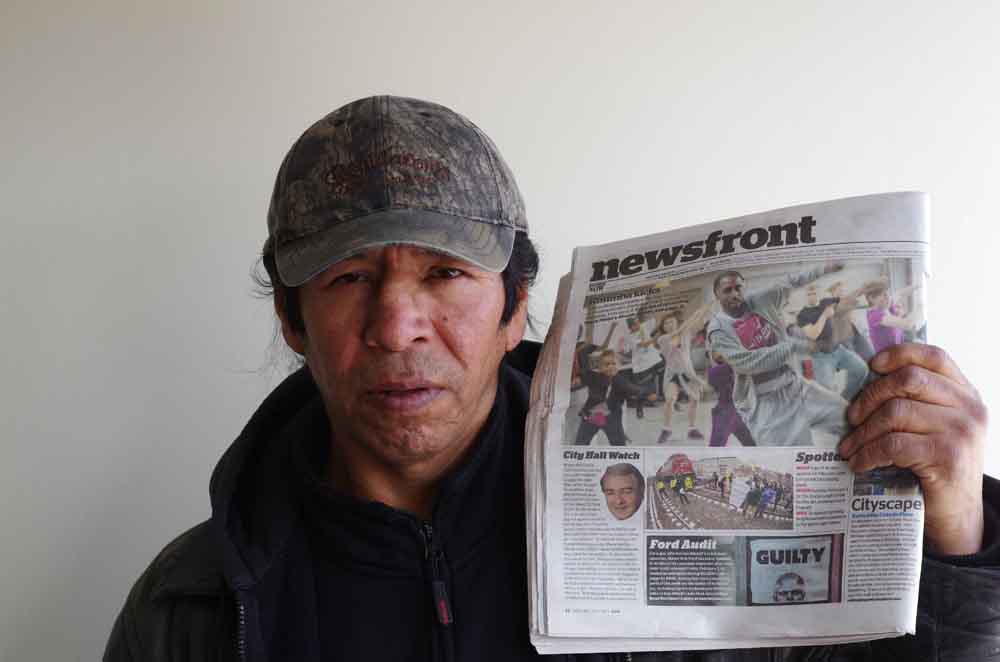
Gary Wassaykeesic’s relentless search for information about his mother’s 1976 death has led him to an activist role for a variety of causes.
“When people started hearing about what I was doing, looking into my mother’s case, I started getting involved with missing murdered Native women’s issues and I started working on other cases, not just my mother’s,” said Wassaykeesic, who began looking into his mother’s death about five years ago after receiving his residential school compensation payment. “But then I started hearing about residential schools, so I started working on residential schools. And then the sixties scoop. And now land claims.”
Wassaykeesic has since been involved with the Mohawks and the Occupy movement in Toronto.
“I was very involved with the occupation in Toronto,” Wassaykeesic said. “One of the good things about Occupy was we got to lead quite a few of the marches — Native people got to lead the marches because we made them realize that we were on occupied land, that they were occupying land and we were occupied people. That’s why we got to lead the marches.”
Wassaykeesic said he is now being labelled as an activist, an advocate and a spokesperson.
“Now I’m getting invited to attend these events and now I’m getting invited to other movements where they want my presence because I’ve learnt to be effective, I’ve learnt to be very vocal and I try to get the word out as to what exactly happened to our people, not just myself but my family, community and people in general right across the country,” Wassaykeesic said. Wassaykeesic was recently invited to help out with a protest at a uranium pellet manufacturing plant in Toronto.
“It was right in the neighbourhood and there are a lot of people who did not know about it over the years,” Wassaykeesic said. “They were bringing this stuff in by train track and taking it out by train track, and it’s right downtown.”
Wassaykeesic said the protestors stopped the train to get their point across to the uranium pellet manufacturing company.
“And then when we stopped the train, that made the news,” Wassaykeesic said.
Wassaykeesic said there are more activist groups in southern Ontario than in Thunder Bay and northwestern Ontario.
“There is more activism down in Toronto, there is more activism down in southern Ontario, so I have managed to acquaint myself with quite a few of these organizations,” Wassaykeesic said.
Wassaykeesic also helped at an Idle No More rally in Six Nations territory.
“We blockaded and we threw out construction workers who were working on Native land with no agreements or no authority through Six Nations,” Wassaykeesic said. “We did marches on the properties and on the building sites and we more or less confronted them and told them to move, to stop all building, to stop all construction.”
Wassaykeesic has also been involved with protests against wind power generation plants in southern Ontario.
“There are starting to be a lot of people up against the windmills,” Wassaykeesic said.
Wassaykeesic obtained the police report on his mother’s death last fall after lobbying for five years. He obtained the police report through a freedom of information request made by a lawyer with Aboriginal Legal Services of Toronto.
Wassaykeesic had been told in 2009 that all the information on his mother’s death was burned when the Ontario Provincial Police’s Central Patricia detachment burned down years ago, but because he had been through the government system for years, he knew government was built upon a paper trail, so he kept digging.
“Now that I’ve got the police report, now I know exactly what happened that night,” Wassaykeesic said.


This past month, I was happy to attend two Pow Wows I hadn't been to in years. I attended the Mattagami First Nation Pow Wow and the Matachewan First Nation...
I was happy to see my home community of Attawapiskat on the James Bay coast announce the opening of the new St Francis Xavier Parish Church on August 25....