


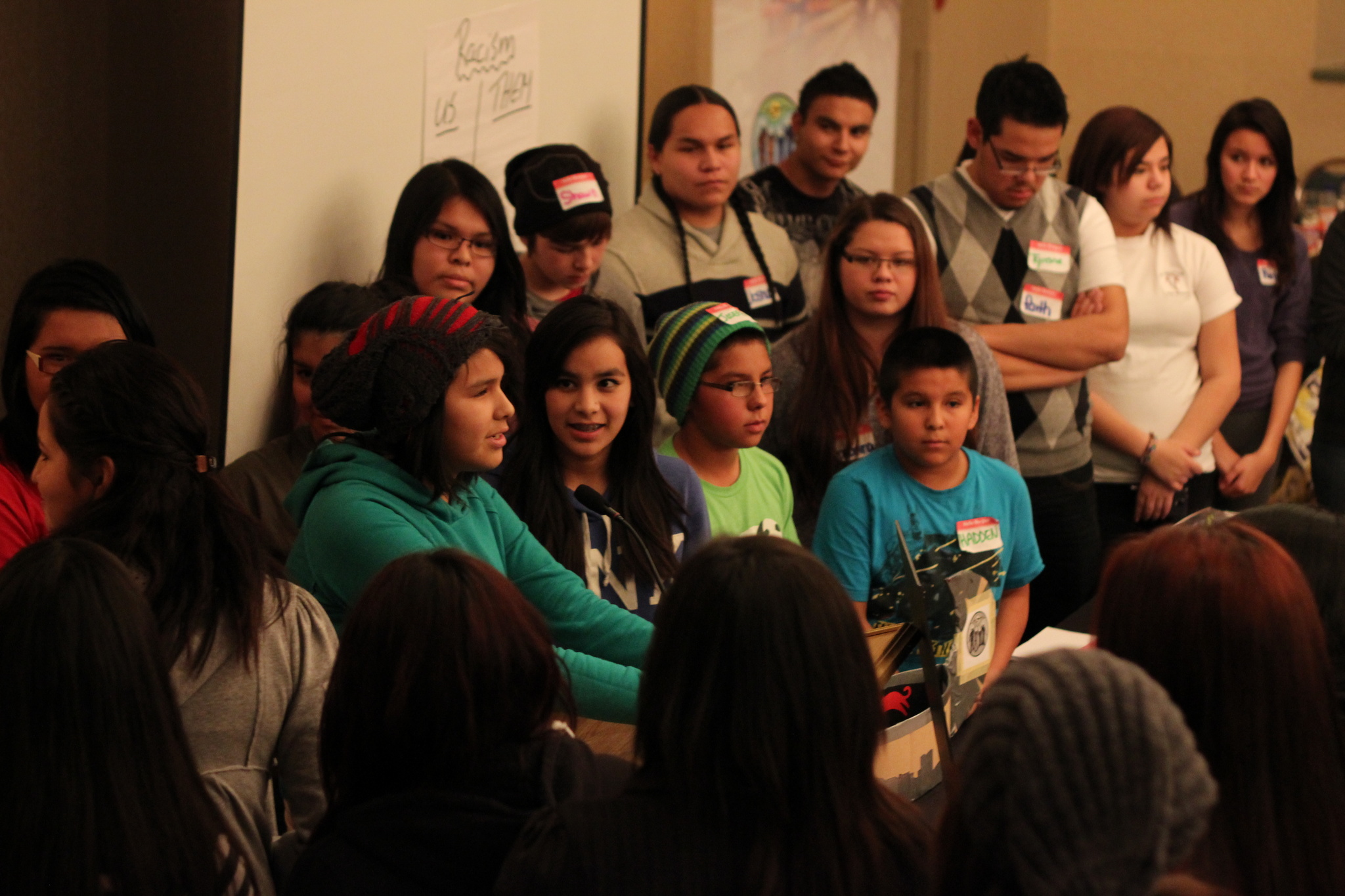
A youth still in elementary public school asked to speak in front of his youth peers during the Thunder Bay Urban Aboriginal Strategy (TBUAS) youth forum on Dec. 13.
He talked about an altercation he had been involved in that was started by a non-Native classmate, and how rather than hear both sides of the story, the teacher sided with the non-Native student, resulting in discipline for the First Nation youth.
“I don’t think there should be racism in schools,” said the youth, who was among the youngest at the gathering. He began to tear up as he continued. “I think teachers shouldn’t be racist. There should be more Native teachers. I never see any.”
As he struggled to continue, most of the youth listening got up and joined him at the podium, standing beside him as support.
It was a scene repeated several times throughout the evening as a number of youth asked to speak about matters important to them, be it racism, suicide or the loss of loved ones.
“Their stories pulled at my heart in a big way,” said Frances Wesley, the strategy planner for TBUAS. “Us, the adults in the room, were really taken. We felt something.”
The forum allowed the youth to voice their concerns and share stories about living as First Nations youth in Thunder Bay.
Clyde Moonias, a Grade 12 student from Neskangtaga First Nation, told the gathering about being on his high school’s football team. He was the only Native person on the squad.
“I felt like I didn’t belong,” he said. “I felt I was pushed to be kicked out, to quit the team.”
He did quit, and watched on the sidelines as the team went on to win a championship.
Other youth told stories about racism on the city transit, in the mall, and being harassed by the police.
Several youth spoke about being affected by suicide and how they once thought about doing so themselves. At intervals, sobs could be heard from youth and adults alike.
But where there was sadness and pain, the youth found healing in each other.
“It feels pretty amazing to hear stories from others,” Moonias said. “I know they felt like crying telling their stories, like they’re stuck inside and they had to be released.”
Tallon Bird, a Grade 10 student from Whitefish Bay First Nation, said he went to the forum with low expectations, but after the discussions, he found it very worthwhile, describing the evening as a “rollercoaster of emotions.”
“To hear the other stories, it makes me sad to know our population goes through all these problems,” he said. “But it also makes me feel better to know there are people out there who want to make a change, and who are making a change, and I’m just happy that we got the help from people before any extremes happened because we lost a lot of people.”
Wesley said what struck her the most was how the youth supported each other.
“It was so empowering,” she said. “I learned a lot from the young people that evening. I think the ones that were there know there is hope.”
Wesley plans to meet with the youth again after the holidays to ask: what do you want us to do next?
“Then we’ll roll out a report and start looking at action planning,” she said.
Moonias offered advice to the youth out there.
“Don’t be afraid to let out your emotions,” he said. “There are health programs, there are people who will hear you.”


This past month, I was happy to attend two Pow Wows I hadn't been to in years. I attended the Mattagami First Nation Pow Wow and the Matachewan First Nation...
I was happy to see my home community of Attawapiskat on the James Bay coast announce the opening of the new St Francis Xavier Parish Church on August 25....