


Global warming continues to be a topic studied in Canada considering the impacts it has on the country’s weather, especially in northern regions.
Recently, a group of researchers from Montreal’s McGill and Concordia universities predicted the widespread disappearance of outdoor hockey rinks across the country over the next 50 years due to global warming.
The scientists — Nikolay Damyanov and Lawrence Mysak of McGill and Concordia’s Damon Matthews — tracked historical temperature trends recorded since 1951 at 142 meteorological stations in every corner of the country.
“The ability to skate and play hockey outdoors is a critical component of Canadian identity and culture,” the three researchers wrote in the latest issue of the U.K.-based scholarly journal Environmental Research Letters.
“Wayne Gretzky learned to skate on a backyard skating rink; our results imply that such opportunities may not be available to future generations of Canadian children.”
The researchers interviewed outdoor icemakers in Quebec and Ontario to find out about what temperatures are required to start up an open-air rink and keep it usable for the duration of the skating season.
They learned that, in general, it takes three consecutive days with a maximum temperature of -5 C to make ice and begin the outdoor skating season.
“Many individual locations have seen a statistically significant decrease in the number of viable ice-flooding days, suggesting a significant shortening of the length of the outdoor skating season over much of the country between 1951 and 2005,” the published paper states.
The impact of global warming has been felt in northern Ontario over the past two years, especially last winter when high temperatures in March resulted in an early closure to the winter road season.
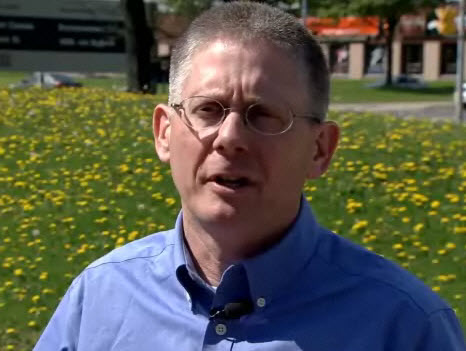
But Geoff Coulson, a meteorologist with Environment Canada, said this winter has been closer to the average temperatures than the previous winter.
“It’s not as mild as last winter, but milder than normal,” he said.
Using Thunder Bay as an example for the northwest since it has more comprehensive data, and Moosonee in the northeast, Coulson said the 2011-2012 winter season was much warmer than the long-term averages, which are calculated from temperature data taken from 1971-2000.
“Last winter, every single month of the winter was notably milder than normal,” he said.
In October and November 2011, Thunder Bay was at 2.2 C warmer than the long-term averages. In Moosonee, October 2011 was 4.2 C warmer and November was 3.4 C.
The differences become more pronounced in the early months of 2012 for both regions.
In January 2012, Thunder Bay was 4.4 C warmer while Moosonee was 3.7 C warmer.
March 2012 had the biggest difference, as it was 6.6 C warmer for both regions.
“It was felt right across the province from Thunder Bay, to Sioux Lookout, to Moosonee, to Ottawa, to Toronto, pretty much everywhere got incredibly warmer than normal temperatures for March 2012,” Coulson said, adding that many record temperatures were set.
The day of March 20, 2012 was particularly noteworthy. Thunder Bay reached 21.1 C while Moosonee was 24.5 C. Thunder Bay’s average for that date is 1.5 C.
“To say we were 21.1 (in Thunder Bay), we can’t even say we’re above normal,” Coulson said. “It was an incredible stretch of weather.”
This winter has been colder than the previous winter, though still milder than the long-term average.
In Moosonee, the monthly averages never went beyond a 3.1 C difference from the long-term average, while in Thunder Bay the difference did not exceed 3.6 C. Both those differences were last December.
For Thunder Bay, last month was colder by a degree compared to the long-term average while in Moosonee, it was off by 0.8 C.
Coulson said he is often asked if we could expect a repeat of warm temperatures from last March.
“We’re not seeing a similar situation setting up,” Coulson said. “It’s looking like it’s going to be a traditional month in most locations.”
Based on a 14-day forecast as of March 7, Coulson said temperatures will be colder than average. But based on a model used by meteorologists, early to mid-April will have higher than average temperatures.
The past two winters has also seen less snowfall compared to previous winters. Last winter, Thunder Bay had 98 cm of precipitation by the end of March. As of March 7, Coulson said 97.3 cm has fallen this winter. The long-term average is 146 cm of precipitation by the end of February. Precipitation data was not available for Moosonee.
While Coulson acknowledged that the past two winters have been milder, he was reticent to say it was a result of global warming.
“When the climatologists and experts talk about climate change, it’s a tendency that occurs over decades,” he said. “At this point, there’s a lot more study needed to get a sense of,
are we seeing a trend here, or is a variation of year to year?”
“It’s difficult then to make any kind of statement based on, how was the winter last year, how the was winter before that.”


This past month, I was happy to attend two Pow Wows I hadn't been to in years. I attended the Mattagami First Nation Pow Wow and the Matachewan First Nation...
I was happy to see my home community of Attawapiskat on the James Bay coast announce the opening of the new St Francis Xavier Parish Church on August 25....