


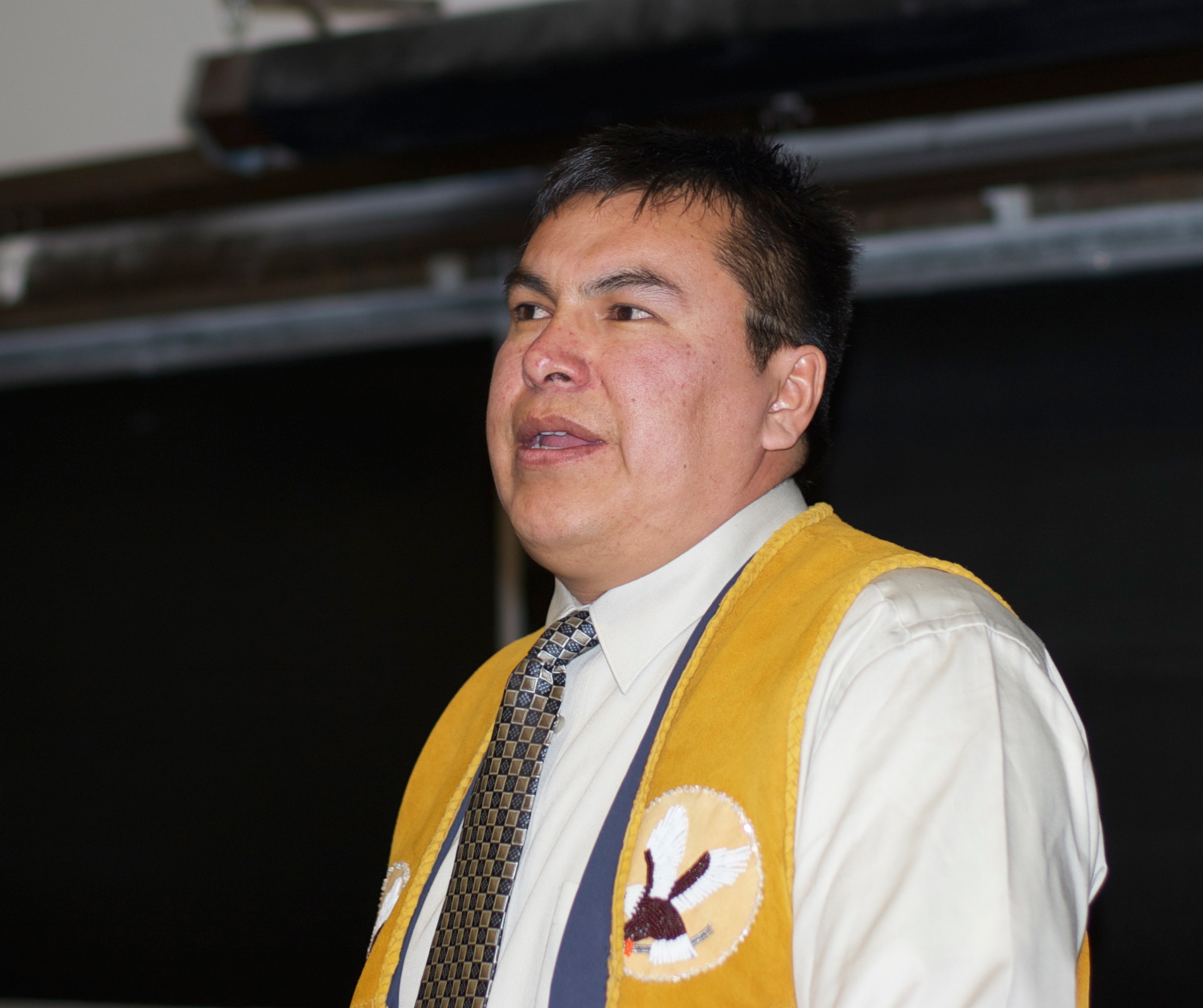
Flying Post Chief Murray Ray wants to see the different perspectives on the treaties taught in schools throughout Ontario.
“We’re finally getting what is our perspective on what happened at treaty, we have Ontario’s perspective on what happened, we’ve got Canada’s perspective,” Ray said on the second day of the Treaties No. 5 and 9 Symposium.
The Symposium was held Feb. 23-24 at Lakehead University in Thunder Bay. “We don’t have to agree, but get the information out to everybody,” Ray said. “Put it in (the education system) right from kindergarten up to university. Once everybody has all the information, they can make up their own minds.”
Ray is fascinated with learning more about the treaties, noting that is where history was made and is still being made.
“Knowledge is the key,” said Ray, who sits on the Nishnawbe Aski Nation/Canada Treaty Discussion Forum.
Presented through a joint partnership between the NAN/Canada Treaty Discussion Forum and Lakehead University’s Aboriginal Initiatives unit, the symposium featured a variety of presentations, including a historical look at the treaty relationship by Weenusk Elder Louis Bird, Janet Armstrong of Armstrong Historical Research and Jean-Pierre Morin, a historian with the federal government.
Discussions included a NAN/Canada Treaty Discussion Forum, a NAN Leadership Panel with Sandy Lake Chief Adam Fiddler and Fort Albany Chief Andrew Solomon, and a Canada/Ontario Panel. The Lakehead University student perspective was also presented.
“The understanding of the Elders is that we were put here on this planet by God, by the Creator,” Fiddler said during the NAN Leadership Panel. “He put us here on this planet to occupy it. He put us here and he also gave us the necessary tools for our survival – he gave us the land, the water, the air, the animals, the fish, everything that we needed.”
Fiddler said First Nations people lived a self-sufficient lifestyle for thousands of years in this area.
“We have a spiritual connection to the land,” Fiddler said. “Our Elders tell us that we were given the land by the Creator and we have a responsibility to take care of that land, not only for our generation but for future generations. It is not our land to destroy – it is not up to us to make decisions on the land that will affect future generations.”
Nipissing University professor John Long spoke about his book, Treaty No. 9: Making the Agreement to Share the Land in Far Northern Ontario in 1905.
The book includes the neglected account of a third commissioner and outlines how many crucial details about the treaty’s contents were omitted in the transmission of writing to speech, while other promises were made orally but not included in the written treaty.
Louis Bird suggested a role-playing routine for students to learn about the treaties, with some students acting as First Nation representatives and others acting as representatives of the Crown.
“They will see what happens,” Bird said. “That is the only way they could learn about the treaty if they could put themselves into these people.”


This past month, I was happy to attend two Pow Wows I hadn't been to in years. I attended the Mattagami First Nation Pow Wow and the Matachewan First Nation...
I was happy to see my home community of Attawapiskat on the James Bay coast announce the opening of the new St Francis Xavier Parish Church on August 25....