


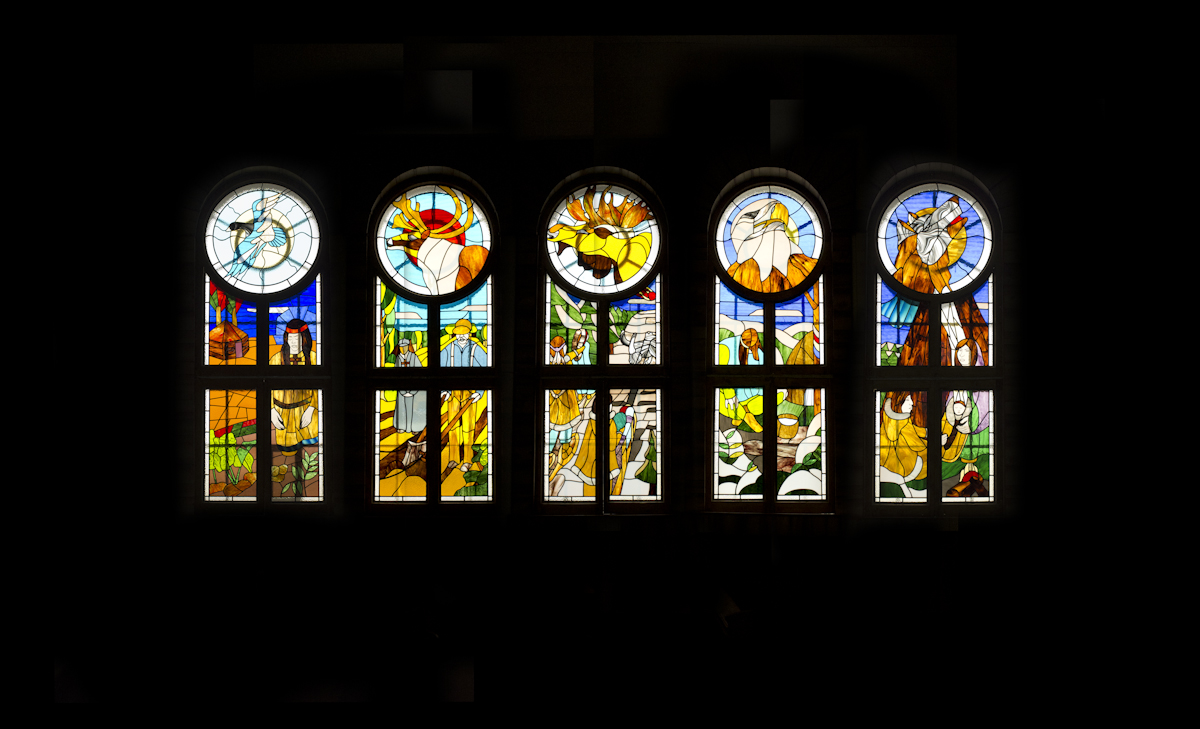
With no experience in cutting or designing stained glass windows, Jackie Hookimaw-Witt and her partner Norbert Witt began a project last January.
Five months later, they completed and installed the last of the six window panels measuring three metres tall and a metre wide that are now in the local Catholic church.
The project had its origins when the couple applied for a grant with the Truth and Reconciliation Commission of Canada (TRC), which offered art grants that helped with reconciliation of the residential school experience between the church and survivors.
In January, Hookimaw-Witt said when they discovered their grant was approved, they were given the option to complete the project by the end of the current fiscal year - which was in March - or next year. They decided to shoot for the current year.
“We were faced with a tight schedule and I was naive thought we would finish in two months,” she said.
But part of the reason for the decision was the need to ship the glass before the end the winter road season. Otherwise, they would have to wait a full-year.
In late January, Hookimaw-Witt and Witt flew to Ottawa to take part in an intensive one-week training program where they learned how to cut, solder, cement and lead the stained glass. As an artist who had painted murals, Witt said it was challenge to work with new media.
“(Hookimaw-Witt) was better in soldering than I was,” Witt said. Witt originally hails from Germany and was teaching in Attawapiskat when he met Hookimaw-Witt.
After they returned to the community, Hookimaw-Witt broke her arm in an accident, which limited her ability to work with the stained glass.
“So we had to train my brother (Dominic), who’s a skilled carpenter,” she said. They had him start off with a small glass segment and after the window panel, he had picked up the techniques and worked day and night cutting the glass.
“He became so specialized,” Hookimaw-Witt said.”Me and (Norbert) were so slow and inaccurate because we’re not as skilled with our hands, but Dominic, he was so fast and I was impressed.”
In designing the glass panels, the couple were only able to find one local artist to design a panel. With a tight deadline and unavailability of local artists, Witt designed the remaining five panels himself.
Drawing on local culture and history, the couple decided to do six panels, with each representing the seasons, as there are six seasons in Cree culture. Each panel tells a story relevant to the community.
One panel displayed fishing to denote the summer months, another showed goose hunting in the spring, and another featured a Nativity scene in a tipi. Some panels had special meaning for Hookimaw-Witt. One panel shows a local Cree plowing a field alongside a missionary.
Hookimaw-Witt said her father was taught how to grow and harvest potatoes within the community.
“So each windows represents an element, like the clans, and the bottom tells the story,” she said. “You can interpret the pictures in many ways.”
The panels were installed as they were completed, with the last one installed in May.
Hookimaw-Witt said she was concerned about the reaction of the local church to the project since churches tend to avoid the residential school subject. But the local priest of more than 30 years, Father Vezina, was receptive to the stained glass panels.
Word of the project spread and a bishop from Moosonee visited Attawapiskat to see the panels himself, along with a priest from Toronto. Hookimaw-Witt said they appreciated and liked the stained glass panels.
“I wanted to show something, that when we do an art, something to do with religion, we should do something decolonized like being spiritual rather than being institutionalized, and incorporating our indigenous philosphies,” she said.
Hookimaw-Witt said she used to have questions about her identity and struggles as a Native woman.
It was not until she went to university that she began to understand the socio-economic issues facing First Nations people and the residential school legacy. She went on to receive a Phd in sociology and equity studies.
Hookimaw-Witt said the stained glass project was a form of healing for her, Dominic and the community.
“When we share our energy, we talk about the art what it means to us, together cutting glass, it’s healing for us too,” she said. “It was good for our self esteem and psychological well-being.”


This past month, I was happy to attend two Pow Wows I hadn't been to in years. I attended the Mattagami First Nation Pow Wow and the Matachewan First Nation...
I was happy to see my home community of Attawapiskat on the James Bay coast announce the opening of the new St Francis Xavier Parish Church on August 25....