


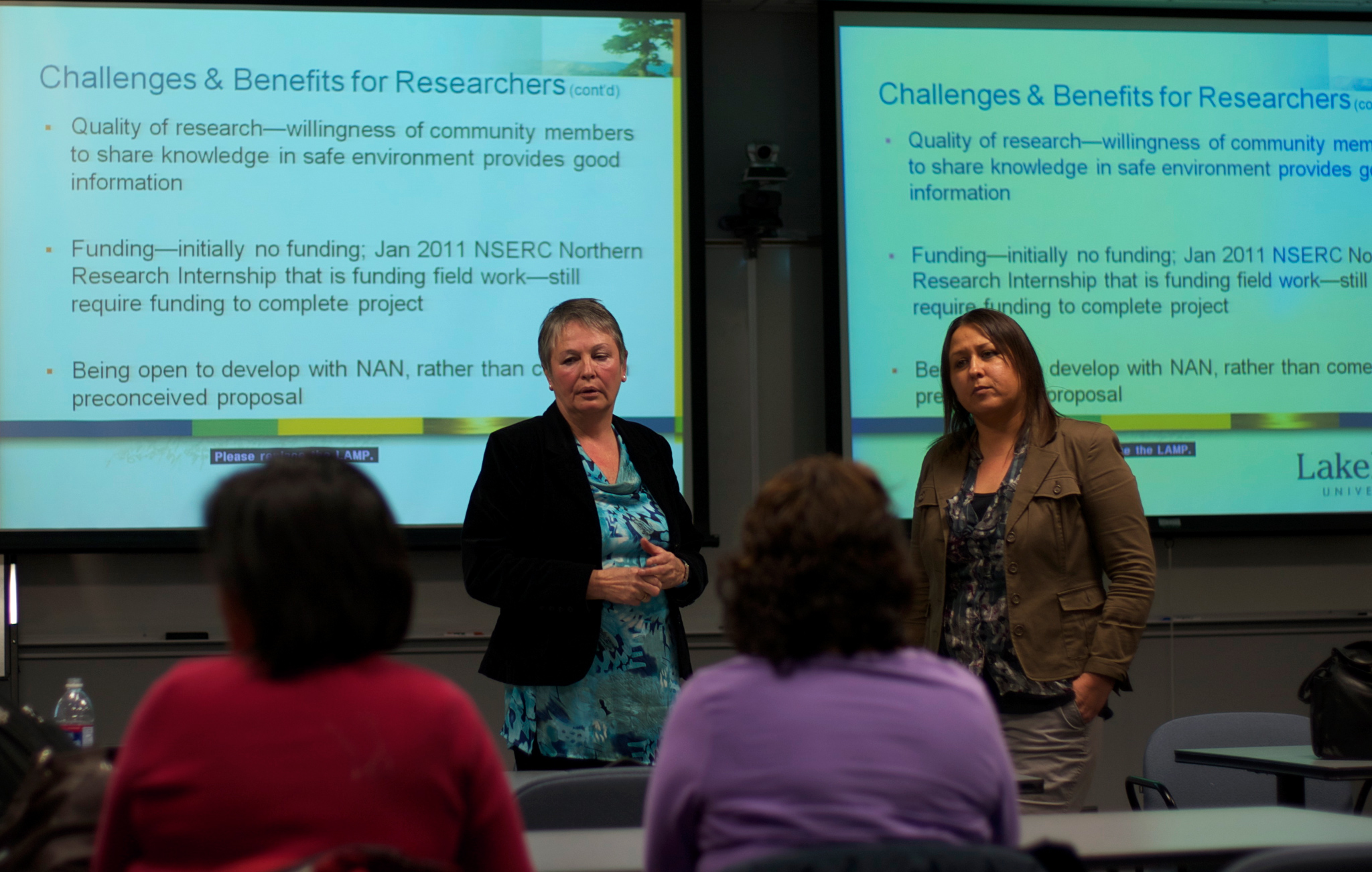
Research in Aboriginal communities was the focus Feb. 18 at Lakehead University’s Aboriginal Research and Innovation Day.
“As you know, the relationship between First Nations and researchers has been a shaky one in the past,” said Carol Audet, Nishnawbe Aski Nation’s director of lands and resources, during her presentation on Bridging the Aboriginal Community/Researcher Divide: Forging a Mutually Beneficial Relationship.
Audet has been working with Peggy Smith, an assistant professor in Lakehead’s Faculty of Natural Resources Management, on the project since October 2010.
Audet said First Nations do not trust the research process because the results have not been mutually beneficial in the past. She also said research should not be conducted without the consent of First Nations.
“The issue of traditional knowledge is a very sensitive one for First Nations,” Audet said. “Because of the significance of it, First Nations are raising the issue of traditional knowledge with different governments and international organizations such as the (Secretariat of the) Convention on Biological Diversity and the World Intellectual Property Organization.”
Audet said First Nations also have problems with research done by environmental organizations that have different agendas from First Nations.
Smith raised the United Nations Declaration on the Rights of Indigenous Peoples, noting the principle of prior, fully informed consent.
“First Nations should be fully aware of the research that is going on in their community,” Smith said, adding that First Nations should also be participating in the research, benefits should be outlined, and there should be a focus on the communal nature of rights.
Holly Prince, a research associate at Lakehead’s Centre for Education and Research on Aging & Health (CERAH), delivered a presentation with Tom Grinnell, CERAH’s Aboriginal community facilitator, and Mary Lou Kelley, CERAH research affiliate and professor of social work at Lakehead University, on Improving End-of-Life Care in First Nations Communities: The Perspectives and Experiences of First Nations Communities in Northwestern Ontario.
“My passion in palliative care came a result of losing a very close friend of mine,” Prince said. “The research came out of a result of Treaty 3 communities whereby local First Nation health care providers recognized the need for a culturally appropriate education and palliative care program based on the fact that the majority of their Elders were having to leave the communities to die in long-term care in hospitals.”


This past month, I was happy to attend two Pow Wows I hadn't been to in years. I attended the Mattagami First Nation Pow Wow and the Matachewan First Nation...
I was happy to see my home community of Attawapiskat on the James Bay coast announce the opening of the new St Francis Xavier Parish Church on August 25....