


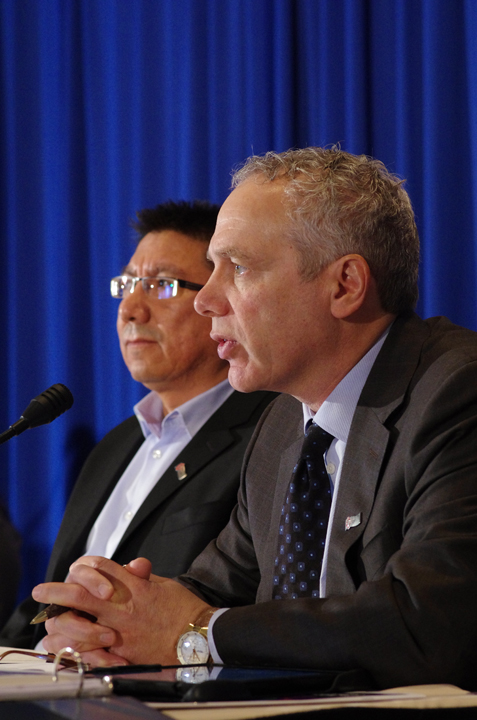
Mishkeegogamang Chief Connie Gray-McKay is calling for a focus on partnership after the First Nations Representations on Ontario Juries report was released on Feb. 26 in Thunder Bay.
“It reflects on the original intentions of the treaty that anything that goes forward has to begin as a partnership,” Gray-McKay said. “That was envisioned by our Elders when they signed the treaties — that it’s a government-to-government relationship. We had systems there before contact and those have to be recognized. And one of those was the system of justice.”
Gray-McKay said the report’s first recommendation, on establishing an implementation committee, was an inspiration to her.
“It shows me that he listened,” Gray-McKay said about former Supreme Court justice Frank Iacobucci, who delivered the report on Feb. 26 in Thunder Bay. “He didn’t listen with his ears; he listened with his heart to the concerns of our First Nations people.”
Iacobucci said the justice system and juries process is in a state of crisis for Ontario’s First Nations people, particularly those living in the north.
“As a result of our face-to-face meetings with leaders and community members from 32 First Nations across Ontario, we developed 17 recommendations that will help ensure that the cultural values, laws and ideologies of First Nations are better reflected in the Canadian justice system,” Iacobucci said. “Implementing the recommendations to improve Ontario’s juries and justice system will, I believe, make great strides in improving the access and participation of First Nation peoples in Ontario’s justice system.”
The report’s recommendations include establishing an implementation committee and establishing a First Nation advisory group to the Attorney General.
Attorney General John Gerretsen agreed to immediately work to address those two recommendations.
“Since no solution to increasing First Nation representation on jury rolls can occur without working directly with First Nation partners, we will form an implementation committee that includes representatives from the First Nations community and from various government ministries,” Gerretsen said, adding that a provincial advisory group will also be established to focus on First Nations justice issues.
Iacobucci stated in the report that the prevailing message he learned from every First Nation he visited was very clear: substantive and systemic changes to the criminal justice system are necessary conditions for First Nations participation on juries in Ontario.
“The most significant systemic barrier to the participation of First Nations peoples in the jury system in Ontario is the negative role the criminal justice system has played in their lives, culture, values, and laws throughout history,” Iacobucci wrote in the report. “This became very apparent in discussions with First Nations leaders, Elders and others during the engagement sessions. They uniformly expressed the position that, until significant and substantive changes are made to the criminal justice system, the issue of jury participation will not improve.”
Leaders across the north called for quick action on the recommendations.
Kenora-Rainy River MPP Sarah Campbell said the provincial government cannot afford to take its time in implementing the recommendations.
“If the justice system continues to fail us, First Nations will never be willing participants in it and the problem will move beyond the realm of jury representation,” Campbell said.
Nishnawbe Aski Nation Deputy Grand Chief Alvin Fiddler called for action on the recommendations, noting the implementation committee established after the 2007 Ipperwash Inquiry is “only halfway there” to implementing recommendations.
“We want to see some solid markers,” Fiddler said. “We want the implementation committee to be formed fairly quickly in consultation with our communities and to be properly resourced with a clear mandate to move forward.”
NAN began pushing for a review of jury rolls after it was revealed during the Kashechewan Inquest that not a single member of Kashechewan had ever been included on a jury roll and the Kenora Judicial District jury roll only contained names of First Nations people from 14 of NAN’s 49 First Nations.
“This report draws an important linkage between the narrow question of First Nations exclusion from the jury system and the broader alienation of First Nations from the justice system,” said Julian Falconer, NAN’s legal counsel. “Justice Iacobucci has been clear about the way forward. It is only through respectful government-to-government relationships that justice and jury issues can be resolved.”
Falconer said it is not enough to simply fix First Nations representation on jury rolls, noting that First Nations youth are being disproportionately jailed and First Nations police services are operating without a regulatory framework and are “grossly” underfunded.
“These impact directly on the willingness of First Nations to engage in the justice system,” Falconer said. “All of these pieces fit in together — one can’t be touched without the other.”
NAN and two First Nation families won a landmark Court of Appeal judgement in March 2011 recognizing their right to conduct inquiries into the validity of the juries empanelled in the Thunder Bay Judicial District. The appeals followed the refusals by the presiding coroners at the Inquest into the Death of Reggie Bushie and the Inquest into the Death of Jacy Pierre to summons the court official responsible for assembling the Thunder Bay jury roll, to give evidence as to whether First Nations people were adequately represented.
Iacobucci’s full report is available at http://www.attorneygeneral.jus.gov.on.ca/english/about/pubs/default.asp#....


This past month, I was happy to attend two Pow Wows I hadn't been to in years. I attended the Mattagami First Nation Pow Wow and the Matachewan First Nation...
I was happy to see my home community of Attawapiskat on the James Bay coast announce the opening of the new St Francis Xavier Parish Church on August 25....