


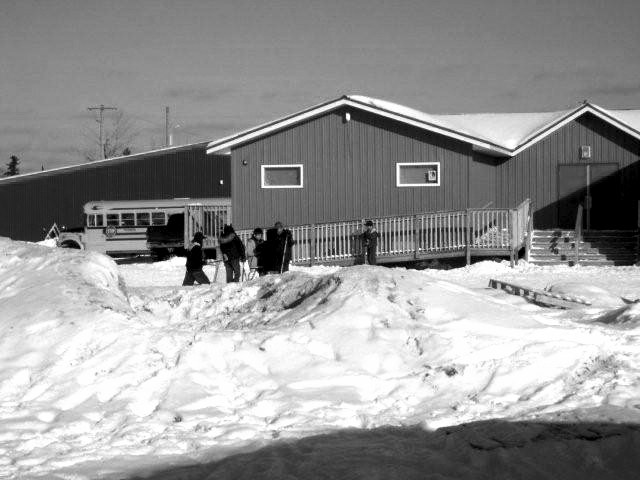
Most classes at Pikangikum’s Eenchokay Birchstick School were closed Jan. 9 due to mould in the teacher’s living quarters.
Twenty-five of the school’s 31 teachers left the community after mould was found in their accommodations during an air quality assessment conducted by an independent consultant. The assessment was called for after a teacher became ill.
“I gave them the green light on (Jan. 6),” said Kyle Peters, Pikangikum’s director of education. “They’ve been slowly going home and a couple of teachers are still here. They need time to pack up.”
The remaining six teachers, including four from the community and two living in newer accommodations, are currently teaching about 120-130 students in junior kindergarten, senior kindergarten, Grade 2, Grade 4 and Grade 5 classes. More than 600 students were left without classes due to the class closures.
As the teachers left the community, Peters was not sure if the high school students would finish their school year.
“They are three to four weeks away from finishing up the first semester,” Peters said. “We were anticipating our highest graduation number ever — 17 possible graduates. I don’t know what is going to happen.”
See Pikangikum on page 8
See Peters was worried that most of the school’s students would lose half a school year or possibly a full school year due to the mould.
“The students’ education is a major concern,” Peters said, noting he was affected by a similar situation during his last year of high school in 2000, when a fuel spill at the school forced him to graduate a year later than he was expecting to.
“I just stayed at home and waited around to see what was done to get the school back up and running. It was kind of frustrating. We had to go to school on Saturdays to make up time.”
After meeting with federal government officials in Winnipeg during the week of Jan. 9-12, Pikangikum Chief Jonah Strang said considerable progress had been made regarding the teachers’ accommodations.
“I believe we have achieved an understanding that will ensure a quality investment in our children’s education and accommodations of teachers coming into our community,” Strang said in a Jan. 12 press release. “We are encouraged by the commitment of the federal government and remain optimistic these negotiations will result in a return of full operations of the school and teacher’s early return.”
A senior communications officer with Aboriginal Affairs and Northern Development Canada (AANDC) said high school classes in the community will resume Jan. 18, following emergency action to find accommodation for teachers.
“Departmental officials are working with the First Nation to ensure that the project to remediate mould from the teachers’ accommodations is completed as soon as possible and with minimal disruption to the students’ school year,” said John Schmied, in a Jan. 11 e-mail response. “A contractor is on site to prepare a scope of work and cost estimate for this project.”
Schmied said the Ontario Ministry of Transportation has set aside three rooms as temporary accommodations until the teachers’ living quarters are remediated.
“School is in session for some elementary classes at Eenchokay Birchstick School,” Schmied said. “All high school classes will resume on Jan. 18. Remaining classes will resume as remediation to the teacherages are completed and teachers return.”
Nishnawbe Aski Nation Deputy Grand Chief Terry Waboose first raised the issue in a Jan. 10 statement, noting the community had been looking at a number of options to keep the high school classes operating.
“For years the community has asked the government of Canada to repair or replace these teacherages, and it is a tragedy that these students are now being denied their basic human and legal right to education because the government can’t provide teachers safe and healthy living conditions for educators,” Waboose said. “The government of Canada must immediately provide adequate living quarters so that teachers can return to the community and these students can get back to class as soon as possible so they don’t lose the entire school year.”
Schmied said the First Nation is the landlord of the teacherages and is responsible for the operation and maintenance of the facilities, adding that AANDC is providing Pikangikum with $464,931 to assist with the operation and maintenance of the teachers’ accommodations in 2011-2012.
Regional Chief Angus Toulouse said the situation illustrates the challenges First Nations experience stemming from years of government underfunding of First Nations education.
“If immediate action is not taken, we will continue to see and hear about similar crises in other communities,” Toulouse said in a Jan. 12 press release.
Toulouse brought up the Senate Committee on Aboriginal Peoples report, Reforming First Nations Education: From Crisis to Hope, which stated that First Nations education is in crisis and requires a complete overhaul.
The December 2011 report said First Nations are going into significant debt or cannot deliver basic educational services that are taken for granted elsewhere because the current funding formula, last updated in 1996, does not include money for libraries, computer or technology labs, athletic facilities and capital costs.
“Among the most difficult testimony presented to this committee is that, right now, across this country, there are uncounted numbers of First Nations children and youth who are receiving an education vastly unequal to their non-First Nations neighbours,” said Senator Lillian Dyck, deputy chair of the Senate Committee on Aboriginal Peoples. “Alarming drop-out rates and poor academic performance continue to compromise the future of many First Nations youth. In some instances, we heard that children will attend schools that are crumbling, infested with black mould or that are situated on contaminated land. Most of these children will learn from textbooks that neither reflect who they are or speak to them of who they can become. In time, some will be lost to themselves, to their families and communities, and to this country.”
Toulouse said it is clear for all to see that the funding of First Nations education has been sorely inadequate for many years.
“It is false for the government to imply funding is not the problem --- it is, and this is clear in their own reports and evaluations,” Toulouse said. “This is fact. Now is time for action to address the funding inequities and to finally provide a first class education for First Nations children.”


This past month, I was happy to attend two Pow Wows I hadn't been to in years. I attended the Mattagami First Nation Pow Wow and the Matachewan First Nation...
I was happy to see my home community of Attawapiskat on the James Bay coast announce the opening of the new St Francis Xavier Parish Church on August 25....