


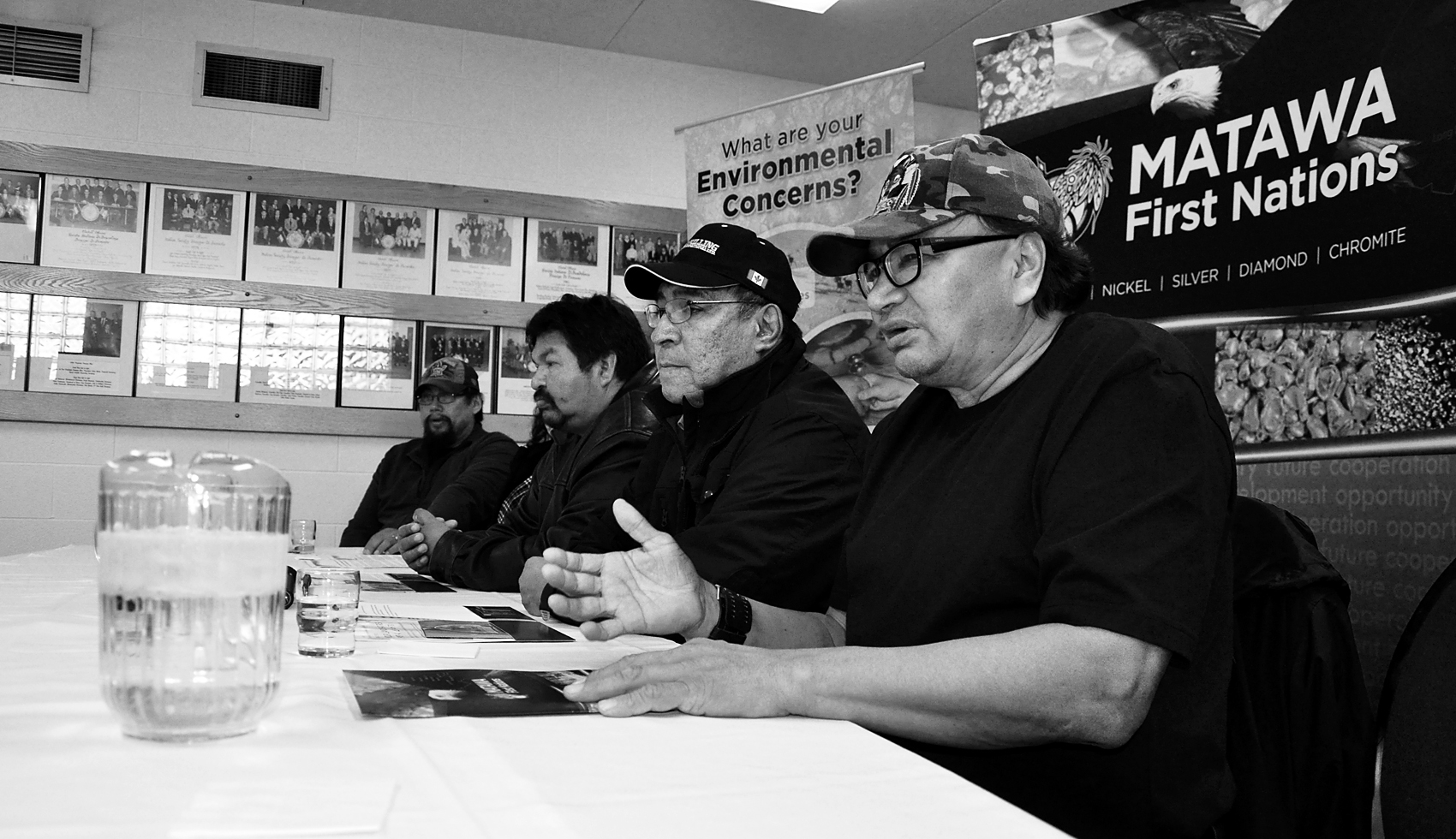
The chiefs of Matawa First Nations have withdrawn their support for development in the Ring of Fire. The Oct. 21 announcement comes after the federal government announced plans to conduct an environmental study of a potential mine project in the Ring of Fire, an area in the James Bay lowlands near several Matawa communities.
But Matawa chiefs said they want a more thorough study of the chromite mine proposed by Cliffs Natural Resources, a company based out of Cleveland, Ohio.
Constance Lake Chief Roger Wesley said that request fell on deaf ears by the federal agency responsible for environmental studies.
“We will be forced to resort to alternative measures if Canada and Ontario continue to ignore the First Nations that are being impacted by Ring of Fire developments,” Wesley said. “We want development, but we also want to make sure that our lands, waters, wildlife, and our way of life are not destroyed in the process.”
Wesley did not say what those alternative measures would be, but it’s the government that is forcing the communities to come up with a plan of action.
“They are not listening to us or consulting us in a meaningful way, and they are certainly not accommodating us,” Wesley said.
The Canadian Environmental Assessment Agency (CEAA) announced Oct. 17 that it is moving forward with a Comprehensive Study of Cliffs’ planned project. In May, Cliffs submitted its project description to the agency, initiating the action. The move comes even though the Matawa communities, for several months, have called for a Joint Review Panel environmental assessment, a more thorough process involving the federal and provincial governments.
“The joint panel is more detailed, and we First Nations are effectively involved in the process, whereas the comprehensive study is limited,” said Chief Cornelius Wabasse of Webequie.
Wabasse said Matawa wants the joint review process because of concerns with environmental impacts the development will have on First Nation traditional territory.
“The land over there is all marsh and they are talking about an open pit mine,” Wabasse said.
The Matawa chiefs feel the government’s approach to development will slowly destroy their traditional way of life, extinguish their treaty rights and destroy their homelands and their children’s future.
Kim Jorgenson, environmental assessment officer for the Matawa Four Rivers Environmental Services Group, said the joint review process is the best option to ensure more opportunity for public participation, allowing for oral hearings in First Nation communities.
“Ideally a new process would be developed to address all the potential environmental impacts from all proposed developments in the Ring of Fire area, but for now a Joint Review Panel is the most appropriate (environmental assessment) for these projects,” Jorgensen said.
The project, outlined in Cliffs’ description filed with the CEAA, consists of an open pit/underground mine, an ore processing facility, a transportation corridor and a refining facility.
The predicted rate of extracting minerals for the proposed 30-year life of the mine is at a rate of 6,000 to 12,000 tonnes per day. The transportation corridor includes a north-south all-season road from Aroland First Nation to the mine site east of Webequie.
Jorgensen said the roads proposed in the Cliffs project would cross about 100 bodies of water, including three major rivers.
“The Cliffs project will re-route three waterways and drain several ponds at the mine site,” Jorgenson said. “These activities will definitely impact fish habitat and wildlife in the area.”
Marten Falls Chief Eli Moonias said government-to-government dialogue is needed to deal with the ongoing frustrations of Matawa leaders.
“We need the Ontario premier and the prime minister to intervene and come to the table,” he said. “Visits from junior ministerial representatives telling us what is happening instead of asking us how we want to participate is not consultation or accommodation.”
Moonias is perturbed by the CEAA’s public invitation to comment on the proposed project. He said the CEAA ad features a map of northern Ontario that makes it look like no one lives near the Ring of Fire projects.
“The map didn’t have a single First Nation community on it,” he said. “We aren’t even on their radar. That is offensive to our people. That is exactly the way government views the people who live where these developments are happening, like we don’t exist.”
Despite the concerns of area First Nations, Cliffs said it has a two-fold approach to meeting the environmental requirements of the federal and provincial governments. While the CEAA is doing their study, Cliffs Cliffs will be conducting its own study following provincial guidelines set out in the Ontario Environmental Assessment Act. Their approach will look at the different components of the project as a whole instead of in individual parts.
Patricia Persico, Cliffs’ senior manager of global communications, said in the coming months Cliffs will engage with First Nations and Métis communities and other interested parties to get feedback on the project.
Persico said Cliffs expects to complete and submit its report by late 2012.
Meanwhile, the Ministry of Northern Development and Mines said it is taking Matawa’s concerns very seriously and will be working with the Ministry of the Environment and the CEAA to clarify next steps.
“We want Aboriginal communities to share in the economic benefits of natural resource development,” said Rick Winston, senior communications officer with MNDM in the email.
In the end, Nishnawbe Aski Nation (NAN) Grand Chief Stan Beardy said the Matawa chiefs want to ensure there is a future for upcoming generations.
“They are talking about our homelands and how they want to see those protected but at the same time they are talking about creating an economic base,” Beardy said about Matawa’s leaders. “What they are calling for is a joint panel that would allow the community people, the rights holders, to have meaningful input into the assessment. Right now they are being denied that right. There is a tendency to fast track the project just to get the precious metals out of there.”
Beardy said other NAN communities are also concerned about the situation in the Ring of Fire.
“If there is going to be development, it’s the First Nations people who live there that have to have a major say in how that happens when it happens or if it happens,” he said. “If the environment is damaged, it will impact the people living there now and in the future. You are talking about swamp and water everywhere; if there is a leak somewhere within the project, it is going to affect the whole northwestern Ontario half of NAN.”
Aroland Chief Sonny Gagnon agrees.
“The area being affected is among one of the largest groups of intact wetlands in the world,” Gagnon said. “These Ring of Fire developments are going to impact everyone in the region, one way or another, but especially the First Nations near these developments. These are First Nation homelands and we need the best (environmental assessment) process out there to protect them.”


This past month, I was happy to attend two Pow Wows I hadn't been to in years. I attended the Mattagami First Nation Pow Wow and the Matachewan First Nation...
I was happy to see my home community of Attawapiskat on the James Bay coast announce the opening of the new St Francis Xavier Parish Church on August 25....