


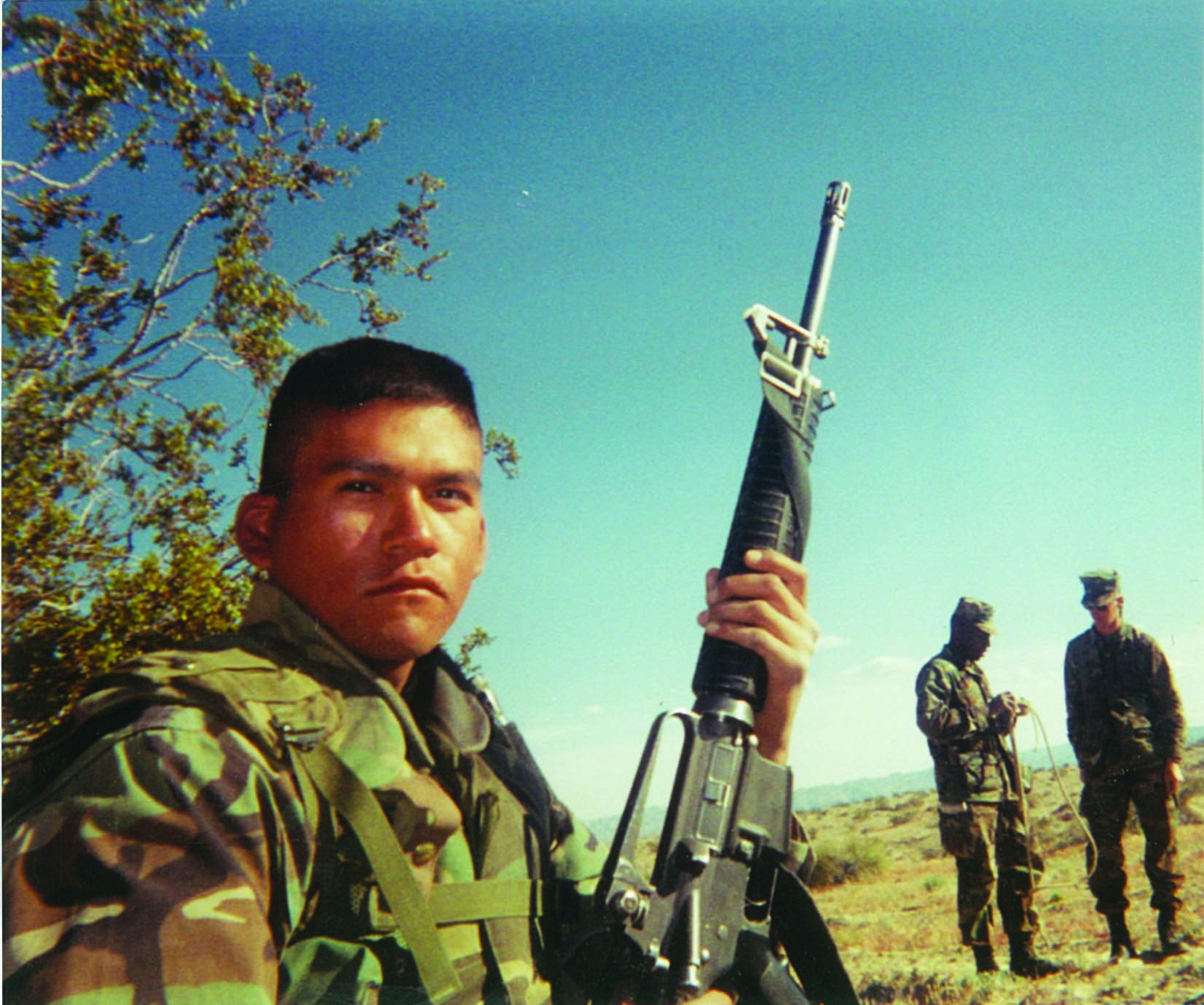
McDowell Lake’s Verlin James feels his upbringing on the land was an advantage during his term of service with the U.S. Marine Corps.
“Other Marines regarded me as being better than them in skills and ability,” said the former Marine Corps rifleman and Pelican Falls graduate in an e-mail interview. “This obviously stemmed from my upbringing in the north, hunting and trapping with my father as a child. I remember once snowshoeing for many miles in the darkness after my dad’s snowmobile broke down. I must have been but seven or eight.”
But James also met many other First Nations servicemen while in the Marine Corps, noting the percentage of those serving was higher than the First Nations population in the United States.
“I would see quite a number of Natives all the time,” James said. “My company first sergeant was Native in fact, same with a gunnery sergeant in the recon or scout sniper platoon.”
James decided to join the Marine Corps for vocational reasons, as in “the call of the warrior,” and not for financial reasons. He said most Marines join for the prestige, as the pay is low.
“The feeling to join was as strong as one feels to join the priesthood,” James said. “The Canadian Forces was not appealing to me. I felt that I had a better chance of survival going through something more difficult.”
James said the recruit training process in the Marine Corps goes from 5:30 a.m. to 8 p.m., with only one hour of free time per day.
“One thing that all Marines miss is the marching cadence they call sing-song, unlike the left-right-left-right cadence you hear here in Canada,” James said. “The marching cadence is sung; this cadence would be incomprehensible to most people. But the sing-song drawl you hear is something that I find myself doing very often.”
James served in the boat company of his battalion, which involved training for raids in rubber zodiac boats during the middle of the night on ocean waters.
“I remember the salt water in my mouth, and my knee being banged against the steel deck plate every time we hit a wave,” James said. “Also, I was lucky being from the north since I never came down with hypothermia.”
James loved the field training and boat raids, but he hated being in garrison.
“Being out of the Marines, your love of it grows the longer that you’re away,” James said. “It affects your every waking hour. You never see life like a normal person, you walk differently, you’re concerned about your physical conditioning and personal appearance. You wonder why people can’t be right to the point or more disciplined.”
James said most active duty Marines joined because they wanted to prove something to themselves.
“You do not have to be a bodybuilder to be a Marine,” James said. “Most active duty Marines are on the skinny side. You never see an overweight Marine, muscular types are rare.”
James encouraged other First Nations youth to consider the Marine Corps, noting that because boot camp is so busy most recruits do not get homesick.


This past month, I was happy to attend two Pow Wows I hadn't been to in years. I attended the Mattagami First Nation Pow Wow and the Matachewan First Nation...
I was happy to see my home community of Attawapiskat on the James Bay coast announce the opening of the new St Francis Xavier Parish Church on August 25....