


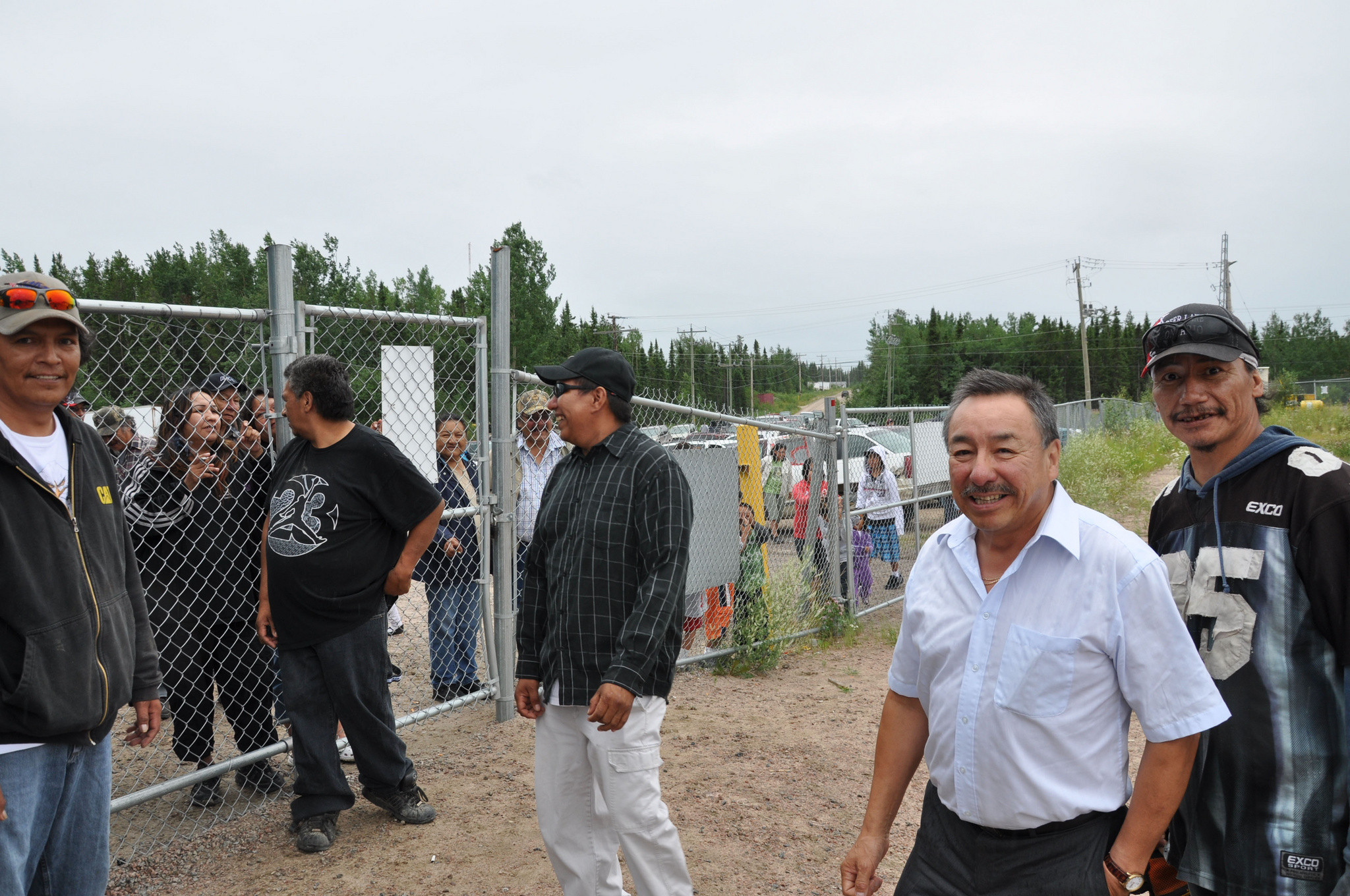
The Deer Lake evacuation focused the story for a number of national and local media representatives during Nishnawbe Aski Nation’s July 21 media flight into the heart of the forest fire crisis.
“Yesterday was very smoky, but the wind has shifted,” said Deer Lake councillor Cory Meekis shortly after a four-engine Hercules aircraft took off from his community with a load of phase-one evacuees and their luggage. “We couldn’t even see 50 feet in front of us when we were driving.”
Meekis said the lower smoke conditions on July 21 provided a good opportunity to evacuate about 550 phase-one evacuees from the community of about 1,200 people.
“It was very rough yesterday,” Meekis said. “I could feel myself getting short of breath while I was running around checking up on people, especially with the Elders, making sure they were OK.”
Meekis said all the Deer Lake phase-one evacuees are being evacuated to a location near Toronto.
“It will be a different life,” Meekis said. “Going from the reserve life to the city life.”
The heavy smoke conditions on July 20 caused smoke and carbon monoxide alarms to go off all day in the community.
Meekis said the nearest fire was located just outside the Ministry of Natural Resources’s 16-kilometre protection area. Two fires that had been burning with the zone were officially out, according the MNR staff.
Deer Lake councillor Johnny Meekis was scheduled to head out with the phase-one evacuees as a counsellor.
“I don’t want to leave but if we have to then we have to look after the people who are there,” Johnny Meekis said. “Some of them have never been out there before.”
Deer Lake has been living with similar circumstances for most of the month of July as forest fires burned nearby. The community was evacuated July 7 due to smoke conditions, with evacuees returning home July 13.
“That’s what it’s been like for the last couple of weeks because we had fires all around us,” Johnny Meekis said. “We had lots of smoke yesterday. We couldn’t even go outside; we stayed indoors all day.”
The forest fire situation eased in the Deer Lake area due to about 20 millimetres of rain over a 24-hour period July 20-21.
“As a result of that the fires are ranked number one and number two, which is smouldering ground fire, very little fire activity, not a lot of open flame,” said Robert Krause, incident commander for the Sandy Lake-Deer Lake complex. “The fires that are closest to the community within the 16-kilometre area are being held at this time and crews are mopping up and in some cases removing gear because we are getting ready to call those fires out.”
Krause said most of the fire crews in the Deer Lake area have been moved to the Sandy Lake area to fight those fires. Most of the smoke in Deer Lake is coming from fires to the east of the community and outside the 16-kilometre protection area.
Beardy said most of the people being evacuated are at high risk: little children, their mothers, the sick and the Elders.
“Anytime there is thick smoke or direct fire, those are the people they have to move out right away,” Beardy said, noting that about 3,000 people from 19 NAN communities had been evacuated as of July 21. “In Sandy Lake, the majority of the people have been moved.”
Beardy said about 2,500 people were evacuated from Sandy Lake and about 550 from Deer Lake.
One Deer Lake band employee expressed numerous concerns about leaving his community.
“How would you feel if you had to leave your home,” said Gary Meekis, a Deer Lake resource worker. “We don’t even know when we’re coming home. We don’t even know where we’re getting sent. I hope everybody is well taken care of. I think we might be all separated — I don’t know.”
For more information on the Forest Fire situation in northwestern Ontario, visit the MRN website: http://www.mnr.gov.on.ca/en/Business/AFFM/2ColumnSubPage/268862.html
Number of fires active: 106
Hectares to date: 541,932
Fire personnel engaged: 2,000 +
Out-of-province personnel: 737
Fire Fighting Aircraft: 9 heavy bombers, 4 light bombers (twin otters), 80 helicopters and other support aircraft
Number of evacuees currently displaced: 2,709
Communities fully evacuated: Keewaywin First Nation, Koocheching First Nation
Communities partially evacuated: Deer Lake First Nation, Kasabonika Lake First Nation, Kingfisher Lake First Nation, North Spirit Lake First Nation, Wawakapewin First Nation, Sandy Lake First Nation, Cat Lake First Nation
Communities Fully Returned: Ebametoong and Mishkeegogamang First Nations
*Info provided by the province of Ontario*


This past month, I was happy to attend two Pow Wows I hadn't been to in years. I attended the Mattagami First Nation Pow Wow and the Matachewan First Nation...
I was happy to see my home community of Attawapiskat on the James Bay coast announce the opening of the new St Francis Xavier Parish Church on August 25....