


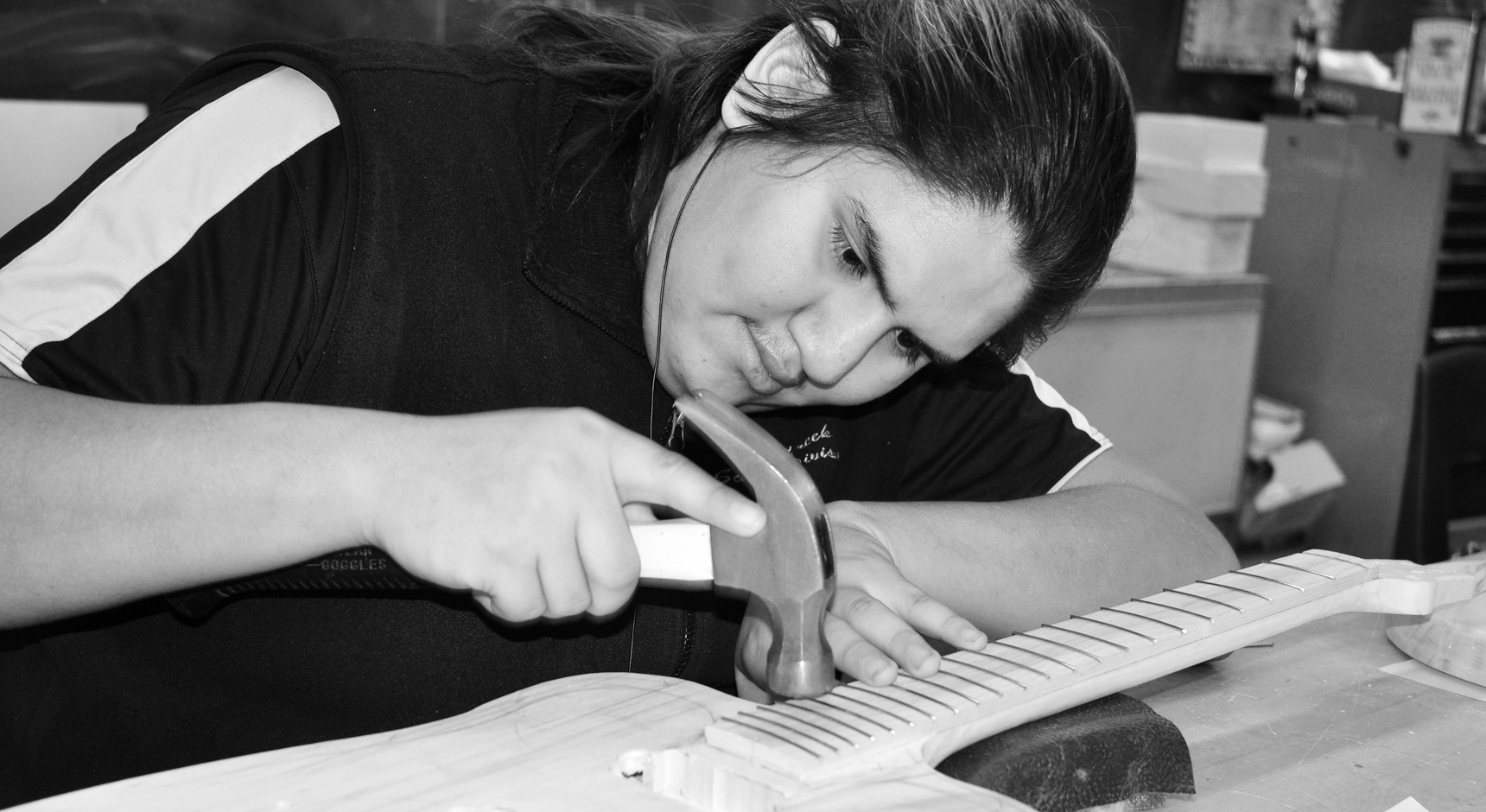
A group of Dennis Franklin Cromarty First Nations High School students in Thunder Bay are looking forward to making music on their own custom-made guitars.
“It’s been interesting – I’d never considered making a guitar and it’s nice to know I can make one,” said Brandon Meekis, a Grade 12 student from Sandy Lake. “I’m glad DFC presented this opportunity to me.”
Meekis had never played a guitar before enrolling in the electric guitar-making class, which was taught by Wild Honey Guitar Company co-owner Erick Hanson during morning classes in DFC’s woodworking shop. Hanson has already built more than 40 guitars.
“The only reason I never learned guitar was because I never had one,” Meekis said. “It’s not only that I can not just buy one, but this will be one I actually built.”
After completing most of his guitar by the end of November, Meekis is now confident he could make more guitars but noted he was careful during the process because he could ruin the whole guitar if he made a mistake.
“If we can get the tools, we can make anything,” he said.
Wapekeka’s Angie Winter also enjoyed building her guitar.
“It’s been fun,” said the Grade 11 student. “It was easy – I like working with my hands.”
Hanson is looking for the six-to-seven students participating in the class to recreate the guitar-making project in their own communities.
“Many people in the north play guitar,” Hanson said. “There is a demand for music in the north and a demand for musical instruments, and I think our students can actually fill that need.”
Hanson said the students have an opportunity to use their finished guitars in a music class during the second semester, noting the plan is to complete the guitars by the end of the first semester in December.
“If they are successful in the music program, they can actually take these guitars home to their own community,” Hanson said.
The guitars were made out of kiln-dried poplar with maple fret boards, so they will not be susceptible to changes in humidity as acoustic guitars.
“We’ve had our guitars out at minus-40 Celsius and brought them back in to plus-20 degrees,” Hanson said. “These should last for quite a few years and be very usable in the North.”
Hanson first dried the poplar down to seven or eight per cent humidity, then the students cut one solid piece for the neck and middle of the body and finished by cutting two pieces for the sides of the body. The sides were then glued to the neck-middle and cut into the final shape.
Hanson said tamarack would be a good replacement for use as fret boards in the North because it is a very hard wood.
“Tamarack would be almost the ideal wood if they couldn’t get maple,” Hanson said.
“Currently, a lot of the major guitar companies use birch for the necks of their guitars.”
Holes were also cut for electronic pickups and volume controls before the sides were glued to the neck-middle.
“The students will be doing the wiring in class, so I’ll be giving a demonstration on how to do it and how to read a simple electronic schematic,” Hanson said.
Hanson said some of the students are planning to do paintings on the sides of their guitars while others are planning to do a solid-colour wash.


This past month, I was happy to attend two Pow Wows I hadn't been to in years. I attended the Mattagami First Nation Pow Wow and the Matachewan First Nation...
I was happy to see my home community of Attawapiskat on the James Bay coast announce the opening of the new St Francis Xavier Parish Church on August 25....