


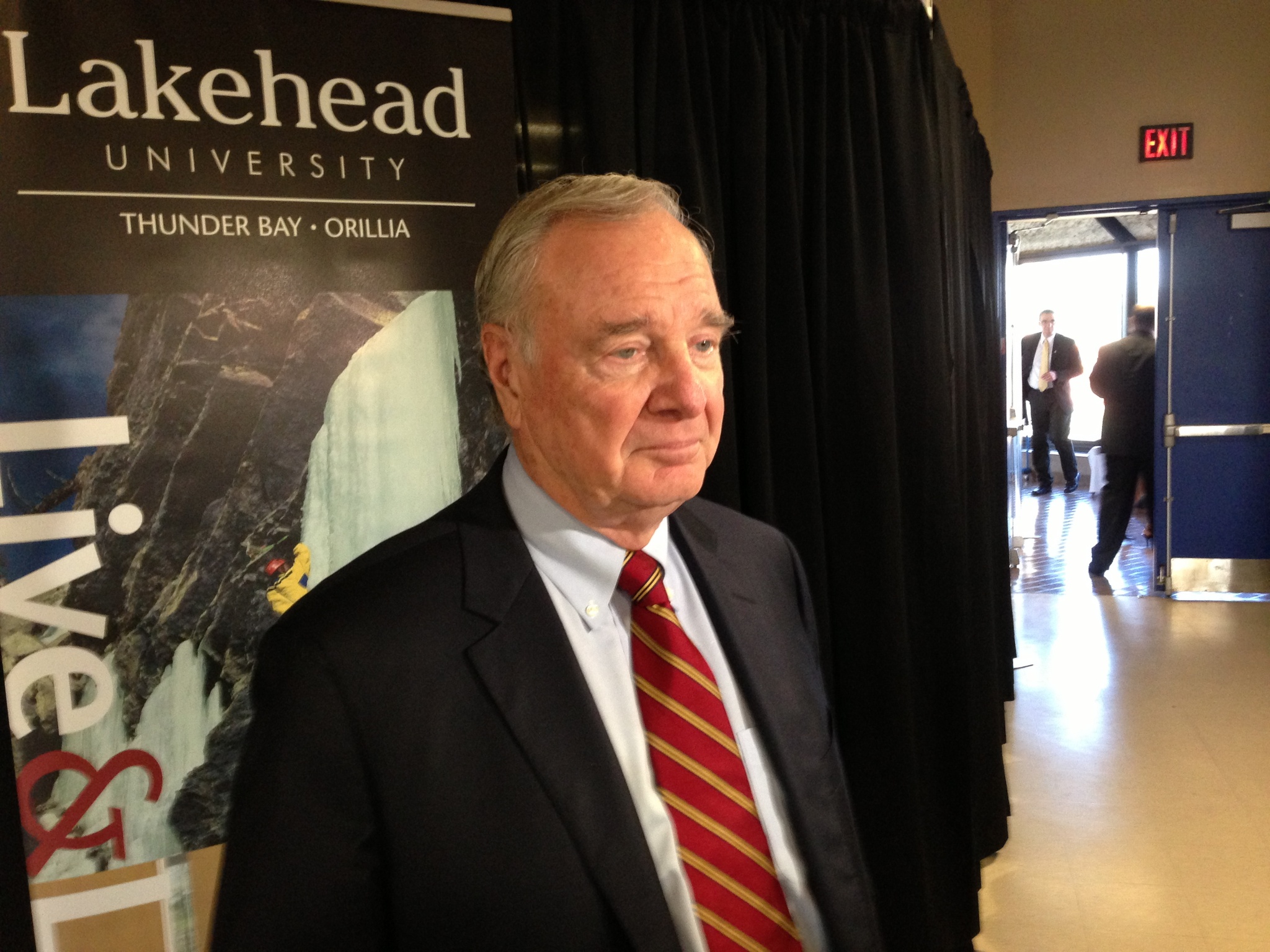
Towards the end of his term as the Canadian prime minister in 2005, Paul Martin and his Liberal government worked with Aboriginal leaders to develop what would be known as the Kelowna Accord.
The accord sought to improve the education, employment, and living conditions for Aboriginal people through governmental funding and other programs.
The accord was not implemented by the time the Conservative party came to power and it was essentially scrapped.
Since he left politics in 2008, Martin has turned his attention to improving Aboriginal education. That year, he established the Martin Aboriginal Education Initiative (MAEI), where the mission is to improve education for Aboriginal people at the elementary and secondary school level and increase graduation rates.
During a visit to Thunder Bay to receive an honourary degree from Lakehead University on June 1, Martin spoke with Wawatay News about why First Nations education is a priority, what the current situation for First Nations issues would be like had the Kelowna Accord been implemented, and the future relationship between Aboriginal people and the rest of Canada.
Lenny Carpenter
Wawatay News
Wawatay (WWT): So you’ve devoted yourself to improving First Nation graduation rates. What kind of progress in being made from your perspective?
Paul Martin (PM): Quite significant. We have found that the graduation rates for those students who have taken our program have gone up dramatically. We are now in 17 schools across the country and I think that we will increase that substantially over the course of the next two years. It shows up in the graduation rates. And it also shows up in the students’ understanding of the economy – what business is all about – and that’s really what this is. And hopefully, the students who take the course will go on either to Confederation College or here at Lakehead University and take the business course, or education course, or the others.
WWT: Of all the issues First Nations face, why did you choose to focus on education?
PM: I think it’s the key to the turnaround. You take a look at anybody in this country, Aboriginal or non-Aboriginal, who is succeeding and doesn’t come from great privilege, you’ll find out it’s because they went out and got an education. And it begins with high school. You don’t get to go to Lakehead University unless you graduated from high school.
This is really where the gap is. Universities and colleges have done a tremendous job, but the same progress as not been seen in the grade schools and high schools where there’s still a huge gap, largely because of the underfunding by the federal government. So our focus on primary and secondary school education is absolutely essential if they are going to have the steppingstone to post-secondary education.
WWT: When you were prime minister, your government worked with First Nations leaders for 18 months to draw up what would be known as the Kelowna Accord. Why was it important to you to attempt something that ambitious?
PM: I think that the issue facing Aboriginal Canadians is the greatest moral, the greatest social, issue this country faces. I also think it’s one of the greatest economic issues. Aboriginal Canadians are the youngest and fastest growing segment of our population. They have to succeed. They have to succeed for their own sake, but they also have to succeed for the country’s sake. I just can’t think of a more important issue than Aboriginal education.
WWT: Had the Kelowna accord been implemented, what do you think the situation for First Nations people in regards to issue like education or housing would be today?
PM: Had it been implemented, I think the gap in funding between what the federal government provides on reserve and what the province provides off reserve would have disappeared. There would be no more gap in funding, which means more kids would be graduating from Grade 8, more kids would be graduating already from high school.
But also the gap in health care funding, the gap in welfare funding would have been eliminated. There would have been no necessity to go to the human rights tribunal to get comparable funding and welfare. We would have made a substantial advance on things like clean water and natural resource sharing. All the issues were on the table, all these issues that the provinces, the Aboriginal leadership of the country and what the federal government agreed to. And we just lost six years.
WWT: You worked to develop the accord, and now you’re working with education. At what point did First Nations issues become a priority for you?
PM: I worked up north when I was 18-19 to put myself through university. And it was there that for the first time I made close friends who were First Nations – largely Dene, Inuit or Metis. And I kept up those friendships for a reasonable time afterwards. And it was there that I realized – this was 50 years ago – some of these young people were in residential schools but I didn’t know it. But I knew there was something missing. They were smart, they were hardworking but they didn’t have the same degree of hope that other kids had. And that’s not fair. That’s just not fair.
WWT: With the rise of Idle No More, talk has been brought up about the treaty relationship. What do you think about the current treaty relationship?
PM: First of all, as so many of the First Nations leaders have said, we are all treaty people. And those treaties were promises. They were promises made to the First Nations and the honour of Canada dictates that we keep our promises.
WWT: What do you think First Nations have in store for the future, and where do you see the relationship between Aboriginal people and the rest of Canada progressing in the future?
PM: I think it’s going to improve steadily. In fact, it has to. Especially given the fact that not only are they the youngest but they’re the fastest growing segment of our population, and they’re going to increase in importance and we’re going to be very heavily reliant on them succeeding and so I think the relationship is going to improve. I think it’s a moral issue and I also think it’s an economic issue. I would hope that the moral issue is what is going to carry it.


This past month, I was happy to attend two Pow Wows I hadn't been to in years. I attended the Mattagami First Nation Pow Wow and the Matachewan First Nation...
I was happy to see my home community of Attawapiskat on the James Bay coast announce the opening of the new St Francis Xavier Parish Church on August 25....