


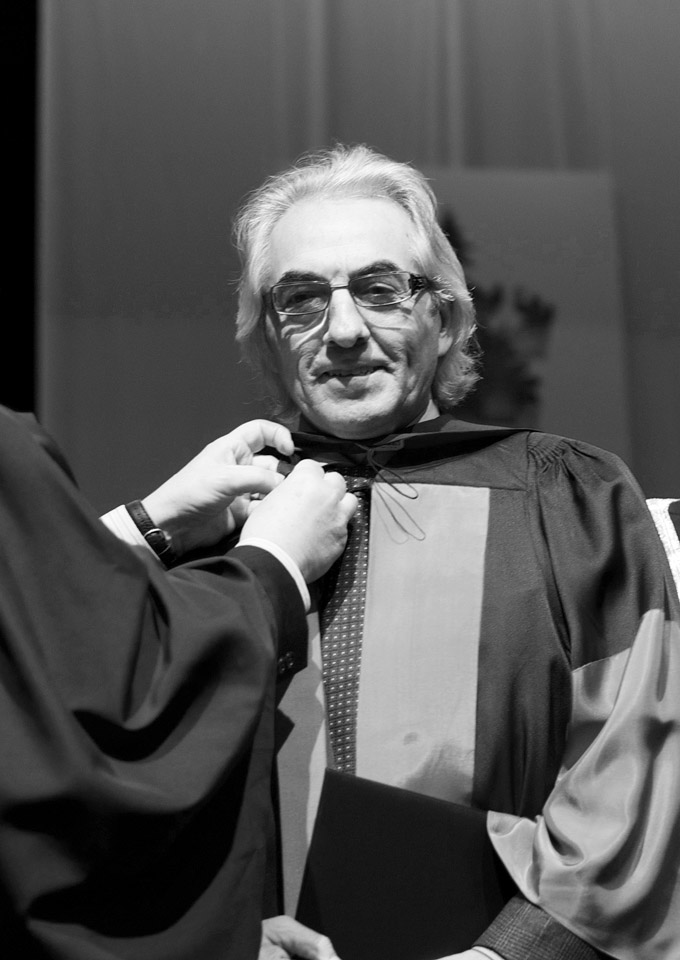
Former national chief Phil Fontaine took the opportunity to raise issues facing First Nations people during his Dec. 1 acceptance of a honourary doctorate of laws at Lakehead University in Thunder Bay.
“We must understand that healing from the harm of the residential school legislation will take a long, long time, perhaps decades into the future,” Fontaine said.
Fontaine brought up the second inaugural speech of former United States president Abraham Lincoln, noting his speech was about reconciliation and healing and is relevant at this time in Canada. Lincoln was responsible for emancipation of African-Americans from slavery.
“With malice toward none, with charity for all,” Fontaine said, quoting from Lincoln’s speech. “We all know as First Nations people that our Elders embrace this sentiment, in very powerful and generous and kind ways.”
Fontaine stressed the importance of building a “better, more generous and more fair Canada.”
“This will require imagination; it’s going to require resources and commitment from every level,” Fontaine said. “We want a Canada that respects our dignity and our rights and celebrates our cultures, our languages and community.”
Fontaine said non-Aboriginal Canadians need to imagine things many have never imagined before, such as spending time in First Nation communities.
“We’ve heard calls in the last few days from different quarters calling on (Aboriginal Affairs and Northern Development Canada Minister) John Duncan to go up to Attawapiskat to see for himself those terrible, depressing conditions that those people are being forced to live,” Fontaine said. “Like enjoying what we just witnessed and heard here today – a drum group, indeed a very young drum group, honouring all of us with their songs, presenting their values to us in the most generous and kind way imaginable, so very powerful.”
Fontaine said reconciliation is going to require resources to close the health and well-being gap that exists between First Nations communities and the rest of the country.
“We need to create a Canada where discrimination and racism are a thing of the past, where land claims are accepted fairly and justly, where our treaties, your treaties, indeed your treaties, are honoured,” Fontaine said. “Treaties aren’t just about First Nations people; they aren’t just about us, they are about the entire country. Treaties are about all of us, just like the residential school experience is a Canadian experience. It isn’t just about survivors, it isn’t just our history, it isn’t our shame, it really is about all of us.”
Fontaine called for Canadians to insist that treaties be implemented and First Nation rights and interests be recognized, respected and given fair acknowledgement.
“And what about imagining your children, our children learning to speak Cree or Anishinabemowin at school,” Fontaine said. “What’s wrong with that? Why isn’t that so? What’s wrong with learning the history of the First peoples? What’s wrong with learning the history of the residential school experience? What’s wrong with learning the true history of Canada? What’s wrong about accepting that we deserve to be treated with respect and dignity?”
Fontaine looks forward to the day when Canada affirms that the country was built on three founding nations, the Indigenous as well as the British and French.
“Only when Canada and Canadians understand our true heritage and the great migration success story that followed will we recognize that which has been long denied,” Fontaine said. “This continent was possessed with an ancient civilization and still is.”


This past month, I was happy to attend two Pow Wows I hadn't been to in years. I attended the Mattagami First Nation Pow Wow and the Matachewan First Nation...
I was happy to see my home community of Attawapiskat on the James Bay coast announce the opening of the new St Francis Xavier Parish Church on August 25....