


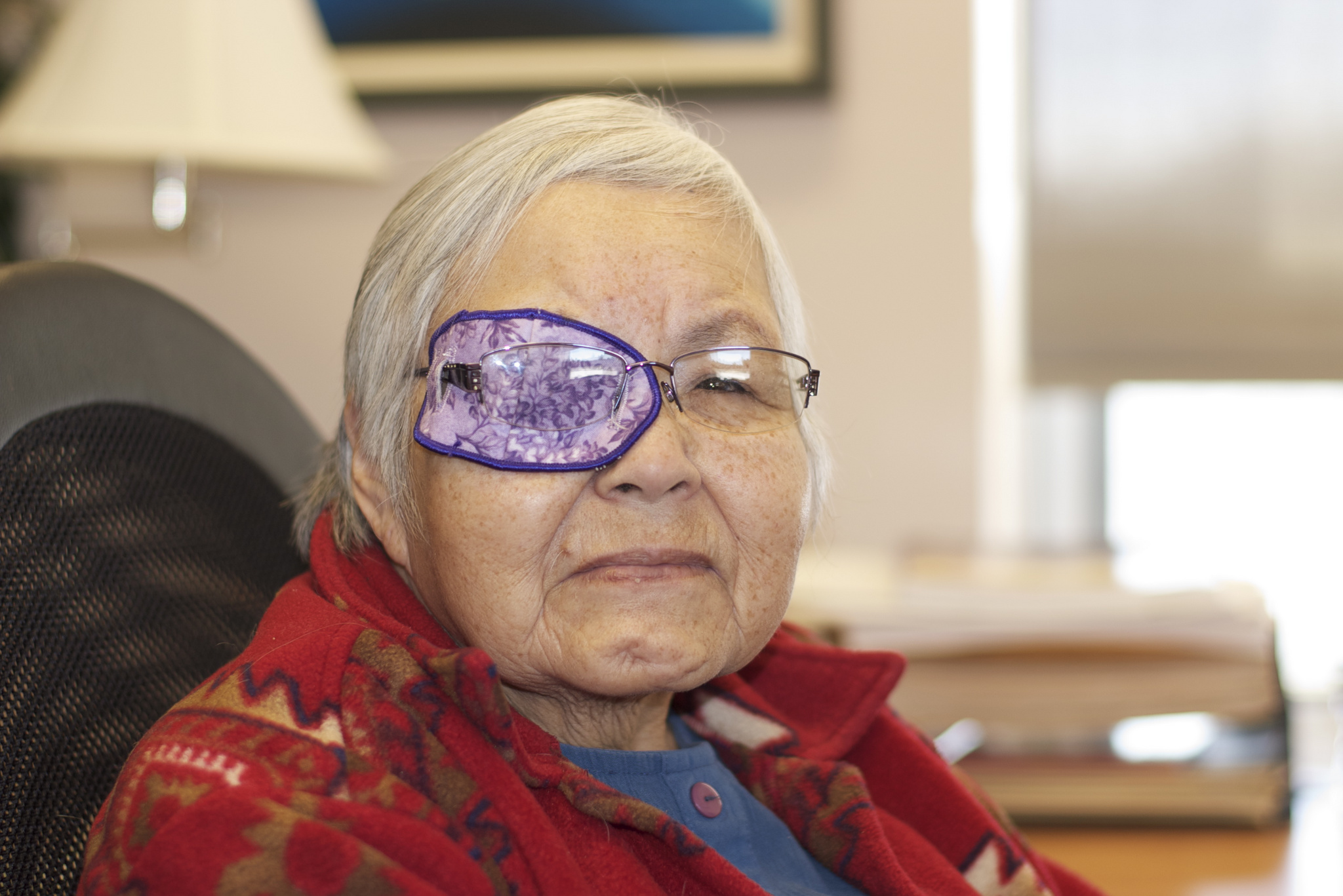
Lakehead University professor Dolores Wawia is recovering from a rare diabetic complication of the eye – third nerve palsy.
“At the end of October I woke up on a Saturday morning and my eyelid was drooping,” said the longtime Faculty of Education member. “I couldn’t see very well so I looked in the mirror and my eye was closing shut.”
Wawia went the local emergency department and was given a CAT scan and an MRI (Magnetic Resonance Imaging) in case she had suffered a stroke, but everything was normal.
“They said, no, the eye had just froze right down,” Wawia said. “It wouldn’t move up or down or sideways. The eyelid had closed to protect it.”
Wawia said the doctor told her it was diabetes related, as did her optometrist two days later.
She was told nothing could be done and it would take three months to heal.
Wawia then went to an eye specialist, who gave her the same diagnosis.
Third nerve palsy is a condition of the third cranial nerve that supplies nerve signals to muscles responsible for eye movement.
It also affects muscle in the upper eyelid leading to a drooping upper eyelid. The third nerve can be injured anywhere along its path from the brain to the muscles.
Her next move was to see a diabetes specialist who examined her eye and asked her to do some eye exercises with the affected eye.
“I couldn’t move my eye,” Wawia said. “It wouldn’t turn, it wouldn’t blink, it wouldn’t do anything.”
She said the diabetes specialist agreed it was third nerve palsy, but he also told her after healing the eyelid would eventually open up again.
“So I said, ‘can I drive,’ and he said ‘no, it will put a strain on your good eye,’” Wawia said.
To protect her eye while it healed, the diabetes specialist gave her an eye patch to wear.
“Two months later my eyelid slowly hoisted up, slowly moved up until it opened up,” Wawia said. “I had to leave the patch on because my eyes wouldn’t focus properly.”
Wawia returned to the eye specialist at the end of January three months after the third nerve palsy had originally set in.
“The eye was completely functioning now, opening up and blinking and all that,” Wawia said. “I said ‘what should I do about the patch’ and he said ‘take it off.’”
Wawia said for the first two or three hours her eyes had a “tough time” focusing and she couldn’t achieve proper equilibrium, but in the afternoon “all of a sudden my eyes focused properly.”


This past month, I was happy to attend two Pow Wows I hadn't been to in years. I attended the Mattagami First Nation Pow Wow and the Matachewan First Nation...
I was happy to see my home community of Attawapiskat on the James Bay coast announce the opening of the new St Francis Xavier Parish Church on August 25....