


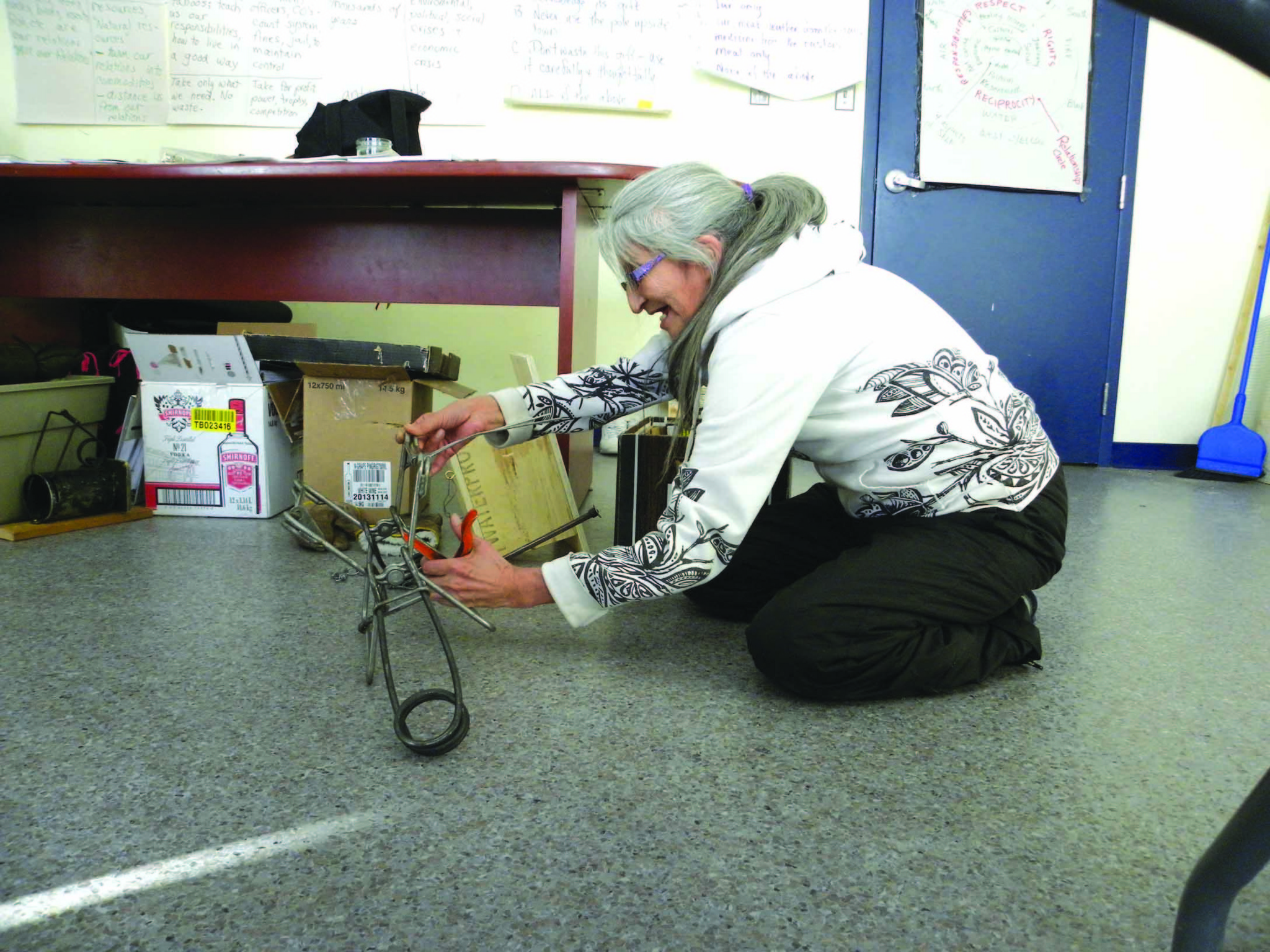
The first animal Kaaren Dannenmann ever trapped was a martin.
“I wasn’t very happy,” Dannenmann laughed when asked about the experience. “It’s not a pleasant thing, to kill an animal. That’s why we say this animal is our relation and you only do it because you need to do it.”
Dannenmann learned how to trap growing up with her family and extended family members.
“It wasn’t always full-time trapping, but it was part of the daily life to trap,” Dannenmann
said.
She travels to different communities in Treaty 3 and also Nishnawbe Aski Nation to teach trapping courses. Dannenmann, who lives in Red Lake but comes from Trout Lake near Lac Seul, has been involved in teaching trapping since the early 1990’s.
“We started when we were going through the tripartite negotiations between Treaty 3 and Ontario back in 1992,” Dannenmann explained.
“We wanted to look at trapping from our perspective as Anishnaabe people rather than as an industry.”
She said that she took a trapping course and found that it wasn’t connected at all to her life on the land.
“It was a lot about legislation and this and that,” she said.
Dannenmann said it took several years after those negotiations to develop the trapping course. The course Dannenmann now teaches has a focus on going back to the traditional ways of trapping and thinking about trapping.
“It’s a part of respecting the land, and our relations on the land,” she said.
“We have to start changing the language we use. Instead of thinking of the animals as ‘renewable animal resources,’ we say, ‘this animal is our relation.’ We start calling them our relations.”
“A moccasin made from a moose, and fur from a beaver – we don’t call that a product. We call it a gift that our relations the moose and beaver have given us. It’s much more in line with our teachings,” Dannenmann said.
She explained that words like “natural resources” distance people from those “relations” and makes a commodity of, and objectifies, the animals.
Dannenmann herself does not do much trapping these days.
“I don’t do a lot of trapping because I don’t need to. One of our teachings is to take what we need. I don’t really need it a lot of when I do, I don’t sell it – I use it myself.”
Students are given a certificate upon successful completion of the course. The Ministry of Natural Resources and Treaty 3, as well as Nishnawbe Aski Nation, recognize the certificate.
“I’ve been to Poplar Hill, Pikangikum, I went to Pelican Falls School, I’ve been to Whitefish Bay, North Spirit Lake, Lac Seul,” Dannenmann said of the places her course has been taught.
She said the number of participants in some communities is not as high as expected, but it does not surprise her because of the daily requirements on people’s time.
“When I was in North Spirit, there were four people who were certified,” she said. “I’m very pleased with that because they are four people who intend to go out to their trap line.”
Dannenmann holds a sharing circle after each course, and she said the feedback has been positive.
“I ask them if it was worth their time learning how to set traps and taking the course, and they say yes,” Dannenmann said.
“What they say is it puts trapping into perspective with their whole traditional lifestyle and they can understand the role of traditional practices on the land and what they are for.”
Dannenmann feels it is important to continue on with trapping because it helps keep Anishnaabe people connected to their traditional areas.
“And with traditional teachings being the foundation, it (trapping) keeps that connection ongoing and hopefully into future generations,” she said. “A hundred years ago, we didn’t have our kids going through courses. We taught our kids right from birth.”
More information about the trapping courses can be found by contacting Grand Council Treaty #3.


This past month, I was happy to attend two Pow Wows I hadn't been to in years. I attended the Mattagami First Nation Pow Wow and the Matachewan First Nation...
I was happy to see my home community of Attawapiskat on the James Bay coast announce the opening of the new St Francis Xavier Parish Church on August 25....