


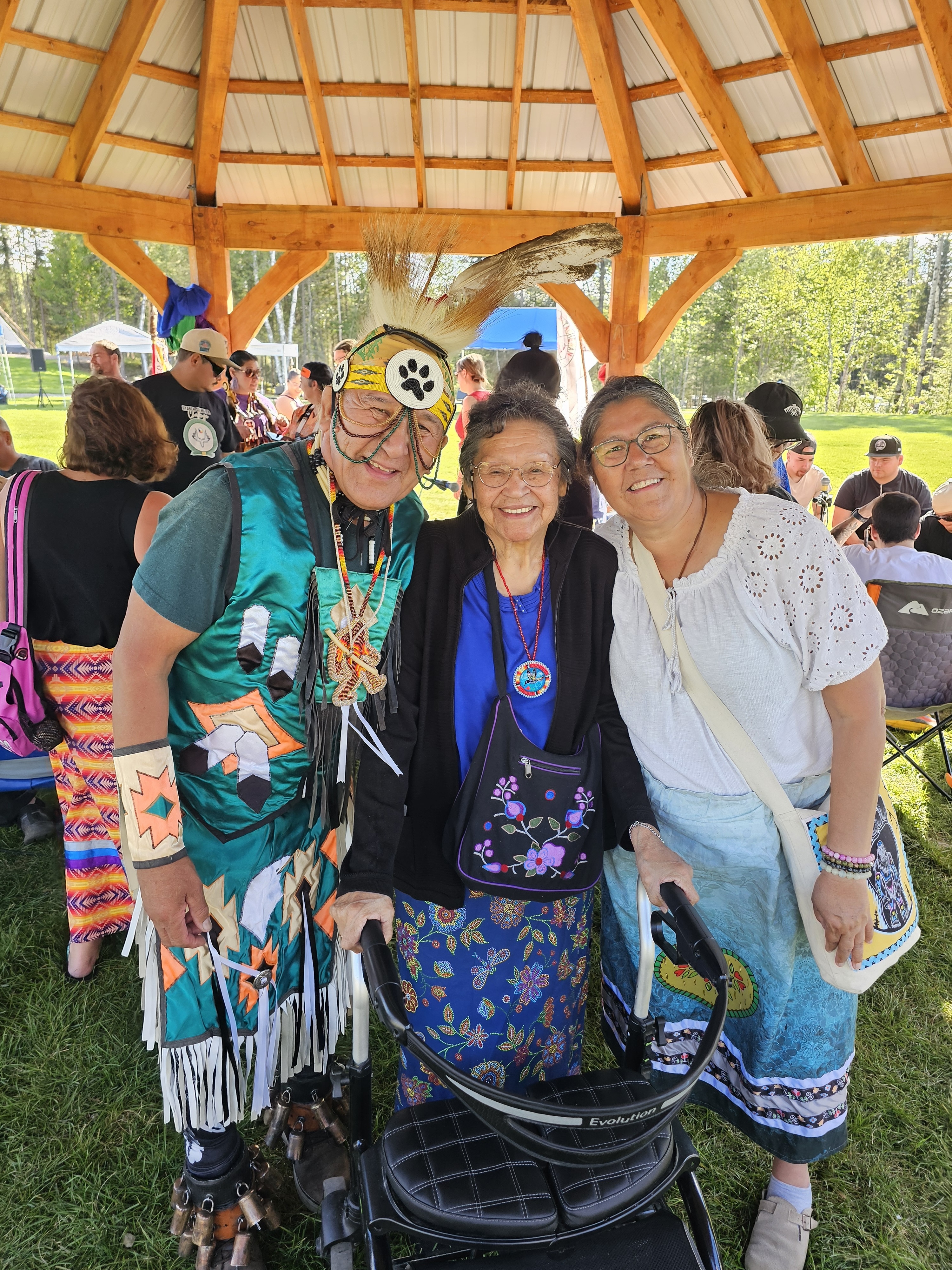
photo by Xavier Kataquapit
Many First Nations come together at every Pow Wow to celebrate culture and heritage. At the Matachewan FN Annual Pow Wow which ran August 29 and 30 are from L-R: Traditional Dancer George Rose, Attawapiskat FN; Elder Vina Hendrix-Landry, Matachewan FN and Betty Naveau, Mattagami FN.
This past month, I was happy to attend two Pow Wows I hadn't been to in years. I attended the Mattagami First Nation Pow Wow and the Matachewan First Nation Pow Wow. These are two special communities I have had the good fortune to be involved in for over 30 years.
I stopped attending public events eight years ago when my partner Mike was diagnosed with a debilitating disease. We could not afford for him to get sick with a common cold which meant that I also could not catch anything for fear of passing on any sickness to him. We both missed many events over the years but we were more than happy to hear about these Pow Wows since they meant so much to so many people.
Many people who hear about Pow Wows mainly think of them as entertainment events filled with drumming by young people and surrounded by male and female dancers who perform for everyone’s viewing pleasure. Part of these events is to make everyone feel good about the sights and sounds. It is a powerful feeling to hear the pounding of the drum, even from far away and it is entrancing to hear the metallic, rhythmic shaking of a jingle dress. It’s also amazing to witness the bright coloured twirling and twisting of a fancy shawl dancer, or the power and athleticism of a young male fancy dancer or grass dancer.
The Pow Wow is more than just performance art or entertaining music. Over the years, I’ve been taught and informed by many drummers, dancers and traditional people that Pow Wow is foremost a ceremonial and spiritual event. To many traditional people, it is a religious gathering meant to bring families together and allow those who are hurt, grieving and mourning to heal and be around a supportive community.
Many of the MC announcers, Arena Directors, drummers, singers, dancers and organizers are lifelong practitioners of traditional culture, dance and ceremony. These traditional people are often drummers, dancers and singers themselves who take on different roles for different Pow Wow events. They have spent years learning from Elders in their home community, as well as from other traditional teachers from many places.
The dancers wear regalia and it is incorrect to refer to their dress as ‘costumes’. These dancers and their families have spent a lifetime accumulating everything they wear. Each piece tells a story of how it was made, what it symbolizes, what the colours mean, who did the beadwork, and often, the parts are handed down from relatives, parents, grandparents or Elders. There is a story to every part of their regalia.
The grand entry and exit are the most sacred moments of the gathering and those in attendance are asked not to take photos or videos. Everyone is asked to stand solemnly to honour the opening, remind ourselves why we attend these events and why these gatherings are important and think of our families, friends and loved ones in attendance, as well as those who are no longer with us.
Over the past 20 to 30 years, Indigenous people in northeastern Ontario have worked to reconnect with our cultural past. A few generations before, our people were taught to disregard our cultural past. Survivors of the residential school era were taught to fear any traditional gathering and many of them grew up believing that they would be punished for taking part in Pow Wow. I was very happy to see so many young people working towards rekindling this sacred connection to our past. People like Elaine Daley, Jean Lemieux and Marilyn Groulx worked with Elders like Vina Hendrix-Landry and the late Marie Boucher to bring Pow Wow back to Matachewan FN. In Mattagami FN, I watched young people like Dana Cosgrove, Janelle McKay-Golinowski and Kourtney Baulne as they became part of the traditional revival in Mattagami FN and worked with local leaders like Dorothy Naveau, Devin Naveau and current Chief Jennifer Constant, as well as Elders such as Elder Clara Prince, Elder Walter Naveau and Elder Morris Naveau. There are so many other people from these communities who developed their annual Pow Wows and it makes me proud to see them celebrating our traditional culture.
In my own home community, I see people like my cousin George Rose and his family leading Pow Wow events, as well as Charlie Kioke and his family. I’ve felt a great sense of pride seeing my own community members over the years, like Gordon Hookimaw, Sage Iahtail, Conrad Iahtail, Tristan Ashishkeesh, Ramon Kataquapit, Janie Kataquapit, Rosie Kataquapit and so many others who sing, drum and take part in ceremony.
These two Pow Wows were definitely a healing event for me in so many ways. These gatherings honour our traditional past, remember our loved ones, celebrate our identity, comfort our pains and share the love we feel for one another. Chi-Meegwetch misiway, pah-tee-mah meena (Thanks very much, everyone, until next time).


This past month, I was happy to attend two Pow Wows I hadn't been to in years. I attended the Mattagami First Nation Pow Wow and the Matachewan First Nation...
I was happy to see my home community of Attawapiskat on the James Bay coast announce the opening of the new St Francis Xavier Parish Church on August 25....