


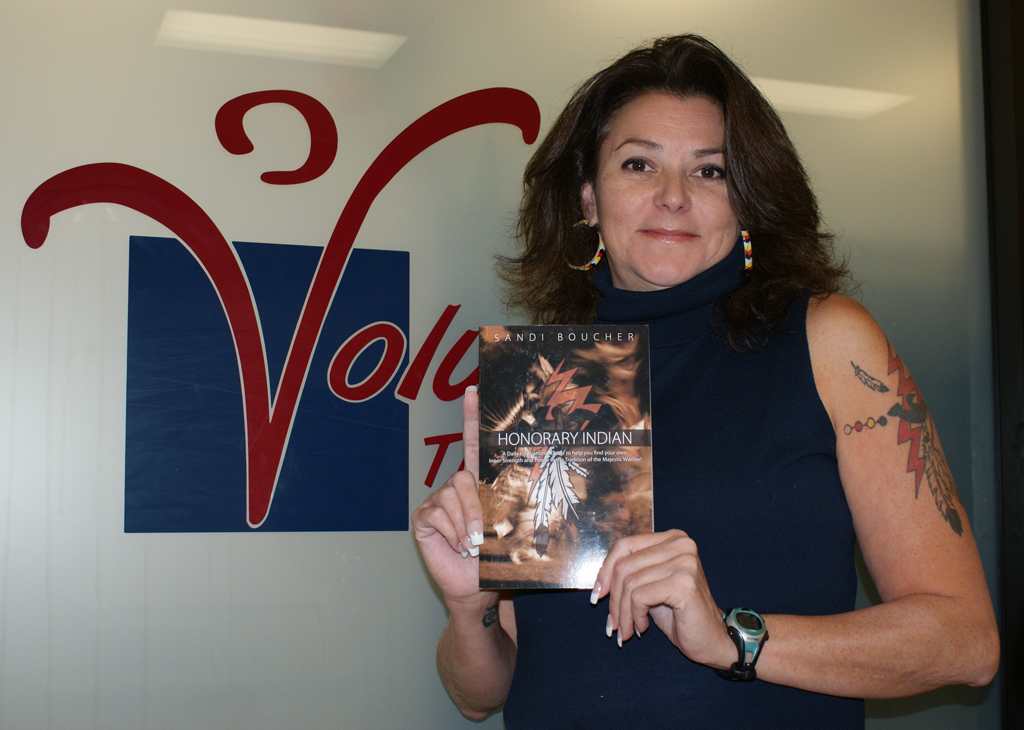
Sandi Boucher has gathered her mother’s teachings into a daily inspirational guidebook to share with others.
“Everything stems from when my mom passed away,” said Boucher, whose mother was originally from Couchiching First Nation near Fort Frances but lived in Hudson with her husband and children for many years. “She had all these amazing teachings and I am her only daughter and I only have one daughter.”
Boucher said she passed on her mother’s teachings to her own daughter, but after working in employment and training for many years, she realized there were so many women out there who had never received similar teachings or an example of a strong woman.
“I actually felt selfish,” said the owner of meno bimahdizewin consulting group and executive director of Volunteer Thunder Bay. “I thought I need to share these and I had no idea of the reaction the book would get. I thought if I helped five women, I would be really happy – the book was promoted only through my website and word of mouth and I’m nearing 600 copies (sold) since January.”
Boucher’s book, Honorary Indian, has been sold so far to customers in Newfoundland, British Columbia and Texas.
“A woman in Ireland ordered it off the website (www.sandiboucher.ca),” Boucher said.
Boucher lives and breathes the medicine wheel and its four colours every day.
“We’ve heard from the white segment for a long time now, but the red segment has really strong teachings to share as well that could help the other colours,” Boucher said. “The whole premise of the book is to make you an honourary Indian for a day and I’m going to show you how we look at the world.”
Boucher said the daily inspiration format of the book provides people with a daily reminder of First Nation teachings.
“If I’m going to change how you think, it’s a process,” Boucher said. “It’s not something that is going to happen overnight. If I can get you thinking differently for even five minutes every day, it becomes a habit.”
Boucher first had 300 copies printed in Mississauga after receiving positive feedback from the inspirations she had been sharing on social networking Internet site Facebook.
“I had been working on writing a book for the past 10 years. It was just going nowhere so I finally decided to get serious and finish it,” Boucher said.
“In March of 2009, out of the blue I got a call from a woman who found me on Facebook and said she wanted to publish my book. I never could have done it without her. Her design team came up with the cover and she helped me select the format inside.”
Boucher is “thrilled” with the work.
“To me it looks like an old diary,” she said, explaining the way it looks handwritten like a journal. “Because it is very personal, it’s written about my life, it fits, it totally fits,” Boucher said.
Boucher said her mother had survived a lot of hard times during her life.
“She grew up in a time period where it wasn’t easy being Indian and definitely not an Indian woman,” Boucher said. “And my own personal path, I survived the domestic violence and I survived extreme poverty.”
Boucher said if her mother’s teachings were able to help her mother and herself through their tough times, then they should be able to help others through a tough day at work.
“Absolutely everything happens for a reason, even the bad stuff,” Boucher said. “When I do my workshops, I explain to people you have got to stop asking why is this happening to me and change it to what is the lesson here.”
She said to not take things personal.
“God, Creator, whatever you want to call him, is not out to get you and is not out to ruin your life. If something is happening, what can you learn from it? Are you doing the same old things to yourself and not liking the results?”
Boucher said her mother’s spirit is alive and well in her book.
“It is touching women,” Boucher said. “I was just the vehicle. I had the means to write and pass on those words of wisdom and I’ve had women from the northern communities and women from Toronto relate to that book.”
Boucher said she once delivered a workshop to a group of women from diverse backgrounds, including university professors and homeless women living in poverty.
“By the end of the day, we were just women,” Boucher said. “Everyone had taken down those walls of their defined little roles and we were all just women, worried about our kids, trying to figure out our partner, trying to get through day to day, and that’s what the book does: it helps you realize you are not alone.”


This past month, I was happy to attend two Pow Wows I hadn't been to in years. I attended the Mattagami First Nation Pow Wow and the Matachewan First Nation...
I was happy to see my home community of Attawapiskat on the James Bay coast announce the opening of the new St Francis Xavier Parish Church on August 25....