


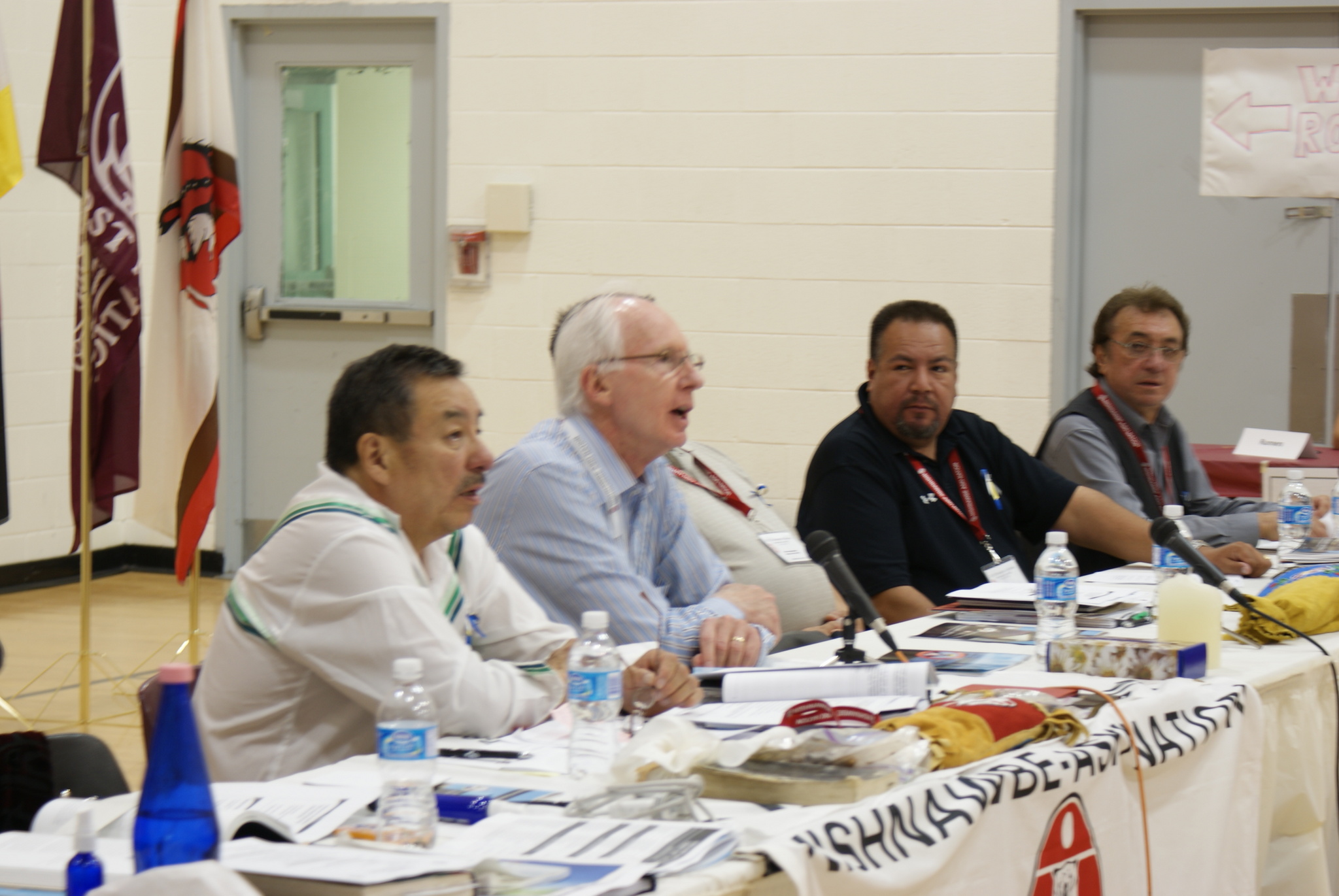
There are many economic challenges and opportunities facing Nishnawbe Aski Nation.
These were discussed during the Keewaywin Conference, June 8-10 in Sandy Lake.
Fred Lazar, an associate professor of economics at York University’s Schulich School of Business in Toronto, discussed the need to create preconditions for consultation during his June 8 presentation.
“First, there is no need to reinvent the wheel,” Lazar said. “Each consultation process does not have to begin from scratch. You have a lot of history, there are some basic demands that will be falling across all consultation processes.”
Lazar said consultations should not be time consuming, but it should involve a process with prepared preconditions.
“You make it clear to all parties and you tell them now that you are stepping onto our land, these are the minimum requirements,” Lazar said. “If you are willing to play by (the) rules of the game, let’s sit down and fill in some of the gaps. If they are not willing to play by the rules of the game, tell them they are not invited.”
Lazar said the preconditions should be simple, clear and concise as well as clear to anyone outside the community.
“Finally, in developing the preconditions, you have to have consensus among all the First Nations of NAN and you have to develop a sharing mechanism that is fair to all people in NAN,” Lazar said.
While the development process for a mine can take from 10 to 20 years, Lazar said it is also important to consider the closure and rehabilitation process of shutting down a mine during the negotiation process.
“That becomes a critical important stage for you,” Lazar said. “As well, … there is never any guarantee that a mine will go into production. Despite what one may hear about the Ring of Fire, despite what one may surmise from the positive comments about resource findings, there is no assurance there will ever be a development in this area.”
Lazar encouraged NAN First Nations to stand together and make it clear to the mining companies and government that unless they meet the minimum requirements there will not be any discussions.
“If they sit back and let the government and mining companies pick them off one at a time, then the deal will basically be biased towards the companies and will not favour any of the NAN First Nations and definitely not NAN as a whole,” Lazar said. “If they stand together, then it’s going to be clear to the mining companies and the government that they can’t play the games they have in the past and they are going to be forced to meet these demands.”
Innu Nation Grand Chief Mark Nui described the Innu Nation’s negotiation strategy of not entering into Impact Benefit Agreements unless the benefits far outweigh the impacts during his June 10 presentation.
“We have never signed a treaty, but we are in … treaty negotiations with Canada and Newfoundland,” Nui said. “We signed a framework agreement many days ago and are now close to an agreement in principle.”
The Innu Nation, which is made up of about 2,700 community members living in the two communities of Sheshatsiu and Natuashish, initialed an agreement Feb. 16 that completed outstanding issues in the Tshash Petapen (New Dawn) Agreement signed in principle in September 2008 with the government of Newfoundland and Labrador, which includes the Innu Rights Agreement, the Lower Churchill Impacts and Benefits Agreement and Innu redress for the upper Churchill hydroelectric development.
“Since 2005 we have been working very hard to complete these agreements,” Nui said. “Previously in 2002 we entered into an Impact Benefit Agreement with Voisey Bay Nickel Company, which is fully owned by Inco and now owned by Vale Inco.”
The Innu Nation requires an affirmation of Aboriginal consent in the IBA, financial benefits from the company and government, environmental protection and monitoring, business contract priorities and employment of Innu. It also requires workplace conditions, Innu use of infrastructure, and tools to weigh potential impacts and benefits, including full and complete disclosure by the company of technical and operational aspects of the proposed project, full and complete financial disclosure of costs and revenues from the proposed project, a superb legal and technical team to work with leaders and negotiators to assess information, full and unlimited funding provided by the project proponent, ongoing community consultations and expert input by the Elders.


This past month, I was happy to attend two Pow Wows I hadn't been to in years. I attended the Mattagami First Nation Pow Wow and the Matachewan First Nation...
I was happy to see my home community of Attawapiskat on the James Bay coast announce the opening of the new St Francis Xavier Parish Church on August 25....