


When I was a boy growing up in my home community of Attawapiskat on the James Bay coast, I was deathly afraid of looking at the full moon.
I grew up in a very traditional Cree environment in my home community of Attawapiskat on the James Bay coast in northern Ontario. In the 1980s, my family and I only spoke Inineemoon or ‘James Bay Cree’ because it was the language our parents and grandparents spoke.
The language and the world my parents and grandparents raised us in were very different from those in the rest of Canada. Storytelling was very important to our parents and grandparents and many of these stories were told in humorous or frightening ways to make them memorable.
One story that always stuck with me was the legend of Chikabesh and the moon. In the story, he disobeys his family and suffers unusual consequences. There are many variations of the legend across families, regions, and communities, but the character of Chikabesh and his interactions with the moon are common to all of them. I always found it interesting that we call the moon, ‘Ta-pis-ka-pee-sim’, in our Cree language because the literal translation of that word is ‘night sun’. ‘Tee-pis-kow’ is nighttime and ‘pee-sim’ is sun and combining the two words becomes ‘Ta-pis-ka-pee-sim’ - the ‘night sun’.
The story of Chikabesh that I remember from my childhood describes how his family tells him not to look at the full moon because it is dangerous and might take his spirit away. At one point, he has to fetch water late in the evening, a common activity in the wintertime because nights are so long and days are short. He obeys his family’s warning at first and does not look at the full moon. The first few times he does so, nothing happens, and he quietly fetches water from a hole cut in the ice and walks home. One night, when he goes about his work, a voice from high above gently calls out to him to look up. The voice says he is ‘Ta-pis-ka-pee-sim’ and that he would like to talk and be friends.
Chikabesh is reluctant at first, says he is not allowed to look at him and refuses to talk. However, they keep chatting, and eventually Chikabesh looks up and sees the bright, illuminated face of ‘Ta-pis-ka-pee-sim’. They continue talking and sharing stories until Chikabesh finally realizes he is rising toward the moon to be moved closer as they talk. By the time Chikabesh realizes what is happening, it is too late and he has been taken up by ‘Ta-pis-ka-pee-sim’ never to be seen again. The only sign left of Chikabesh was two frozen buckets left by the hole in the ice where people fetched their water.
The delivery of this legend depended on the storyteller. I remember my Kookoom Louise (Paulmartin) Rose sharing this story with us and laughing about the silly things that Chikabesh said and did along his way. However, the story was meant to caution children into listening to their parents and Elders.
As a young boy, I remember being absolutely afraid of looking up at the bright light of a full moon for the longest time. It took me several years when I was really young before I dared to look up at ‘Ta-pis-ka-pee-sim’ for fear that he might take me away from my home and my family.
This was a legend and story that came to my mind when I sat down with friends to watch the launch of the Artemis II spaceflight that took four astronauts which included NASA American astronauts Reid Wiseman, Victor Glover and Christina Koch and Canadian Space Agency astronaut Jeremy Hansen, on a ten-day flight to fly by the moon.
I was very happy to be invited by my friend John Elliott to sit with a group of friends to watch this major event. This is an historic event because it is the first crewed mission beyond low Earth orbit since the Apollo moon missions in 1972. John reminded me that we would all be talking about this event in years to come, the way people spoke about the Apollo moon missions. The 17 Apollo moon space missions took place from 1968 to 1972 and landed 12 people on the moon.
It made me laugh to myself that a group of scientists, engineers and flight specialists from around the world had indeed looked up at the full moon for far too long and had finally been taken up to see ‘Ta-pis-ka-pee-sim’. It made me hopeful that someone might be able to say ‘wachiyeh’ or ‘hello’ to Chikabesh up there. The night of the watch party, I was more than happy to look up at the Ta-pis-ka-pee-sim.
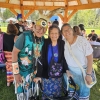


This past month, I was happy to attend two Pow Wows I hadn't been to in years. I attended the Mattagami First Nation Pow Wow and the Matachewan First Nation...
I was happy to see my home community of Attawapiskat on the James Bay coast announce the opening of the new St Francis Xavier Parish Church on August 25....