


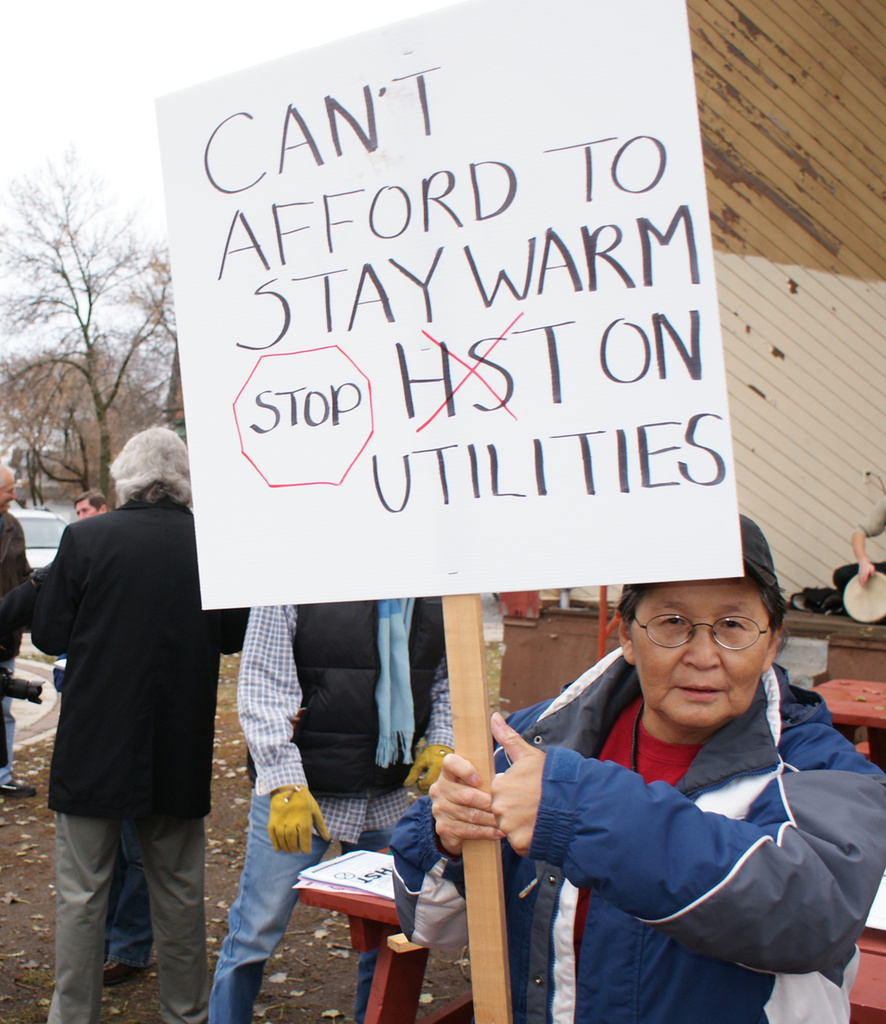
Forget Canada Day celebrations. When July 1 comes this year it will be met with frustration, as the Provincial Sales Tax will be combined with the federal Goods and Services Tax to create the Harmonized Sales Tax.
The 13 per cent HST will be imposed on First Nation people who buy goods off-reserve. No longer will merchants honour point of sale exemptions.
Ontario Regional Chief Angus Toulouse of the Chiefs of Ontario said First Nation leaders have directed his political advocacy office to look into how the HST will impact their community members.
In the report, Annual Cost Burden for the First Nations of Ontario of Integrating the Provincial Sales Tax (PST) into the Harmonized Sales tax (HST), Dr. Fred Lazar of York University in Toronto said the income gap between First Nations and non-Aboriginals will only widen.
Lazar estimates the potential yearly tax burden for all First Nations in Ontario to start in the range of $85 million to $121 million. He also determined the existing income gap between First Nation citizens and everyone else is Ontario is at least $2.1 billion.
Lazar posed the question, “Does the government really need an additional $100 million or more from First Nations, especially when the First Nations face an income gap in excess of $2 billion?”
Toulouse said attempts by First Nation leaders to meet with Jim Flaherty, federal minister of finance, have been refused.
“He continues to refuse to meet with the First Nations leadership, and to us he is sending a clear signal that he is not willing to. This is an unreasonable position on the part of Canada,” Toulouse said.
Similarly, Toulouse said the Minister of Indian Affairs, Chuck Strahl, has provided no assistance First Nation citizens to come up with reasonable solutions.
Neither the Ministry of Finance or Indian and Northern Affairs Canada would respond to a request for comments as of press times. A message left with Finance Minister Jim Flaherty’s office was not returned.
“We have treaties with Canada, and some with Ontario as well, but these treaties provided no authority to either government to tax our people,” Toulouse said. “What needs to be understood is that First Nations have never ceded our authority to tax our people to another government, and the government has just gone ahead to impose taxes on our citizens, in spite of our opposition.”
There has been a long established sovereign relationship between the crown government and First Nations with the Royal Proclamation of 1763.
“It’s been understood there is a nation-to-nation relationship,” Toulouse said. “Treaties can only be signed between nations, and it is understood that one nation cannot unilaterally impose its will on another nation.”
Tax exemption is covered under Section 87 of the Indian Act created in 1867.
“We have been here since before the Indian Act. A piece of legislation doesn’t supersede that fact,” Toulouse said.
With regard to taxes, a portion of Section 87 states: “The delivery requirement may be waived for qualifying remote stores that deal mainly with customers who are Indians, Indians bands, and band-empowered entities.”
The current point of sale rebate system administered by the provincial government allows First Nation citizens to be exempt from PST for off-reserve purchases.
Under the new rules HST will not apply to goods bought on a reserve. However, Lazar’s report said “goods bought off a reserve by ‘Indians, Indian bands, and unincorporated band-empowered entities’ will be subject to the HST.”
To get a point of sale tax exemption, First Nation citizens will have to prove they are registered under the Indian Act and that any purchased goods will be delivered to a reserve by a vendor or a vendor’s agent.
But Lazar’s report recommends the continued use of the point of sale system over the imposition of HST on First Nation citizens.
“We’ve seen the (Ontario) Premier indicate they agree with us, that they want to continue with the point of sale rebate but we need a more substantive commitment than words. We need some commitment that will give us comfort,” Toulouse said.
While First Nation leaders are pursuing legal, political and communication strategies, Toulouse strongly encourages First Nation citizens to work together to take a united stance.
“Citizens need to ask ‘what can we do in our backyard to get the attention of the government?’” Toulouse said.
“It needs 133 communities to send the message that somebody is taking something away from them. We need that message to go beyond the leadership and to get right into the councils and get our citizens to become aware and mobilize.”
Toulouse further suggests letter writing and email campaigns to voice concerns, particularly for the First Nation citizens of remote northern communities.
“We are simply motivated by the responsibility to protect our citizens, many of whom struggle to put food on the table and clothes on the backs of our children.
“We are motivated to protect the erosion of our Aboriginal and treaty rights” Toulouse said.
I was happy to see my home community of Attawapiskat on the James Bay coast announce the opening of the new St Francis Xavier Parish Church on August 25....
Attawapiskat First Nation wrapped up another successful Kattawapiskak Keekehwin Gathering for the community. The week-long event was held from August 2 to 8...