


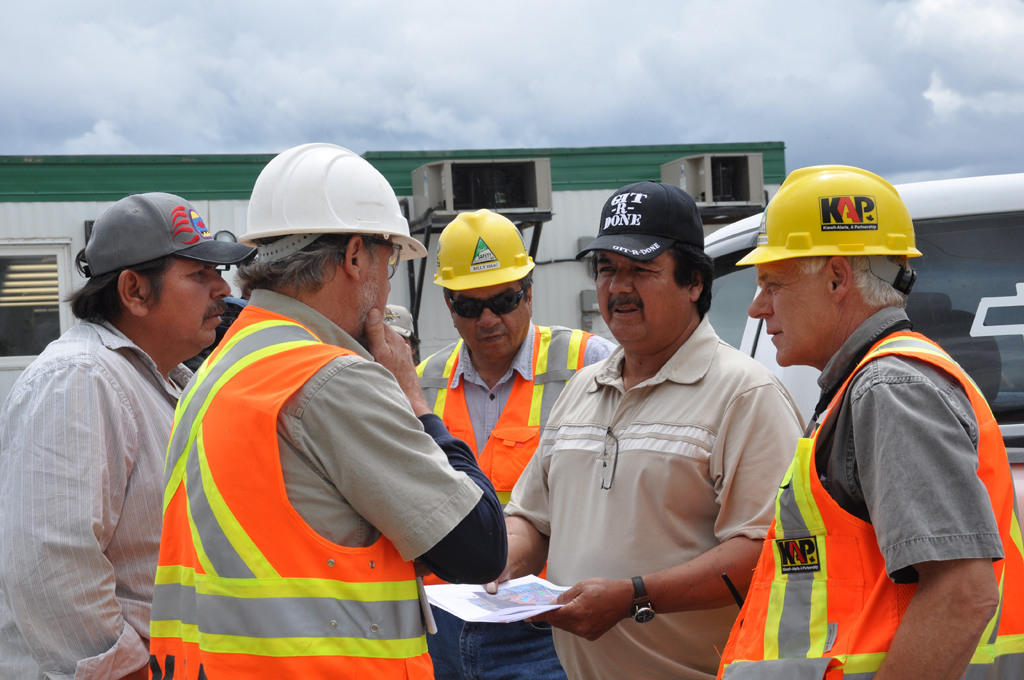
Investigation into a possible Aboriginal burial ground temporarily halted construction of the base camp for Ontario Power Generation’s Lower Mattagami Hydro Electric Project north of Kapuskasing.
Because of the nature of the allegations, construction of the base camp for the $2.6 billion dollar project 70 kilometers north of Kapuskasing was in jeopardy.
Ontario Power Generation and Moose Cree First Nation signed the Amisk-oo-skow Agreement in late May allowing the hydro expansion project to move ahead.
Shortly thereafter, Cree Elders Jimmy Rodrique and Gerti Johnson, both of Moose Cree First Nation, provided oral testimony to Gaius Napash, appointed chief of the breakaway group called the Kapuskasing Cree, that there were burial sites in the vicinity of the Smoky Falls site.
Napash began looking into the burial sites testimony June 10. He informed OPG representatives of the gravesites and asked construction activity in the area be stopped immediately to allow for an investigation.
In recent decades, the reporting of Aboriginal burial sites has become a sensitive issue. In the past, public or private land owners and developers have refused to acknowledge Aboriginal burial places or heritage sites. In many cases, they have refused to consult with Aboriginal peoples about the disposition of the sites.
Ontario has laws on its books to protect graves and burial sites, such as those Napash was investigating.
“Any person discovering or having knowledge of a burial site shall immediately notify the police or coroner,” according to Section 69 of the Cemeteries Act.
In that court ruling, Justice Sidney B. Linden of the Ontario Supreme Court wrote: “Aboriginal heritage and burial sites become flashpoints for an occupation or protest when Aboriginal peoples believe they must act to protect a site from desecration.”
The Kapuskasing Cree are a group whose members currently fall under the Moose Cree First Nation registry system.
However, they have grown up in the Kapuskasing area hundreds of kilometers away from Moose Factory.
For months now, the group has been affirming its sovereignty from the Moose Cree band.
Their families have historically lived off the land in the Smoky Falls area. This is why they have taken measures to protect the site from further construction activity, said community spokesman Archie Sutherland.
“We know where our burials are through our Elders,” Sutherland said. “We let OPG acknowledge where they are so they can get their archeologist go and dig it up and slowly look for any kind of burial.”
Michael D’Mello, registrar and manager of the Cemeteries Regulations Unit of the Ministry of Consumer Services was not aware of the situation occurring at the construction site.
“When human remains are discovered, there is a requirement that anyone who knows of an Aboriginal site they must report it,” he said. “I don’t believe it has been reported to us yet. They cannot disturb the burial site, especially if they know it is there.”
Ontario Power Generation representative Rick Dickson said OPG workers received orders to cease work at the site as of 9:30 a.m. June 22.
However, video footage Napash captured from a helicopter that afternoon allegedly shows workers actively working at the site at 1 p.m.
Napash and several of his community members visited the site June 23.
He told the OPG workers they were standing in an area that has been reported as a grave site.
“You are going to destroy that piece of information where they are buried,” Napash said.
The area in question was once the trapping territory of the Sutherland and Napash families. Their families had 12 trap lines within the Gordon Corsten forest. They still possess five trap lines in the area.
Community groups split over location of burial sites
When the Smoky Falls Station was originally built in 1922 the mill provided a constant supply of newsprint for the Sunday edition of the New York Times, a co-owner of the mill.
The building of the original dam resulted in parts of the First Nation’s hunting and trapping territories sustaining flooding damage.
According to Sutherland, any evidence of the settlement of Smoky Falls was destroyed, and the inhabitants had to relocate to the town of Kapuskasing when children were required to attend school.
OPG remains adamant they will only deal with the Moose Cree leadership on any negotiations.
“The Moose Cree are our partners,” said OPG media relations officer Ted Gruetzner. “We are working with them to ensure we show the proper respect.
“We have decided that it’s not a burial site – the Moose Cree have decided.”
In terms of dealing with the grievances of the Kapuskasing Cree breakaway group, Grueztner made it clear it was the Moose Cree band they would continue to deal with. “They are our partners. Gaius (Napash) is of Moose Cree. We work with Moose Cree on all of those issues that come up. We work with any partner on resolving things.”
A technical team from Moose Cree has been dealing with OPG while Moose Cree Chief Norm Hardisty Jr. has been away from the office. Fred Hunter, executive director of Moose Cree said the chief is aware of the situation.
The technical team consists of Stan Louttit, Fred Hunter and Billy Isaac of Moose Cree.
“It is not the Cemetaries Act, that does not apply here,” Hunter said. “The archaeologist has protocol for dealing with sensitive sites. They reviewed and went over their protocol, and we followed that to a ‘T’.”
Louttit, environmental co-ordinator of the project, said the burial site has been incorrectly placed.
“It’s the same one that we identified and we know about it and it’s blocked off from activity. We think we found the area and we protected these areas within a buffer zone. We are a competent group. We feel that we are doing this properly and we are quite comfortable,” Louttit said.
For the group of Kapuskasing Cree members, the struggle to protect the burial sites will continue.
“Moose Factory, they think they know who, where and what is going on in the Kapuskasing area, but they don’t because they don’t live around here,” Sutherland said.“We are going to have to try to move forward by some other means.”
After three days of investigating the reports of the burial sites, work commenced at the Lower Mattagami Project June 25.
I was happy to see my home community of Attawapiskat on the James Bay coast announce the opening of the new St Francis Xavier Parish Church on August 25....
Attawapiskat First Nation wrapped up another successful Kattawapiskak Keekehwin Gathering for the community. The week-long event was held from August 2 to 8...