


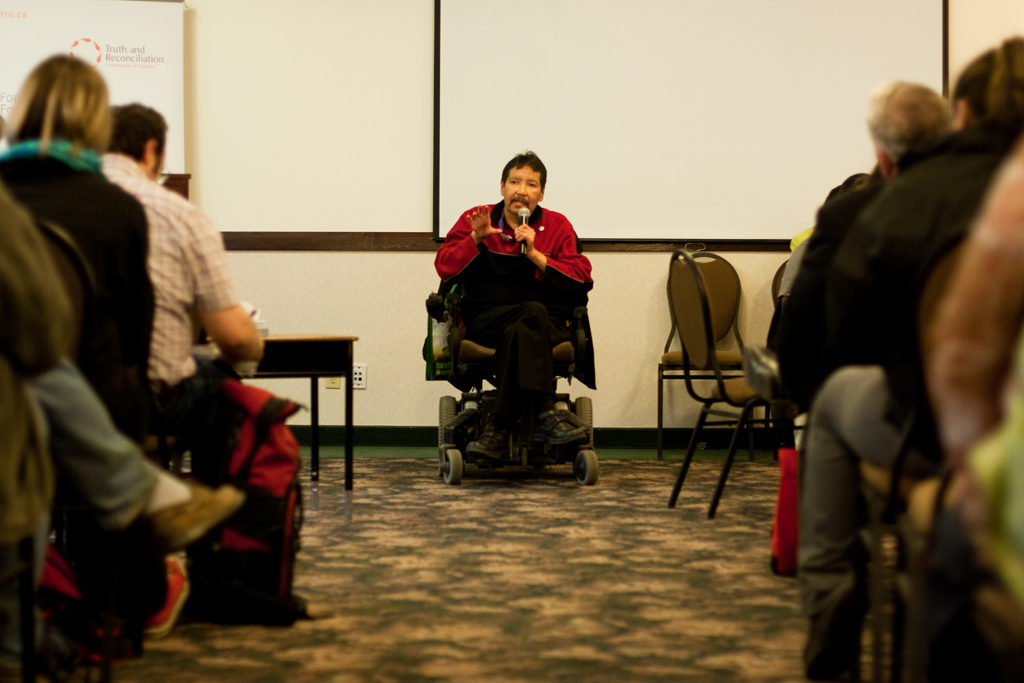
It’s a long road to reconciliation, but the chair of the Truth and Reconciliation Commission (TRC) is optimistic it can be done.
Justice Murray Sinclair said it a few times during his visit to Sioux Lookout May 12 and 13.
“Keep your eye on the prize,” he said, referring to the mantra of civil rights activists of the 50s and 60s in the U.S.
In this case, the prize is reconciliation. Sinclair believes this means respect.
“We need to ensure we have a respectful relationship for the future,” he told a crowd gathered at the Nishnawbe Gamik Friendship Centre for a welcoming ceremony.
Sinclair’s visit, hosted by Sioux Lookout’s Community Coalition for Healing and Reconciliation, also included private statement taking from residential school survivors, an objective of the TRC.
It’s the stories that are most important, Sinclair said, so greater understanding of how the residential school system has impacted Aboriginal people can be understood by the larger Canadian society.
Sinclair is realistic reconciliation may not be achieved by the end of the five-year mandate of the commission.
But the stories need to be gathered, if only to get people to understand the history of residential schools and how it has contributed to social breakdown of Aboriginal families and communities. The stories are also important for today’s Aboriginal youth, who may not understand why their parents or grandparents were not ideal caregivers.
“The life they gave us was not complete,” Sinclair said of what survivors learned in residential schools. Many children went back to their communities not able to function completely. The losses were many, from loss of language and culture to basic parenting skills, as seven generations of Aboriginal people in Canada have gone through a system that sought only to assimilate.
Sinclair believes survivors must share their story to help a new generation of children understand what survivors went through and hopefully, help this new generation forgive their parents.
“It’s not just about you, it’s about them too,” Sinclair said to survivors, asking them to not only to find peace with themselves, but to do it for their children.
He challenged survivors to provide what they can to today’s youth, especially Aboriginal culture.
“They want the gift of language, to be Anishnawbeg. Can you give them that?” he asked.
Richard Morris, a residential school survivor who took part in a sharing circle on the second day of TRC visit, believes it’s time to think of the future and move on from the social chaos sometimes inflicting Aboriginal communities.
Morris, a Kitchenuhmaykoosib Inninuwug band member who now works in Sioux Lookout as an education advisor for Independent First Nation Alliance, said understanding the full context of how colonialism has affected Aboriginal people is crucial.
This understanding includes what happened in residential schools.
“I think it’s very critical to understand the pain and the hurt our people went through and to empathize and be sensitive to that. But we need to move on,” he said.
Morris said Aboriginal people are a strong resilient group who can overcome adversity. But understanding needs to happen and it requires a change in attitude from being victims to being strong and resilient people.
“Yes, we are victims, but we can move beyond that,” he said.
Morris said people need to acknowledge what they went through in the residential schools. He said too many people are stuck in a victim mindset, focused on pain and suffering. Without letting go of the terrible things that happened, the hate and bitterness is a burden that doesn’t need to be carried.
“It drags us down, it drags our people down and all those people we come in contact with. It’s too negative. Forgiveness means lifting that load off your shoulders,” he said, adding that forgiveness is a key element of reconciliation.
By understanding the oppression and colonialism faced by Aboriginal people, only then can they find solutions to move forward.
And he said only Aboriginal people can do it for themselves, not with help from outside sources.
“I call it taking back our lives, reclaiming our lives, so that we can once again be the strong proud people we were,” he said.
It’s may be a long slow process to reconciliation and Garnet Angeconeb, member of the Community Coalition for Healing and Reconciliation, said it’s a process that’s just beginning.
It was Angeconeb who personally asked Sinclair to visit Sioux Lookout.
The Lac Seul band member and residential school survivor has been an advocate for bringing education to the greater public about residential schools and it’s impact. He believes it takes a community to move forward together to reconcile the past.
“Reconciliation is a social change progress,” he said during a public forum on the evening of May 12 in Sioux Lookout.
Reconciliation was a common theme throughout the TRC visit. Sinclair may have had his own ideas about what reconciliation means, but he said it’s still a conversation that needs to happen as the TRC works to fulfill its mandate.
“What are your teachings around reconciliation?” he asked.
He said different First Nations could have different teachings and meanings in their own languages about what it may mean.
Sinclair’s words, however, seemed to resonate with those who participated in the activities during his visit, which also included a stop in Lac Seul First Nation May 14.
He said it boils down to mutual respect between survivors, Aboriginal people and the general public.
“You keep your eye on the prize, you’ll have reconciliation,” he said.
I was happy to see my home community of Attawapiskat on the James Bay coast announce the opening of the new St Francis Xavier Parish Church on August 25....
Attawapiskat First Nation wrapped up another successful Kattawapiskak Keekehwin Gathering for the community. The week-long event was held from August 2 to 8...