


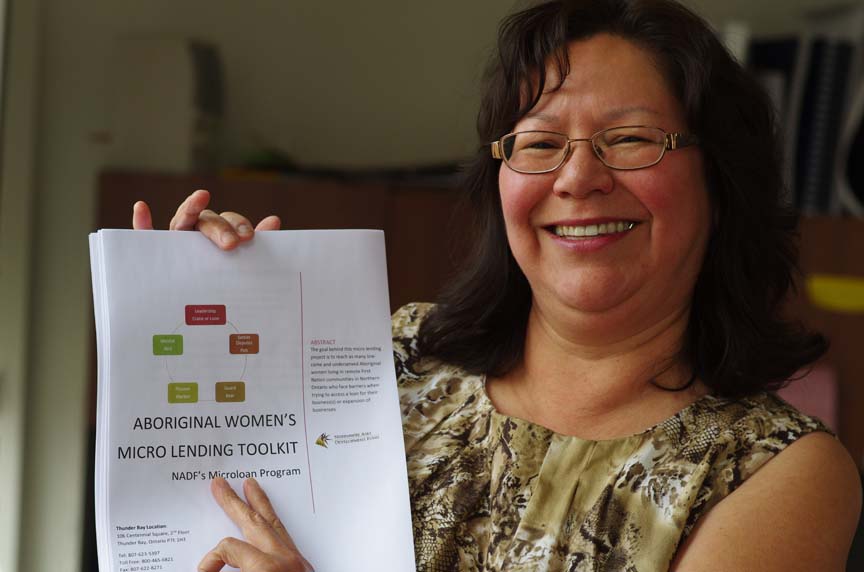
Nishnawbe Aski Development Fund is looking to develop peer lending groups through its recently implemented Aboriginal Women’s Microloan Program.
“We’re hoping to have five-plus women in (each) group and only three at once can access the loan,” said Linda McGuire, NADF’s microloans project coordinator. “The women who are going to be accessing these loans are either women who are in business or expanding their business or want to start a business.”
McGuire said the groups also require one or two mentors with business or leadership knowledge.
“The women are going to monitor and mentor each another,” McGuire said. “They are the ones who are going to be in control — if they get a loan, they’ve got to make sure they pay back that loan.”
Once the peer lending groups are formed, they will have access to $500 to $1,000 loans in stage one, to be paid back within nine months; $2,000 in stage two, to be paid back within 18 month; $3,000 in stage three, to be paid back in 27 months; or $5,000 in stage four, to be paid back in 27 months.
“They have to go through each stage, get their loan paid back, and then they can move on (to the next stage),” McGuire said. “Or else they can just stay at that one stage if they want.”
McGuire said the program will provide easier access to loans than is available through traditional banking institutions.
“They won’t need collateral and they don’t need a credit history,” McGuire said. “Our goal is for the woman to build that credit history so they can access that big loan in the future.”
NADF’s goal is to reach underserved Aboriginal women in remote First Nation communities across northern Ontario who face barriers when trying to access loans.
“We understand that $500 to $1,000 doesn’t mean much when you’re in the north, but it’s just a little seed money to start,” McGuire said.
McGuire said peer lending began in India about 50-60 years ago before spreading to South America, Africa, Mexico and the United States.
“Now it’s worked its way up to the Canada, for the past 20 years plus, and now we’re trying to promote it in First Nation communities,” McGuire said. “We know women face a lot of barriers, and in most cases when a woman does apply for a loan, they will take a high interest rate.”
Women aged 18 and older are eligible for NADF’s peer lending groups.
“We will also be providing training, (involving) one-on-one business plans, financial literacy, how to budget, how to do a cash flow, maybe some life skills, and start them up with an action plan,” McGuire said. “Once we do get their circle going, we also have created a toolkit where I’ll go in for two days and start them off with their circle, how to run their circle, how to keep their circle going.”
McGuire said the toolkit includes the history and pros and cons of micro-lending, action plan and economic security activities and a mini-questionnaire.
For more information, contact Linda McGuire at 807-623-5397 or e-mail lmcguire@nadf.org.




This past month, I was happy to attend two Pow Wows I hadn't been to in years. I attended the Mattagami First Nation Pow Wow and the Matachewan First Nation...
I was happy to see my home community of Attawapiskat on the James Bay coast announce the opening of the new St Francis Xavier Parish Church on August 25....